Ceiling Fan Replacement Cost in Brisbane (2026): $150–$350
Ceiling fan replacement cost Brisbane: $150-$350. See real job examples from a local Capalaba electrician. DC fans, smart fans, outdoor fans priced honestly.
How much does it cost to replace a ceiling fan in Brisbane? For a straightforward replacement using existing wiring, you’re looking at $150–$350 including labour and the new fan. At Amplus Electrical & Air, we charge a flat $150/hour with no call-out fee, so most ceiling fan replacements cost around $200–$300 all-in (fan not included).
I’ve replaced hundreds of ceiling fans across Capalaba, Cleveland, and the Redlands over the past decade. In this guide, I’ll break down exactly what you’ll pay, what affects the cost, and how to choose the right replacement fan for Brisbane’s climate. I’ll also share real examples from jobs we’ve done so you can see what to expect.
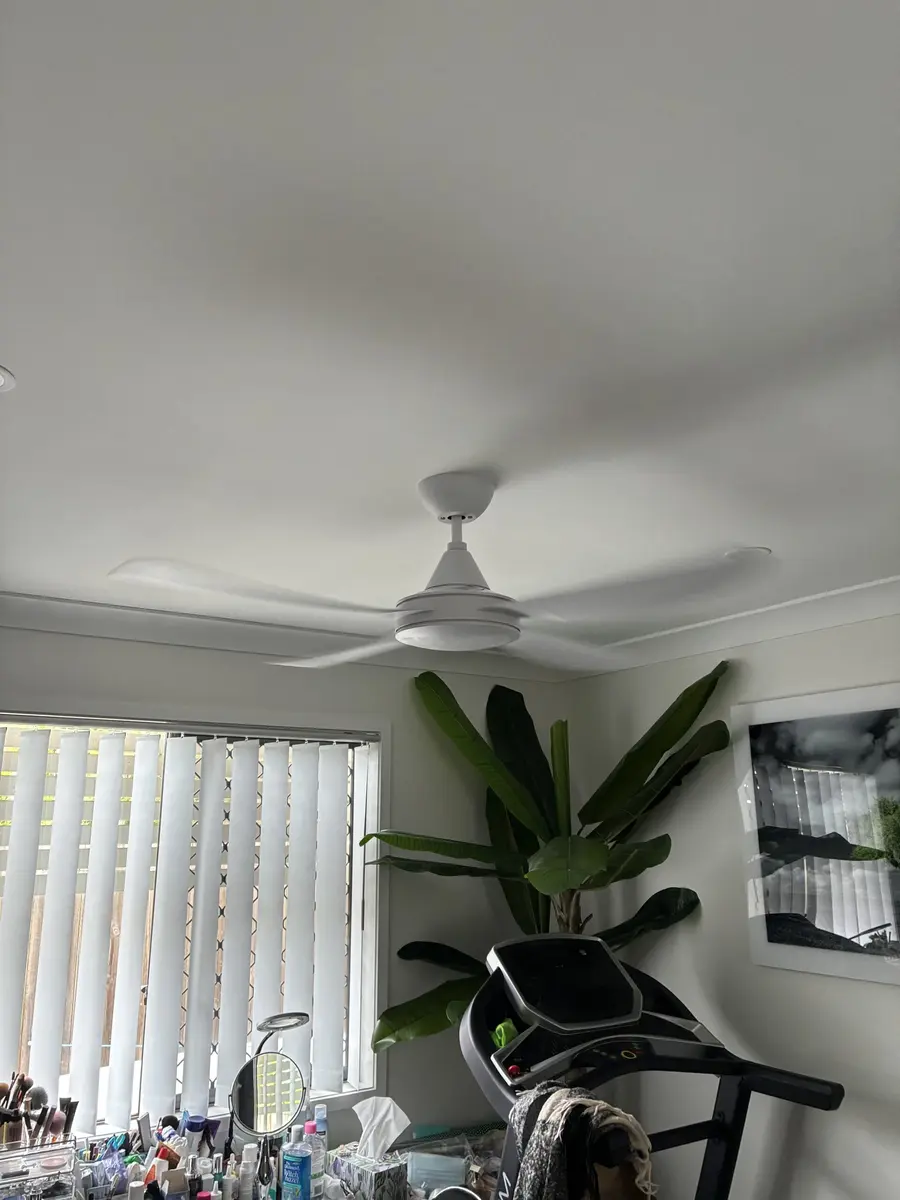
Ceiling Fan Replacement Costs in Brisbane: The Real Numbers
Here’s what licensed electricians actually charge for ceiling fan replacement in Brisbane right now:
| Job Type | Typical Cost | Time |
|---|---|---|
| Replace fan (existing wiring, standard fan) | $150–$300 | 1–1.5 hours |
| Replace fan with DC fan | $200–$400 | 1–2 hours |
| Replace fan with smart fan (WiFi) | $250–$450 | 1.5–2.5 hours |
| Replace fan + install new wall switch | $250–$400 | 1.5–2 hours |
| Replace fan in high ceiling (3m+) | $250–$450 | 1.5–2.5 hours |
| Replace outdoor ceiling fan | $250–$500 | 1.5–2.5 hours |
| Replace fan + repair damaged wiring | $300–$600 | 2–3 hours |
Amplus Electrical & Air pricing:
- $150 per hour — flat rate, no surprises
- No call-out fee — we don’t charge for travel
- Fan not included — you supply the fan, or we can recommend suppliers
- Free quotes for jobs over $500
What Affects the Cost of Replacing a Ceiling Fan?
Several factors influence what you’ll pay for ceiling fan replacement:
1. Type of Fan
Standard AC fans are the cheapest to install ($150–$300). DC fans cost more ($200–$400) because they have more complex wiring and often come with remote controls. Smart fans with WiFi or Bluetooth are the most expensive ($250–$450) because they need configuration and sometimes a neutral wire at the switch.
2. Existing Wiring Condition
If the existing wiring is in good condition and matches the new fan’s requirements, the job is straightforward. Cost: $150–$300.
If the wiring is old, damaged, or incompatible (like old rubber-insulated cable), we need to repair or replace sections. Cost adds $100–$300.
3. Ceiling Height
Standard ceilings (2.4m) are easy to work with. High ceilings (3m+) require ladders or scaffolding, which takes more time. Cost adds $50–$150.
Very high ceilings (4m+) might require special equipment or an extra pair of hands. Cost adds $100–$200.
4. Fan Weight and Size
Lightweight fans (under 10kg) are easy to install. Heavy fans (15kg+) need additional support, like a fan-rated ceiling bracket or reinforcing the joist. Cost adds $50–$150.
Large fans (over 1.5m diameter) are harder to manoeuvre and mount. Cost adds $30–$80.
5. Wall Switch Type
If you’re replacing a pull-chain fan with a wall-switched fan, we need to install a new wall switch. Cost adds $100–$200.
If you’re upgrading from a standard switch to a dimmer or smart switch, cost adds $50–$150.
6. Old Fan Removal
Most electricians include old fan removal in the installation cost. But if the old fan is particularly heavy, damaged, or hard to remove, there might be an extra charge. Cost adds $30–$80.
Additional safety compliance: If your home doesn’t have a working safety switch (RCD) on the lighting circuit, your electrician must install one as part of any fan replacement. This is a legal requirement in Queensland.
Types of Ceiling Fans: Which One Should You Choose?
Here are the most common types of ceiling fans we install in Brisbane homes:
1. AC Ceiling Fans
The traditional type. Runs on alternating current (AC) from your mains. Cheaper to buy ($100–$300) but uses more electricity (60–100W). Cost: $150–$300 installed.
Best for: Budget-conscious homeowners, rental properties, rooms where the fan runs occasionally.
2. DC Ceiling Fans
Runs on direct current (DC) using an internal transformer. More expensive to buy ($250–$600) but uses 70% less electricity (15–35W). Quieter operation and more speed settings. Cost: $200–$400 installed.
Best for: Bedrooms, living rooms, anywhere you want quiet operation and energy savings. DC fans are the most popular choice in Brisbane homes right now.
3. Smart Ceiling Fans
WiFi or Bluetooth-enabled fans that can be controlled via smartphone app, voice assistant (Alexa, Google Home), or automation routines. Can schedule on/off times, adjust speed based on temperature, and integrate with smart home systems. Cost: $300–$700 for the fan, $250–$450 installed.
Best for: Smart homes, automation enthusiasts, rental properties (remote control), energy monitoring.
4. Outdoor Ceiling Fans
Weatherproof fans rated for outdoor use (IP-rated for moisture resistance). Designed to withstand rain, humidity, and salt air. Cost: $300–$800 for the fan, $250–$500 installed.
Best for: Alfresco areas, patios, verandahs, covered outdoor entertaining areas.
5. Ceiling Fans with Lights
Combination fan and light unit. Great for rooms where you want both airflow and lighting from a single fixture. Cost: $250–$700 for the fan, $200–$400 installed.
Best for: Bedrooms, living rooms, rooms with limited ceiling points.
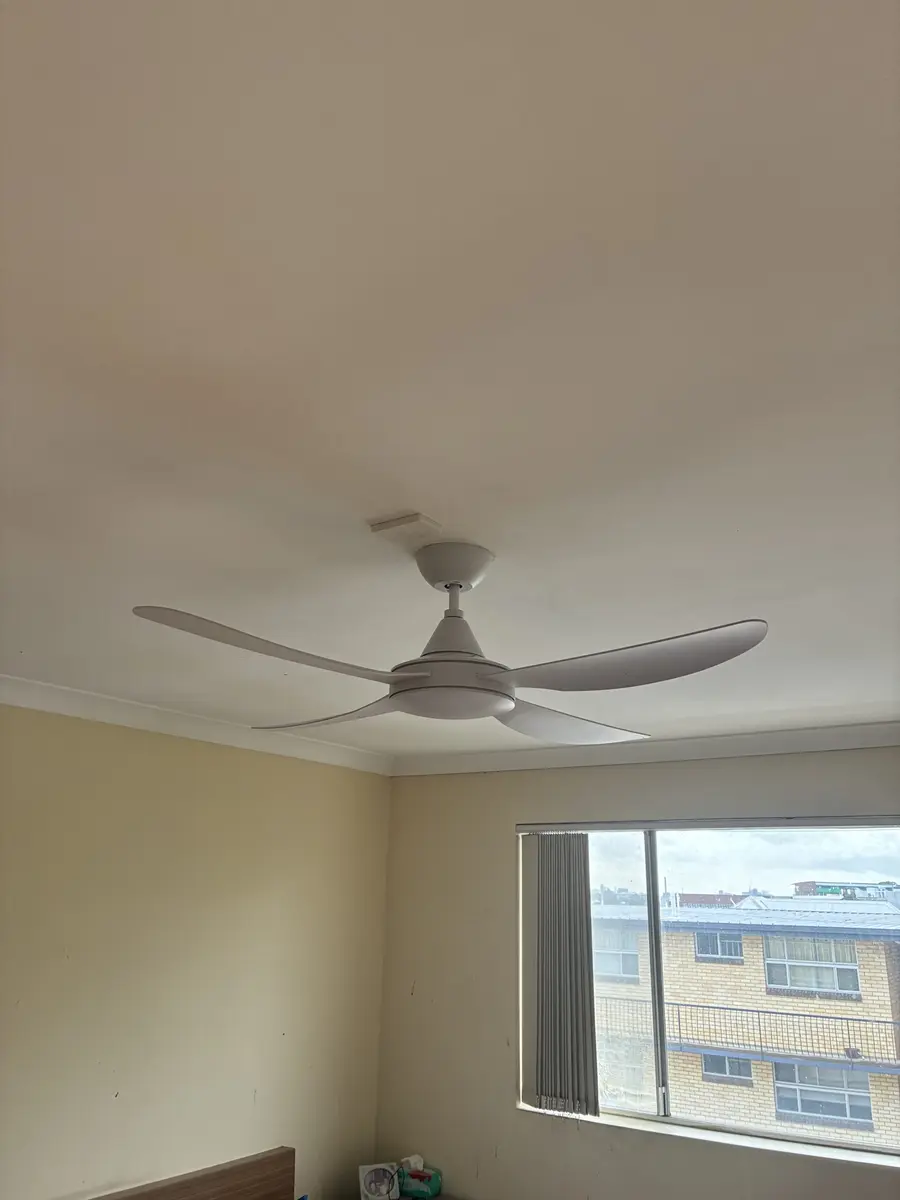
Real Examples: Ceiling Fan Replacements We’ve Done in the Redlands
Here are some real jobs we’ve completed across Brisbane and the Redlands, with actual costs:
Example 1: Replace Old AC Fan with DC Fan in Capalaba Bedroom
The job: Customer’s old AC ceiling fan was noisy, wobbled, and used too much electricity. We replaced it with a modern DC fan with remote control.
The cost:
- Labour: 1.5 hours @ $150/hour = $180
- Remove old fan: included
- Dispose of old fan: included
- Total: $180 (fan not included — customer supplied)
Example 2: Replace 3 Ceiling Fans in Cleveland Home
The job: Customer was renovating and wanted to replace 3 old ceiling fans with modern DC fans. We replaced all 3 in one visit.
The cost:
- Labour: 3.5 hours @ $150/hour = $420
- Remove old fans: included
- Total: $420 (fans not included)
Note: If they’d replaced the fans one at a time, it would have cost around $540. Batching the work saved them $120.
Example 3: Replace Outdoor Fan in Alexandra Hills Alfresco
The job: Customer’s outdoor ceiling fan was rusted and not working. We replaced it with a weatherproof outdoor-rated DC fan.
The cost:
- Labour: 2 hours @ $150/hour = $240
- Remove old fan: included
- Total: $240 (fan not included)
Example 4: Replace Fan in High Ceiling (3.5m) in Thornlands
The job: Customer had a high ceiling in their living room and needed to replace an old fan. We used a ladder and took extra time to ensure safe installation.
The cost:
- Labour: 2 hours @ $150/hour = $240
- High ceiling surcharge: $80
- Remove old fan: included
- Total: $320 (fan not included)
Example 5: Replace Fan + Install Smart Switch in Victoria Point
The job: Customer wanted to replace their bedroom fan with a smart fan and control it via smartphone. We installed a WiFi-enabled DC fan and configured it with their existing smart home system.
The cost:
- Labour: 2 hours @ $150/hour = $240
- Smart switch configuration: $60
- Remove old fan: included
- Total: $300 (fan not included)
How Long Does It Take to Replace a Ceiling Fan?
Most ceiling fan replacements are quick:
- Standard replacement (existing wiring): 1–1.5 hours
- DC fan replacement: 1–2 hours
- Smart fan replacement: 1.5–2.5 hours (includes configuration)
- High ceiling replacement: 1.5–2.5 hours
- Outdoor fan replacement: 1.5–2.5 hours
If we need to repair damaged wiring or install additional support, add an extra 30–60 minutes.
New installation vs replacement: If you don’t have an existing fan and need one installed from scratch (including running new wiring), see our ceiling fan installation cost guide for new installation pricing.
Can I Replace a Ceiling Fan Myself?
No. Queensland law requires a licensed electrician for all ceiling fan installation. DIY electrical work is illegal and can:
- Void your home insurance — if there’s a fire caused by unlicensed work, your insurer won’t pay out
- Be dangerous — you risk electric shock, fire, or death
- Fail inspection — if you sell your home, unlicensed work will be flagged in the building inspection
- Cost more to fix — we often get called out to fix DIY electrical work, and it costs more to undo and redo it properly
Always use a licensed electrician. Learn more about QLD electrical licensing requirements. It’s not worth the risk.
If your switchboard is older and can’t handle the additional load, you may also need a switchboard upgrade before new fans can be safely installed.
Signs It’s Time to Replace Your Ceiling Fan
Here’s when you should consider replacing your ceiling fan:
1. Excessive Noise or Wobbling
If your fan is making grinding, clicking, or humming noises, or if it wobbles excessively, it’s likely worn out. Wobbling can damage the ceiling and is a safety hazard.
2. High Electricity Bills
Old AC fans use 60–100W of electricity. Modern DC fans use 15–35W — that’s 70% less. If you run your fan frequently, upgrading to a DC fan can save you $100–$200 per year on electricity.
3. Poor Airflow
If your fan isn’t moving air effectively, it might be the wrong size for the room, or the blades might be damaged. Replacing it with a properly sized fan can make a huge difference.
4. Outdated Appearance
Old fans can look dated and detract from your home’s appearance. Modern fans come in a range of styles to match your decor.
5. Frequent Repairs
If you’re constantly repairing your fan (replacing capacitors, fixing switches, tightening blades), it’s probably more cost-effective to replace it.
6. Safety Concerns
If your fan feels loose, sparks, or smells like it’s burning, turn it off immediately and call a licensed electrician. These are signs of a serious electrical fault.
Unusual noises or burning smells from your fan or switchboard are a sign to call immediately. Our emergency electrician guide covers what to do when you can’t wait for a scheduled appointment.
How to Choose the Right Replacement Fan for Brisbane’s Climate
Brisbane’s hot, humid climate means you need a fan that can handle the conditions. Here’s what to look for:
1. DC Motor
DC fans are quieter, more energy-efficient, and have more speed settings than AC fans. They’re perfect for Brisbane’s climate where you might run the fan all night.
2. Reversible Motor
A reversible motor lets you switch the blade direction. In summer, set it to counter-clockwise to push air down. In winter, set it to clockwise to circulate warm air without creating a breeze.
3. Appropriate Size for the Room
| Room Size | Fan Size |
|---|---|
| Small (up to 12m²) | 107cm (42″) |
| Medium (12–18m²) | 132cm (52″) |
| Large (18–25m²) | 142cm (56″) |
| Extra large (25m²+) | 152cm+ (60″+) |
4. IP Rating for Outdoor Use
If you’re installing a fan outdoors (alfresco, patio, verandah), make sure it’s IP-rated for weather resistance. IP44 is minimum for covered outdoor areas. IP65 is better for exposed areas.
5. Quiet Operation
Look for fans with DC motors and balanced blades. Cheap fans can be noisy, which is annoying in bedrooms and living rooms.
6. Remote Control or Smart Features
Remote controls are convenient, especially for high ceilings. Smart fans let you control the fan via smartphone app or voice assistant.
For a complete overview of what a licensed electrician costs in Brisbane, including fan installation, check our general electrician pricing guide.
How to Save Money on Ceiling Fan Replacement
Here’s how to keep your costs down:
1. Batch Multiple Fans
If you need several fans replaced, do them all at once. We can share setup time, which saves you money. As we saw in Example 2, batching 3 fans saved the customer $120.
2. Choose DC Fans
DC fans cost more upfront but save you money on electricity bills over time. A DC fan can save you $100–$200 per year on electricity compared to an old AC fan.
3. Use Existing Wiring
If the existing wiring is in good condition, the job is cheaper. Adding new wiring or repairing damaged wiring costs more.
4. Supply Your Own Fan
You can buy fans from Bunnings, Beacon Lighting, or online retailers. Make sure it’s a quality fan with a good warranty. We’ll install it for you.
5. Get Multiple Quotes
For jobs over $500, get at least 3 quotes from licensed electricians. Compare the scope of work, materials, and total cost. Don’t just pick the cheapest option — check reviews and ask about their experience.
Bundle multiple jobs together. If you’re also needing power point installation or light switch upgrades, having everything done in one visit saves on call-out costs and minimises disruption.
Why Choose Amplus Electrical & Air for Ceiling Fan Replacement?
When you book with Amplus, you get Aaron — a licensed electrician (QLD Electrical Contractor Licence #1500996) with over a decade of experience in Brisbane homes. Not a junior tech, not a subcontractor. Aaron does the work himself.
Here’s why homeowners across the Redlands choose us:
1. Transparent Pricing
We charge a flat $150/hour with no call-out fee. You know exactly what you’re paying from the moment we arrive. No hidden fees, no surprises.
2. Licensed and Insured
We’re fully licensed (QLD Electrical Contractor Licence #1500996) and insured. That means you’re protected if something goes wrong. All our work comes with a compliance certificate. We’re proud members of Master Electricians Australia.
3. Local and Experienced
I’ve been an electrician in Capalaba for over a decade. I know the area, I know the common issues in Brisbane homes, and I can fix problems quickly. That saves you time and money.
4. Same-Day Service
Most ceiling fan replacements can be done same-day or next-day. Call us in the morning, and we’ll usually have it sorted by the afternoon.
5. Quality Work Guaranteed
We stand behind our work. If something goes wrong after we leave, we’ll come back and fix it. That’s the difference between a licensed professional and a cowboy sparky.
Need a ceiling fan replaced in Brisbane?
Amplus Electrical & Air charges a flat $150/hour with no call-out fee. Most ceiling fan replacements cost $180–$350 all-in.
Ceiling Fan Maintenance Tips for Brisbane Homes
Brisbane’s subtropical climate puts extra strain on ceiling fans. High humidity, salt air near the bayside, and constant summer use all accelerate wear. Here’s how to keep your replacement fan running smoothly for years:
Clean Your Blades Monthly
Dust and humidity combine to create a grimy buildup on fan blades that throws off balance and reduces airflow. Wipe blades monthly with a damp microfibre cloth. For outdoor fans in Capalaba, Cleveland, or Victoria Point, clean every 2–3 weeks during summer when salt spray and pollen are worst.
Check for Wobbling Every Season
A wobbling fan isn’t just annoying — it stresses the mounting bracket and motor bearings. Tighten all mounting screws at the start of each summer. If wobbling persists after tightening, the blades may be warped or the motor mount may need replacing. This is common in fans older than 8 years.
Listen for Unusual Noises
Clicking, grinding, or humming sounds often indicate worn bearings or a failing capacitor. These problems get worse in Brisbane’s heat and can lead to complete motor failure. A $30 capacitor replacement is far cheaper than a full fan replacement.
Test All Speed Settings Quarterly
Run your fan through all speed settings every few months. If any speed doesn’t work or the fan struggles to start, the capacitor or motor windings may be failing. On DC fans, check that the remote control responds consistently — weak signal often means the receiver unit needs replacing.
Inspect Outdoor Fans After Storms
Brisbane storms between December and February can damage outdoor fan housings, motors, and mounting hardware. After major storms, check for water ingress, loose mounting bolts, or cracked blades. Replace weather-sealed covers if they’re cracked or missing — this is the most common cause of outdoor fan failure in the Redlands.
Replace Proactively, Not Reactively
Ceiling fans older than 15 years are significantly less efficient than modern DC models. A 2010-vintage AC fan might use 70–80 watts on high; a modern DC fan uses 25–35 watts for the same airflow. If your fan is noisy, wobbly, or costing more to run than it should, replacement usually makes more financial sense than repair.
Frequently Asked Questions
How much does it cost to replace a ceiling fan in Brisbane?
Ceiling fan replacement in Brisbane costs $150–$350 including labour. At Amplus Electrical & Air, we charge $150/hour with no call-out fee, so most replacements cost around $200–$300 all-in (fan not included).
How much does it cost to replace a ceiling fan with a DC fan?
Replacing a ceiling fan with a DC fan costs $200–$400 in Brisbane. DC fans are more energy-efficient and quieter than AC fans, and can save you $100–$200 per year on electricity.
Can I replace a ceiling fan myself in Brisbane?
No. Queensland law requires a licensed electrician for all ceiling fan installation. DIY electrical work is illegal and can void your home insurance, be dangerous, and cost more to fix. Learn more from Electrical Safety Queensland.
How long does it take to replace a ceiling fan?
Most ceiling fan replacements take 1–1.5 hours. DC fans and smart fans take longer (1.5–2.5 hours) because of additional wiring and configuration.
Do I need a compliance certificate for ceiling fan replacement?
Yes. All electrical work in Queensland must be accompanied by a compliance certificate (Electrical Safety Certificate). Your electrician should provide this within 30 days of completing the work. Read our guide on electrical safety certificate costs.
What’s the difference between AC and DC ceiling fans?
AC fans run on alternating current and use 60–100W. DC fans run on direct current and use 15–35W — that’s 70% less electricity. DC fans are quieter, have more speed settings, and are more energy-efficient.
How often should I replace my ceiling fan?
Ceiling fans typically last 10–15 years. If your fan is noisy, wobbles, uses too much electricity, or needs frequent repairs, it’s time to replace it.
Can I install a ceiling fan where there’s a light fixture?
Yes, but the ceiling needs to be reinforced to support the fan’s weight. Light fixtures aren’t designed to handle the vibration and weight of a ceiling fan. We can assess your ceiling and install additional support if needed.
How much does it cost to install a ceiling fan where there’s no existing wiring?
Installing a ceiling fan where there’s no existing wiring costs $400–$800 in Brisbane. This includes running new cable from the switchboard, installing a new switch, and mounting the fan. Read our guide on ceiling fan installation costs.
Do ceiling fans use a lot of electricity?
Old AC fans use 60–100W. Modern DC fans use 15–35W — that’s 70% less. Running a DC fan for 8 hours per day costs around $15–$25 per year, compared to $60–$100 for an AC fan. Check the Energy Rating website for efficiency comparisons.
Aaron Ross is a Master Electricians member, licensed electrician and owner of Amplus Electrical & Air in Capalaba, Brisbane. He holds Queensland Electrical Contractor Licence #1500996 and ARCtick Licence AU number for refrigerant handling. Amplus serves Brisbane, the Redlands, and Bayside suburbs with same-day ceiling fan installation and electrical services.
Need a Licensed Electrician in Brisbane Bayside?
Aaron is a licensed electrician (Lic. 1500996) and ARC-certified A/C technician serving Capalaba, Cleveland, Wynnum, Manly, Birkdale, Thornlands, Victoria Point and surrounding suburbs. Honest advice, upfront pricing, and quality work guaranteed.