How Much Does Ceiling Fan Installation Cost in Brisbane’s Redlands? (2026 Guide)
If you want the short version first: ceiling fan installation in the Redlands usually costs $150–$250 to replace an existing fan, $300–$500+ to install at a brand-new wiring point, and $200–$400 for a fan with a light kit…
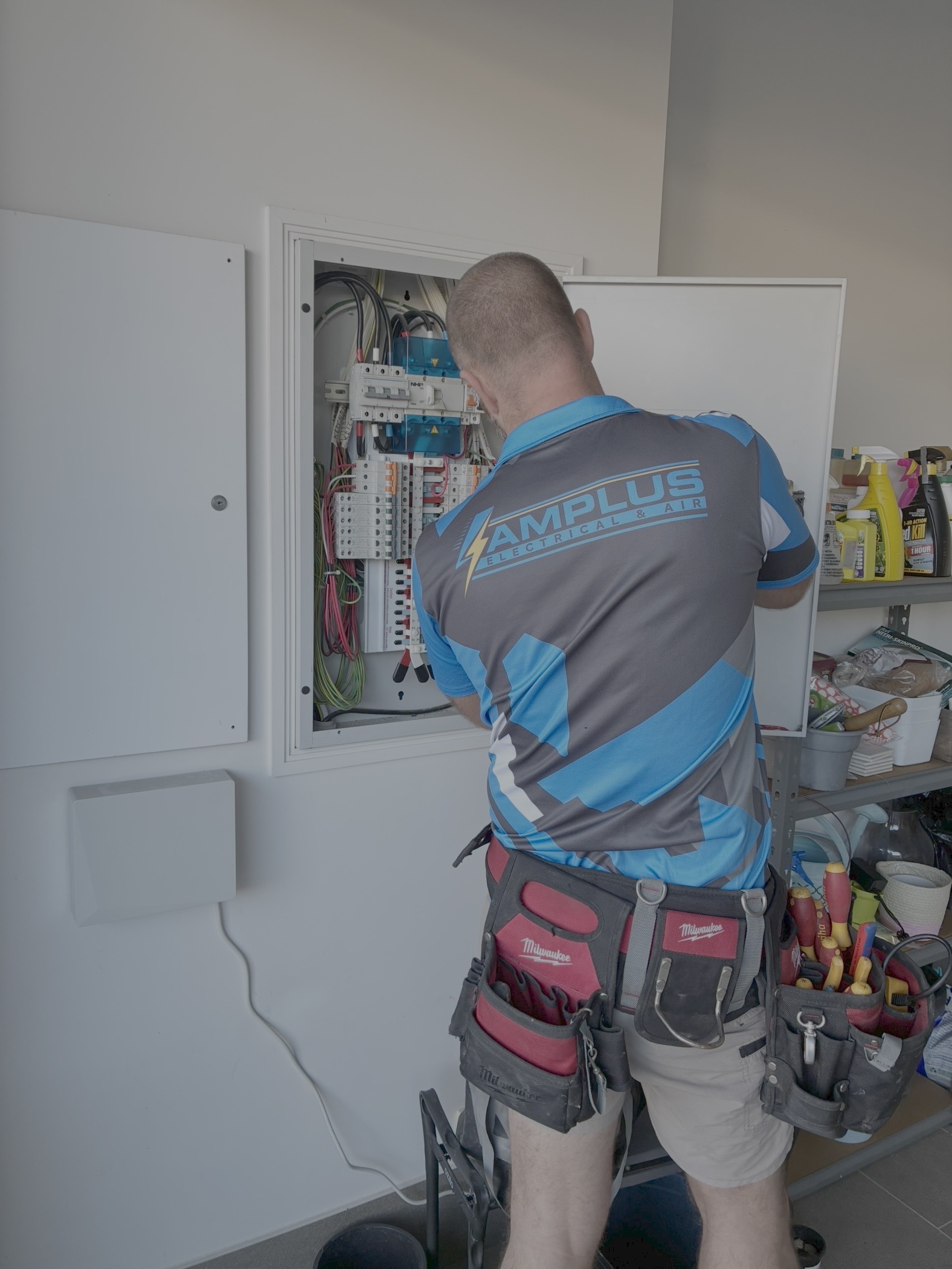
If you want the short version first: ceiling fan installation in the Redlands usually costs $150–$250 to replace an existing fan, $300–$500+ to install at a brand-new wiring point, and $200–$400 for a fan with a light kit — depending on ceiling access, fan type, and whether extra switch wiring is needed. In most Redlands homes, the single biggest price driver is whether the wiring point already exists. You’ve decided you want a ceiling fan — or a few of them. Now you’re trying to work out what it actually costs, and why the quotes you’re seeing vary so much. The honest answer is that ceiling fan pricing depends on your home, not just the fan. This is a practical, no-nonsense guide to ceiling fan installation costs across the Redlands, written by Aaron at Amplus Electrical & Air — a licensed electrician based in Capalaba who installs fans across the bayside every week. If you’re weighing fans against cooling in general, our split system vs ducted air conditioning guide is a useful companion read, and if you want the numbers side of the equation, our 2026 air conditioning installation pricing guide breaks down what Brisbane homeowners usually pay for split, multi-head, and ducted systems.
Why Ceiling Fans Are a Smart Buy in the Redlands
A well-positioned ceiling fan can make a room feel 3–4°C cooler, and most fans cost just 2–5 cents per hour to run — a fraction of what a split system costs over a long, humid Redlands summer. In a part of the world where summers push past 35°C and the humidity makes it feel worse, getting your fans right matters. Whether you’re in a highset Queenslander in Cleveland, a brick-and-tile in Thornlands, a waterfront home in Wellington Point, or an acreage property out at Redland Bay, the same principle applies: a quality ceiling fan, installed properly, is one of the most cost-effective comfort upgrades you can make — and one of the simplest ways to cut your home energy use through summer. But before you buy a fan from Bunnings or order one online, it’s worth understanding what installation actually costs.
What Affects the Cost of Ceiling Fan Installation?
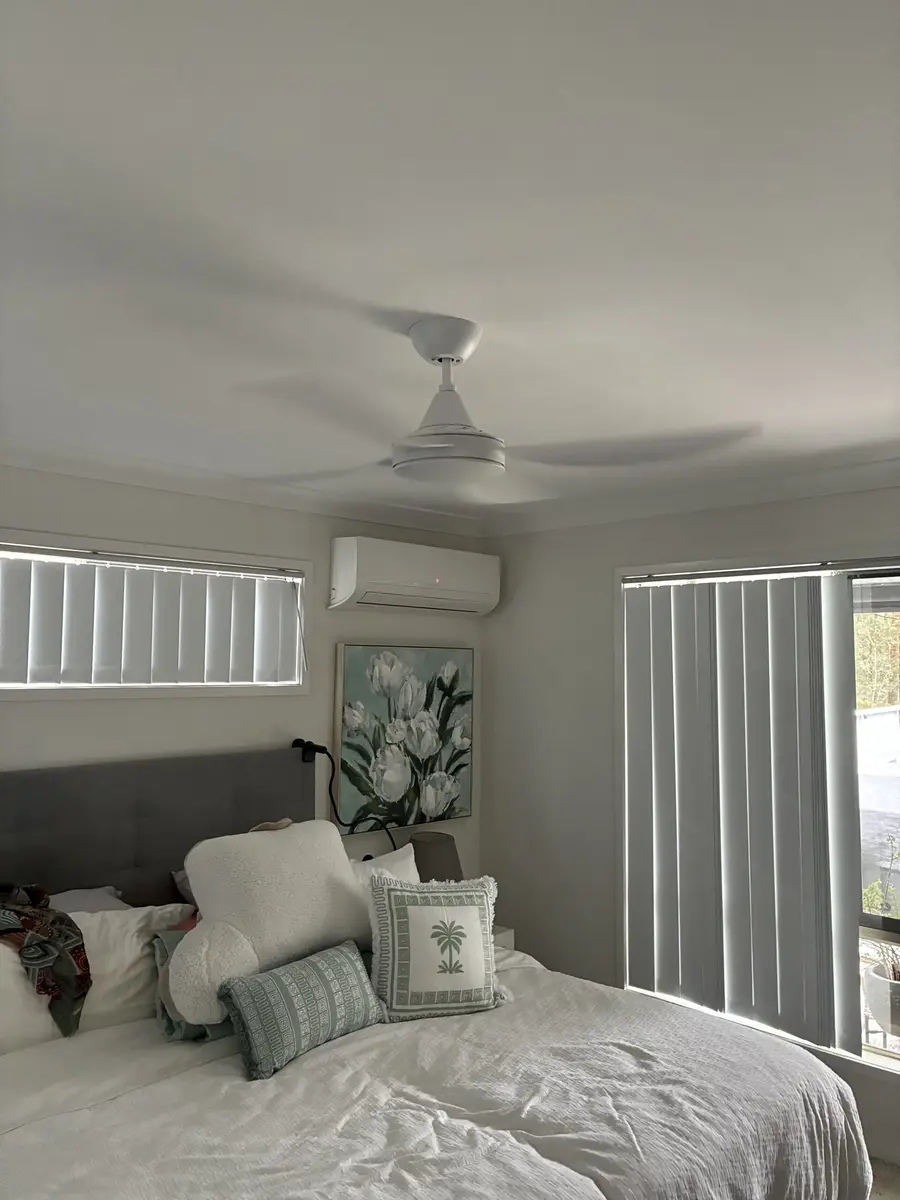
The biggest factor is whether you already have wiring in place. After that, it comes down to a handful of things that vary from home to home across the Redlands. Existing wiring point vs new point. Replacing an existing fan is quick and straightforward. Installing at a new location means running cable from your switchboard or a nearby circuit, which adds time and cost. Ceiling height and access. Standard 2.4m ceilings are easy. High or raked ceilings — common in older Cleveland and Ormiston Queenslanders — take longer and often need a downrod extension to bring the fan to the correct operating height. Without a downrod, high-ceiling fans don’t move air effectively. Roof space access. Good roof cavity access keeps costs down because cable can be run quickly through the roof space. Concrete-slab homes, common in newer Thornlands, Victoria Point, and Redland Bay estates, can require surface conduit or chasing into the ceiling, which pushes new-point pricing higher. Fan type. A basic AC fan is quicker to install than a DC motor fan with a remote receiver or a smart-home-compatible model. The wiring is slightly more involved, but the payoff is quieter operation and lower running costs. Light kit. Adding a light kit can mean extra wiring for separate switching, unless you use a DC fan with a remote receiver (more on that below). If you’re choosing between halogen and LED lighting options for your fan, our halogen vs LED downlights technical comparison covers colour temperature, CRI ratings, and energy efficiency in detail. Outdoor or alfresco installation. Outdoor-rated fans need the correct IP rating and corrosion-resistant components, which matters around bayside suburbs like Wellington Point, Cleveland, Ormiston, Birkdale, Thorneside, Wynnum, and Manly.
Redlands Ceiling Fan Installation Price Guide
These are realistic installed price ranges for jobs across Capalaba, Cleveland, Alexandra Hills, Thornlands, Victoria Point, Wellington Point, Birkdale, Ormiston, Redland Bay, and surrounding Redlands suburbs. ceiling fan replacement costs
Fan Only (No Light Kit) — Existing Wiring Point
| Fan Type | Typical Installed Cost |
|---|---|
| Standard replacement (AC motor fan) | $150 – $220 |
| DC motor fan with remote | $220 – $350 |
| Designer or large-blade fan | $280 – $420 |
Fan with Light Kit — Existing Wiring Point
| Fan Type | Typical Installed Cost |
|---|---|
| Standard fan + basic LED light kit | $200 – $300 |
| DC motor fan + light kit with remote | $280 – $450 |
| Premium fan + dimmable LED light kit | $350 – $600 |
New Wiring Point Required (No Existing Fan or Fitting)
| Scenario | Typical Installed Cost |
|---|---|
| New point, standard fan, good roof access | $300 – $450 |
| New point, fan with light kit | $380 – $580 |
| New point, limited roof access / concrete slab | $450 – $700+ |
Outdoor / Alfresco Fan
| Scenario | Typical Installed Cost |
|---|---|
| Outdoor-rated fan, existing point | $250 – $400 |
| Outdoor-rated fan, new point | $400 – $620 |
All prices above assume supply of a quality fan, professional installation by a licensed electrician, and full testing. Premium fans (DC motor, designer, smart-home-compatible) and specialty outdoor models vary in supply price depending on brand and specification. Ask us for a firm quote based on your specific requirements.
New Wiring Point vs Existing Point — What’s the Difference?
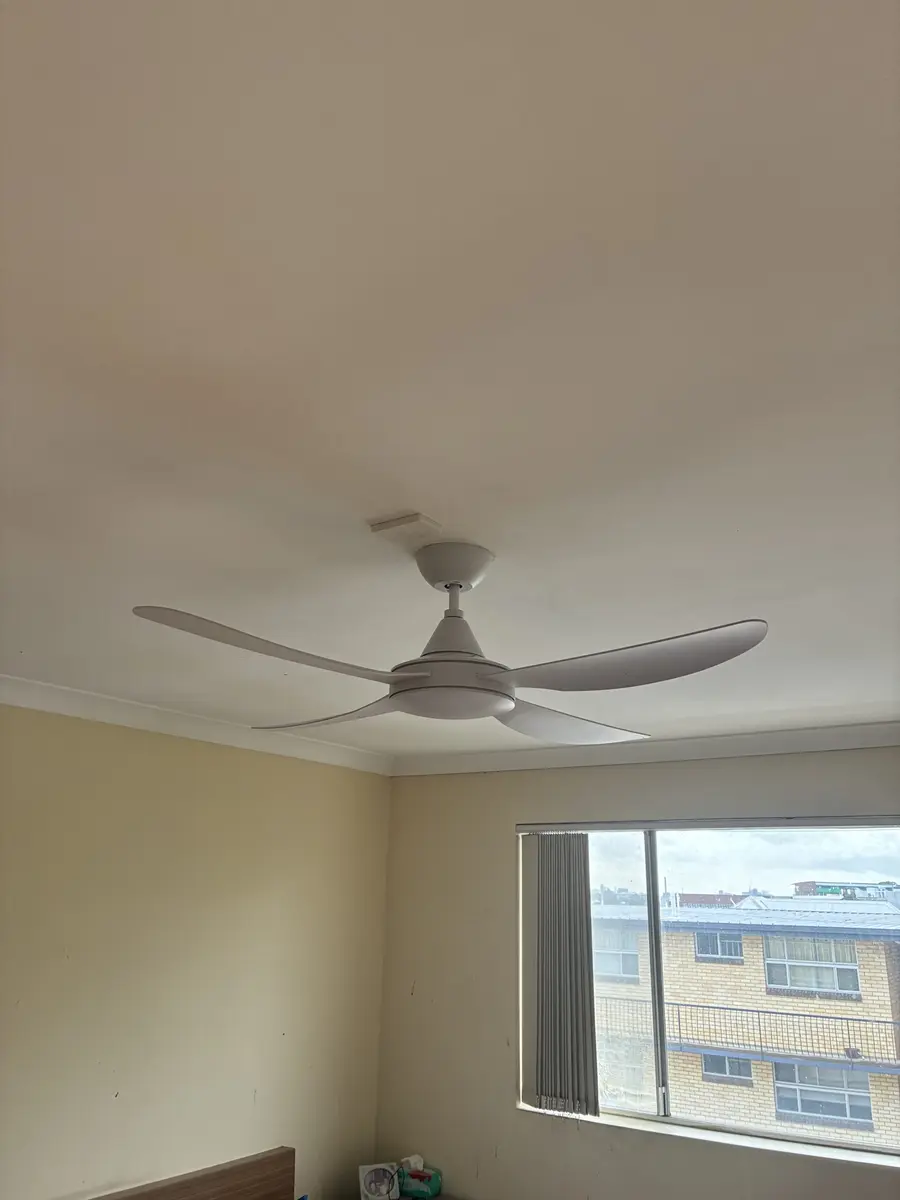
This is the single biggest driver of ceiling fan installation cost, so it’s worth understanding clearly. Existing wiring point (replacing an old fan). Your electrician disconnects the old fan, checks the existing ceiling box is fan-rated, mounts the new bracket, connects the wiring, and fits the new fan. Because the circuit is already there, it’s primarily a labour job. In most Redlands homes, this takes around 45–90 minutes per fan. New wiring point (no existing fan or fitting). Your electrician installs a fan-rated ceiling box, runs new cable from a suitable circuit, and adds or extends a switch leg for the fan — and the light, if required. Depending on roof access and how far the cable needs to run, this typically takes 2–4 hours per point. One practical tip: if you’re adding fans to several rooms that all need new wiring points, book them together. One visit across multiple rooms is significantly cheaper than separate call-outs. We do this regularly for homeowners doing whole-house fan installations in Cleveland, Thornlands, and Alexandra Hills, and the savings add up. If you already have a ceiling fan and just need to replace it (rather than install a new one), the cost is lower. See our ceiling fan replacement cost guide for pricing.
Fan with Light Kit vs Without
A combined fan and light is popular in bedrooms and living spaces because it lets one fitting do both jobs. A few things to understand before you choose: Separate switch leg required for independent control. If you want the fan and light to operate independently (fan on, light off, and vice versa), you need two switched circuits — one for the fan motor, one for the light. If your existing wall switch only has a single switch leg, your electrician will need to run a new one or fit a dual switch plate. This adds to the job cost. DC fans with remote control are the smart workaround. A DC motor fan with a built-in remote receiver controls both fan speed and light independently from a single power feed — no extra switch leg needed. Even though DC fans cost a little more upfront, they can actually reduce the total installation cost on new-point jobs by eliminating additional switch wiring. LED light kits only. Always specify an LED light kit. Halogen and incandescent kits run hot, use far more power, and burn out quickly — especially in Queensland’s summer heat. LED kits run cooler, cost less to run, and typically last the life of the fan.
Outdoor and Alfresco Ceiling Fans
Alfresco entertaining is a way of life across the Redlands. From covered decks in Birkdale to pergolas in Redland Bay and bayside entertaining areas in Wellington Point, an outdoor fan can make the space far more usable through summer. But not just any fan will do outside. IP rating. IP44 minimum for covered outdoor areas that don’t get direct rain. IP55 or higher for areas with more exposure to weather. Corrosion resistance. This is critical in the Redlands. Coastal suburbs like Wellington Point, Ormiston, Cleveland, Manly, Wynnum, and Thorneside are exposed to salt-laden air that destroys standard indoor fan components within a season or two. Outdoor-rated fans use marine-grade materials and sealed motors that hold up in these conditions. Outdoor-rated motor. Sealed against moisture, humidity, and insects. Brisbane’s summer storm season and the Redlands’ bayside humidity make this non-negotiable. Using a standard indoor fan in an alfresco area voids its warranty and creates a genuine safety hazard. It will fail quickly in the Redlands climate, often within the first wet season. Always specify an outdoor-rated model for any covered or semi-exposed installation. Brands that perform well in Redlands conditions include Martec, Mercator, and Hunter, with Big Ass Fans worth considering for larger entertaining areas.
Can I Install a Ceiling Fan Myself in Queensland?
No — not legally. In Queensland, all electrical work — including ceiling fan installation — must be performed by a licensed electrician. This is a firm legal requirement under the Electrical Safety If you’re considering a switchboard upgrade in Capalaba, it’s essential to ensure your home’s electrical system is up to code. Act 2002, and it applies even when you’re simply swapping an old fan for a new one at the same location. It doesn’t matter how straightforward it looks on YouTube. Connecting a ceiling fan involves live 240V mains electricity. Mistakes can cause electric shock, electrical fire, or a voided home insurance policy — insurers regularly reject claims where unlicensed electrical work is found to be involved. Portable fans are different, of course. Any plug-in appliance — pedestal fans, desk fans — is fine. But any fan that connects directly to your home’s wiring requires a licensed electrician, full stop. Before booking anyone, you can check any electrician’s licence on the Queensland Electrical Safety Office register — ours is Lic. 1500996.
If your home still has an old ceramic fuse box or outdated switchboard, you’ll need an upgrade before installing new electrical equipment. Our ceramic fuse box upgrade guide covers costs and safety risks across Brisbane.
What’s Included When You Hire a Licensed Electrician
When you get a quote from Amplus, the price covers everything — not just the labour:
- Inspection of your existing wiring, ceiling structure, and ceiling box to confirm it’s fan-rated
- Supply of a quality ceiling fan, or installation of a fan you’ve purchased yourself
- Installation of a fan-rated mounting bracket and ceiling box if required
- All wiring connections and switch leg work
- Full fitting of the fan, blades, canopy, and light kit (if applicable)
- Testing at all speed settings and light functions
- Tidy-up and removal of all packaging and old fan components
Be cautious of any quote that lists “labour only” without making clear what’s actually included. Ask upfront whether supply is included, and whether there are extra charges for roof access, switch leg work, or downrods on high ceilings. If you’re weighing up other home upgrades while the electrician is on-site, the 2026 Brisbane EV charger installation cost guide walks through what an EV charger install actually involves — useful if you’re already thinking about how to electrify the rest of your home. You might also want to check out our power point installation cost guide for pricing on outlet upgrades.
How to Choose the Right Ceiling Fan for a Queensland Home
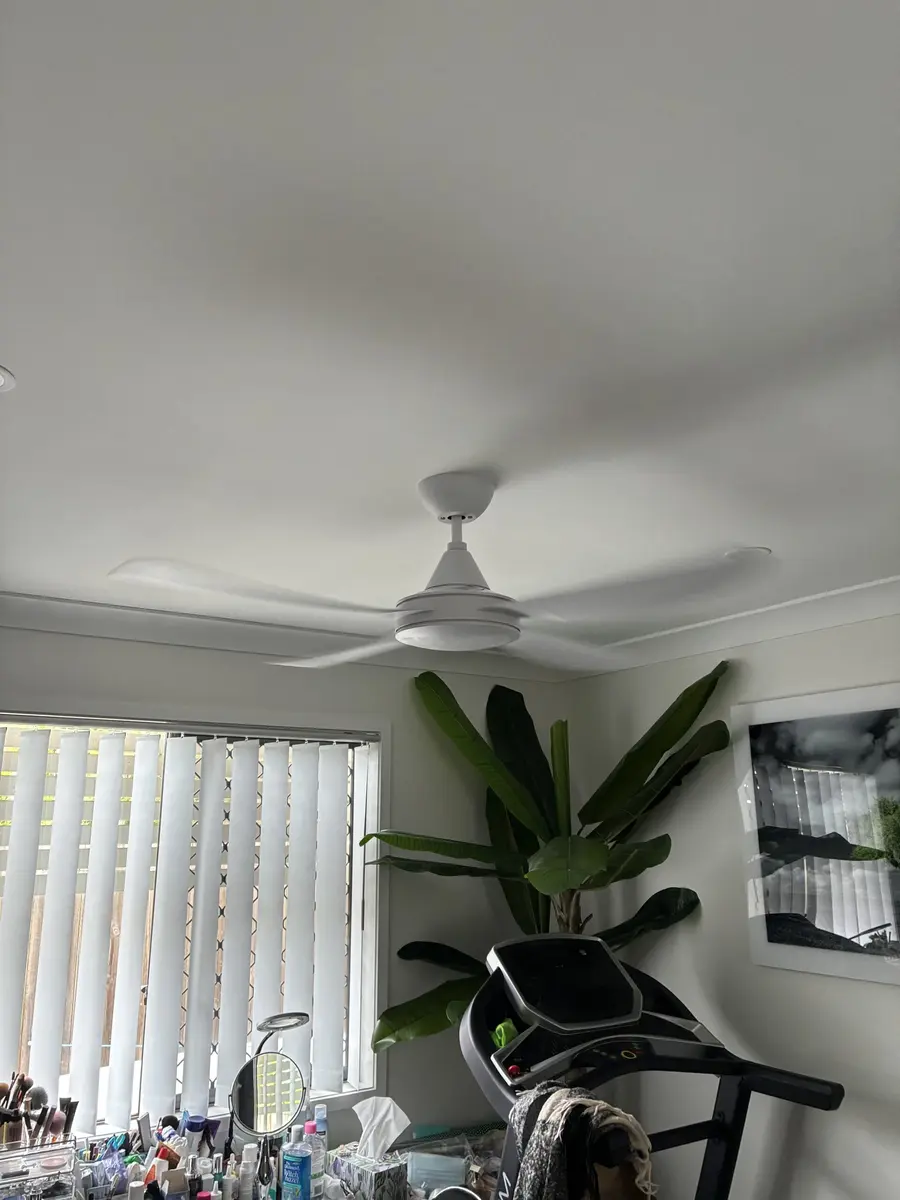
Before you buy, it’s worth taking a few minutes to think about what will actually suit your home and your lifestyle. Blade span. Size the fan to the room. A 900mm fan suits a small bedroom under 10m². A 1200mm–1400mm fan works well for standard bedrooms and medium living areas. Larger open-plan living areas benefit from a 1400mm–1600mm fan, or sometimes two smaller fans placed strategically. Oversized fans in small rooms look awkward and can be noisier than necessary. AC motor vs DC motor. DC motor fans run quieter, draw less power, and offer more speed settings — typically six or more, versus three on a standard AC fan. They cost more upfront but are worth it for bedrooms and main living areas where quiet operation matters. The Brilliant Vector DC ceiling fans we install are a good example — quiet, efficient, and remote-controlled. AC motor fans are fine for less-used or utility areas. Reversible direction. A fan that runs in reverse (clockwise on a low setting) pushes warm air sitting at ceiling level back down into the room during winter. Even in the Redlands, where winters are mild, this is a useful feature. Most quality DC fans include reverse as standard. Remote or smart control. Remote-controlled DC fans remove the need for separate fan and light switch legs at the wall — a genuine advantage on new wiring-point installations. Smart fans compatible with Google Home, Amazon Alexa, or Apple HomeKit add voice and app control, worth considering if you’re doing a whole-home installation. Noise and build quality. Cheap fans often develop a hum, wobble, or rattle within a few years, especially under the thermal stress of Queensland summers. Spend a little more on a reputable brand — Martec, Mercator, Hunter Pacific, and Brilliant Lighting all perform well in Queensland conditions — and you’ll get a quieter, longer-lasting result.
Ceiling Fan Installation Across the Redlands — Suburb Guide
Amplus Electrical & Air is based in Capalaba, right at the heart of the Redlands. We install ceiling fans daily across the full Redlands area, which means short travel times, no inflated travel fees, and an electrician who knows the local housing stock. Capalaba and Alexandra Hills. A mix of 1970s–1990s brick homes with good roof cavity access alongside newer slab constructions. Most have existing fan points in at least the main bedroom; living areas and additional bedrooms frequently need new wiring points. See our Alexandra Hills electrician page for broader electrical services. Cleveland and Ormiston. Older character homes, highset Queenslanders, and waterfront properties. High ceilings are common, so downrods are often needed to bring fans to the correct operating height of 2.1–2.4m above floor level. Coastal proximity means outdoor fans need to be corrosion-rated. More at our Cleveland electrician and Ormiston electrician pages. Wellington Point, Birkdale, and Thorneside. Established family homes and bayside properties. Salt air is a real factor, so outdoor — and even some indoor — fan selections need to be made with longevity in mind. See Wellington Point electrician, Birkdale electrician, and Thorneside electrician. Thornlands and Victoria Point. Predominantly newer estates built on concrete slab. Limited roof cavity access is the main consideration — cable runs for new points require surface conduit or ceiling chasing, which adds to new-point installation costs. Budget accordingly if you’re adding fans to rooms that have never had them. See Thornlands electrician and Victoria Point electrician. Redland Bay and Sheldon. Larger blocks, acreage properties, and modern estate homes. Larger living areas often suit two fans rather than one oversized unit, and outdoor entertaining areas tend to be bigger here too. See Redland Bay electrician and Sheldon electrician. Wynnum and Manly. On the northern edge of the bayside, with similar considerations to Wellington Point — coastal salt air and humidity mean build quality and IP ratings matter for outdoor installations. See Wynnum electrician and Manly electrician. No matter which suburb you’re in, we can give you a firm quote before starting any work. Most ceiling fan installations across the Redlands are completed in a single visit, with minimal disruption to your day. To see what’s covered and what to expect, visit our ceiling fan installation page. Adding a different upgrade to the same Redlands home? My Redlands EV charger installation guide covers the EV charger side of things across the same suburbs.
For more details, see our guide on Redlands rental property compliance.
For more details, see our guide on Redlands electrical compliance.
Frequently Asked Questions
How much does ceiling fan installation cost in the Redlands?
For a straight replacement of an existing fan, expect to pay $150–$420 installed depending on the fan type. For a new wiring point with no existing fitting, budget $300–$700+ depending on roof access, ceiling type, and whether you want a light kit. All prices include supply of a quality fan and full installation by a licensed electrician.
Do I need a licensed electrician to install a ceiling fan in Queensland?
Yes — always. Under the Electrical Safety Act 2002, all electrical installation work in Queensland, including ceiling fans, must be carried out by a licensed electrician. This applies even when replacing an existing fan at the same location. DIY ceiling fan installation is illegal, voids your home insurance, and carries genuine safety risks.
How long does ceiling fan installation take?
Replacing an existing fan at an existing point typically takes 45–90 minutes. Installing at a new wiring point takes 2–4 hours depending on roof access and the cable run. If you’re having multiple fans installed in one visit, we can usually complete three to four replacements in a half-day, making whole-house installations very efficient.
Can I supply my own fan and just pay for labour?
Yes. We’re happy to install a fan you’ve already purchased, provided it’s suitable for the intended location — indoor-rated for inside, outdoor-rated for alfresco areas. Just confirm this when booking. Note that when you supply the fan yourself, its warranty remains your responsibility.
What size ceiling fan do I need?
As a general guide: 900mm for small bedrooms under 10m², 1200mm for standard bedrooms and smaller living areas, and 1400mm–1600mm for large open-plan living areas. For alfresco areas, size the fan to cover the space and always specify an outdoor-rated model. If you’re not sure, we can recommend the right size and blade span when we assess your room.
Is a ceiling fan worth it in Brisbane’s Redlands?
Absolutely. A ceiling fan costs 2–5 cents per hour to run, compared to 30–80 cents per hour for a split system air conditioner. In the Redlands’ subtropical climate, a well-placed fan in each bedroom and living area significantly reduces how much you rely on air conditioning, particularly in spring and autumn when it’s warm but not hot enough to warrant the AC.
Can I put a ceiling fan in my alfresco area?
Yes — but it must be an outdoor-rated fan with a minimum IP44 rating. A standard indoor fan installed outdoors is a safety hazard and will fail quickly in the Redlands’ humidity, rain, and salt air. We install outdoor-rated ceiling fans on covered decks, pergolas, and alfresco areas regularly across the Redlands.
Will my existing wall switch work with a new fan?
It depends on the fan. A basic fan without a light will work from a single existing switch. If you want a fan and light that operate independently, you’ll need either a dual switch leg at the wall, or a DC fan with a remote receiver, which runs from a single power feed and handles fan speed and light independently via remote. We’ll advise the best approach when we see your setup.
How do I know if my ceiling can support a ceiling fan?
Ceiling fans must be mounted on a fan-rated ceiling box — a standard light fitting is not designed for the weight or rotational movement of a fan. As part of every installation, we check your ceiling structure and install a suitable fan-rated mounting box if one isn’t already in place. Never mount a ceiling fan on a standard batten-holder or light fitting.
Do you charge a call-out fee for Redlands suburbs?
No — there’s no extra call-out fee for suburbs across the Redlands. Being based in Capalaba means most Redlands suburbs are within 10–15 minutes for us, so you won’t be charged travel time on top of your quote.
📍 Ceiling Fan Installation Across the Redlands
Based in Capalaba, we install ceiling fans across the Redlands and bayside suburbs. Upfront pricing, no hidden call-out fees, and most jobs done in a single visit.
Need a licensed electrician in the Redlands? Aaron is a licensed electrician (Lic. 1500996) and ARC-certified A/C technician serving Capalaba, Cleveland, Alexandra Hills, Thornlands, Victoria Point, Wellington Point, Birkdale, Ormiston, Redland Bay, Sheldon, and surrounding suburbs. Honest advice, upfront pricing, and quality work — no surprises on the invoice. 📋 Request a Quote 📞 Call 0419 014 146 For a full guide to Brisbane air conditioning installer guide, see our complete Brisbane air conditioning installation guide.
Need a Licensed Electrician in Brisbane Bayside?
Aaron is a licensed electrician (Lic. 1500996) and ARC-certified A/C technician serving Capalaba, Cleveland, Wynnum, Manly, Birkdale, Thornlands, Victoria Point and surrounding suburbs. Honest advice, upfront pricing, and quality work guaranteed.