Smoke Alarm for Deaf & Hearing Impaired Brisbane | 2026 Guide
I’m Aaron, a licensed electrician based in Capalaba (QLD Licence 1500996). I install smoke alarm systems for deaf and hearing impaired homes across Brisbane every week. From 1 January 2027, every Queensland home must have interconnected smoke alarms — and if you’re deaf or hard of hearing, you need specialised equipment like bed shakers, strobe lights, or 520Hz low-frequency alarms. Watch’s Ability Range and Genius 520Hz are built exactly for this. Most homes need 4-5 alarms ($600-$900 installed with accessibility features). NDIS funding may cover the cost. Book early — December gets crazy.
🔑 Key Takeaways
- Standard smoke alarms won’t wake most deaf or profoundly hearing impaired people
- You need specialised equipment: bed shakers, strobe lights, or 520Hz low-frequency alarms
- Watch’s Ability Range (bed shakers + strobes) and Genius 520Hz are built for this
- NDIS funding may cover the full cost if you’re a participant
- Most deaf homes need 4-5 alarms with accessibility features ($600-$900 installed)
- From 1 January 2027, every Queensland home must have interconnected alarms — no exemptions
Why Deaf & Hearing Impaired Homes Need Special Smoke Alarms
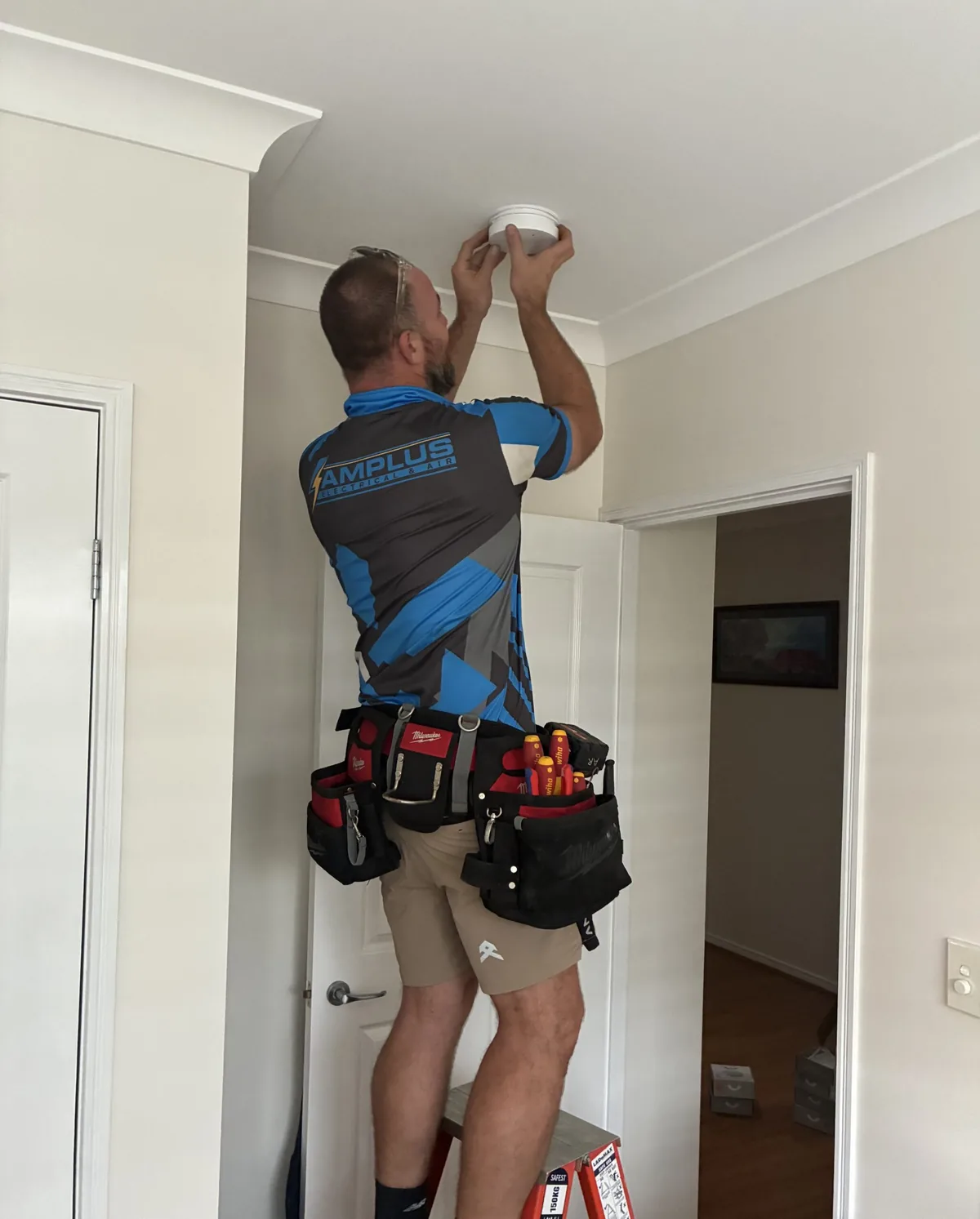
Here’s the problem with standard smoke alarms when it comes to smoke alarm deaf safety: they’re designed for people who can hear. A typical alarm runs at 3000Hz — a high-pitched screech that’s effective for hearing people but completely useless if you’re profoundly deaf or severely hard of hearing.
I’ve installed alarms in dozens of homes across Brisbane where the deaf homeowner had no idea their existing alarms wouldn’t wake them. They’d pass their compliance check because the alarms were technically correct — photoelectric, interconnected, in the right locations — but they’d be dead in a fire because they couldn’t hear them.
The science is clear: Research shows that standard high-frequency alarms fail to wake up to 80% of profoundly deaf sleepers. Even people with moderate hearing loss often sleep through 3000Hz alarms, especially if they’re tired, medicated, or have been drinking.
That’s why accessible smoke alarms exist — they use vibration (bed shakers), visual alerts (strobe lights), or low-frequency sound (520Hz) that penetrates hearing loss. If you’re deaf or hard of hearing, these aren’t optional extras. They’re the difference between life and death.
The Science Behind 520Hz Low-Frequency Alarms
Here’s what most people don’t realise: not all sound frequencies wake you up equally. Research from the US National Institute of Standards and Technology (NIST) and the UK’s fire safety research shows that low-frequency sound (around 520Hz) is significantly more effective at waking people than high-frequency sound (3000Hz).
Why does this matter? High-frequency sound (3000Hz) is easier for young, healthy ears to hear, which is why standard alarms use it. But as you age, or if you have hearing loss, your ears become less sensitive to high frequencies. By the time you’re 50, you may have lost 20-30dB of sensitivity at 3000Hz. By 70, it’s 40-50dB. That’s the difference between hearing an alarm and sleeping through it.
Low-frequency sound (520Hz) penetrates deeper into sleep cycles and is less affected by hearing loss. Studies show that 520Hz alarms wake up to 12x more people with hearing loss than 3000Hz alarms. For profoundly deaf people, 520Hz alone isn’t enough — you need vibration or visual alerts — but for moderately hard of hearing people, 520Hz can be life-changing.
That’s why Watch’s Genius 520Hz alarm exists. It’s not just a marketing gimmick — it’s based on decades of fire safety research. If you’re hard of hearing, 520Hz is the frequency that will wake you up.
QLD 2027 Legal Requirements for Accessible Smoke Alarms
From 1 January 2027, every owner-occupied home in Queensland must have photoelectric, interconnected smoke alarms in every bedroom, every hallway connecting bedrooms, and on every level. This applies to all homes — including deaf and hearing impaired households.
There’s no exemption for disability. If you live in your home, you must comply by 2027. The good news? The law doesn’t just allow accessible alarms — it expects them. The Building Fire Safety Regulation 2008 specifically references that alarms must be “appropriate for the occupants,” which includes deaf and hard of hearing people.
For the full legal breakdown, see my complete QLD 2027 smoke alarm compliance guide. For Redlands-specific requirements, check the Redlands smoke alarm compliance guide. If you’re worried about the cost, I break down pricing in my smoke alarm upgrade cost guide.
The Building Fire Safety Regulation 2008 (QLD legislation) sets out the exact requirements. The Queensland Fire and Emergency Services smoke alarm page has a plain-English summary of what homeowners need. And the Electrical Safety Office warns against DIY electrical work — including smoke alarm installation.
What this means for deaf homes: You need the same number of alarms as everyone else (bedrooms, hallways, every level), but they must include accessibility features — bed shakers, strobe lights, or 520Hz technology. You can’t just install standard alarms and hope for the best.
The 3 Types of Accessible Smoke Alarms (And Which You Need)
1. Bed Shakers (Vibration Alarms)
A bed shaker is a vibrating pad that sits under your pillow or mattress. When the smoke alarm detects fire, the pad vibrates violently — enough to wake even profoundly deaf sleepers. This is the most common solution for deaf homes because it works regardless of hearing ability.
Best for: Profoundly deaf people, heavy sleepers, people who sleep with pillows over their ears
Watch product: Ability Range bed shaker accessory
If you’re dealing with a beeping alarm issue right now, check my smoke alarm beeping fix guide first.
2. Strobe Lights (Visual Alarms)
High-intensity strobe lights flash when the alarm activates. These are mounted on walls or ceilings and provide a visual alert that’s impossible to miss. They’re especially useful for people who are awake when a fire starts, or for hearing impaired people who aren’t profoundly deaf.
Best for: Hard of hearing people, people who are awake during the day, noisy environments
Watch product: Ability Range strobe light accessory
3. 520Hz Low-Frequency Alarms
Standard alarms run at 3000Hz. Research shows that 520Hz low-frequency sound is up to 12x more effective at waking children, older adults, and people with hearing loss. Watch’s Genius range is Australia’s first 520Hz square wave alarm — it literally wakes people who sleep through standard alarms.
Best for: Moderately hearing impaired people, heavy sleepers, families with children, elderly parents
Watch product: Genius 520Hz 240V smoke alarm
Which do you need? If you need a smoke alarm deaf solution, you need bed shakers or strobe lights (sound won’t work). If you’re moderately hard of hearing, 520Hz alarms may be enough. Most deaf homes I install use a combination — bed shakers in bedrooms + strobe lights in living areas. If you need help finding a qualified installer, my smoke alarm installers Brisbane guide covers what to look for.
Watch Ability Range: Bed Shakers & Strobe Lights
Watch’s Ability Range is built specifically for deaf and hearing impaired homes. It’s Australia’s most comprehensive accessible smoke alarm system, and it’s what I install in most deaf homes across Brisbane.
What’s included:
- Bed shaker accessory — vibrating pad that connects wirelessly to your smoke alarms. When any alarm activates, the pad vibrates violently under your pillow or mattress.
- Strobe light accessory — high-intensity flashing light that provides visual alert. Can be mounted on walls or ceilings.
- Wireless interconnection — all alarms, bed shakers, and strobes connect wirelessly. When one alarm detects fire, they all activate together.
Why I recommend Watch Ability:
- Australian-owned and built to AS3786:2014 standard
- 10-year sealed lithium battery (no battery changes)
- Wireless interconnection (no need to run cables through ceilings)
- Works with existing Watch alarm systems
- NDIS-compliant (funding may cover the cost)
Typical installation: For a 3-bedroom home, I’ll install 4-5 alarms (one in each bedroom, one in the hallway) plus 2-3 bed shakers (one for each deaf sleeper) and 1-2 strobe lights (living areas). Total cost: $700-$900 installed, depending on the number of accessibility features.
Watch Genius 520Hz: The Alarm That Actually Wakes You
Watch Genius is Australia’s first 520Hz square wave smoke alarm. The science is compelling: low-frequency sound (520Hz) is scientifically proven to wake up to 12x more people than standard 3000Hz alarms — especially children, older adults, and people with hearing loss.
How it works: The Genius uses a square wave tone at 520Hz instead of the standard 3000Hz screech. Low-frequency sound penetrates deeper into sleep cycles and is less likely to be filtered out by hearing loss. It’s not louder — it’s different.
Key specs:
- 520Hz square wave alarm tone (scientifically proven to wake more people)
- Photoelectric sensor (detects smouldering fires fast)
- 240V mains powered with 10-year lithium backup battery
- Wireless RF interconnection (connect up to 40 alarms)
- AS3786:2014 & ISO8201 certified
- 10-year warranty
Who is Genius for? If you’re moderately hard of hearing (not profoundly deaf), Genius may be enough on its own. It’s also ideal for families with children, elderly parents, or anyone who’s a heavy sleeper. For profoundly deaf people, I usually combine Genius with bed shakers for maximum protection.
Cost: Genius alarms are about $20-$30 more than standard alarms per unit. For a typical 3-bedroom home, the upgrade cost is $80-$150 total — worth every dollar if it wakes you up.
How Many Accessible Smoke Alarms Does My Home Need?
The same rules apply to deaf homes as everyone else: you need one alarm in every bedroom, one in every hallway connecting bedrooms, and at least one on every level. The difference is that some or all of those alarms need accessibility features (bed shakers, strobes, or 520Hz).
Typical setups I install:
- 3-bedroom single-storey home (deaf homeowner): 4 alarms (3 bedrooms + 1 hallway) with 2 bed shakers and 1 strobe light. Total: $700-$800 installed.
- 4-bedroom two-storey home (deaf couple): 6 alarms (4 bedrooms + 2 hallways) with 3 bed shakers and 2 strobe lights. Total: $900-$1,100 installed.
- 3-bedroom home (moderately hard of hearing): 4 Genius 520Hz alarms (no bed shakers needed). Total: $600-$700 installed.
For exact pricing, see my smoke alarm installation cost guide. For a quick quote on your specific home, call me on 0419 014 146.
NDIS Funding: Can I Get Help Paying for This?
If you’re an NDIS participant, a smoke alarm deaf system may be fully funded under the Assistive Technology category. The NDIS recognises that standard smoke alarms don’t work for deaf and hearing impaired people, and they’ll fund the equipment and installation.
What NDIS covers:
- Bed shakers and strobe lights (Assistive Technology – Low Cost)
- 520Hz alarms if clinically justified (Assistive Technology – Low-Medium Cost)
- Installation by a licensed electrician
- Ongoing maintenance and battery replacement
How to access funding: You’ll need a recommendation from an audiologist or occupational therapist confirming that you need accessible smoke alarms. I can provide a quote that you submit to your NDIS planner or support coordinator. Most approvals come through within 2-4 weeks.
Not an NDIS participant? If you’re deaf or hearing impaired but not on NDIS, you may still be eligible for state government funding or disability support programs. Call Disability Services Queensland on 1300 362 432 to check what’s available.
What Happens During Installation?
Installing accessible smoke alarms is the same process as standard alarms, with a few extra steps for the accessibility features. Here’s what to expect:
Step 1: Home assessment (30 minutes)
I’ll walk through your home with you and check your current alarms. I’ll ask about your hearing level, where you sleep, and whether you’re a heavy sleeper. This helps me figure out how many bed shakers and strobes you need.
Step 2: Alarm installation (1-2 hours)
I’ll install the alarms in the required locations (bedrooms, hallways, every level). If you’re using Watch Genius 520Hz alarms, I’ll hardwire them into your 240V system with battery backup. If you’re using wireless alarms, I’ll mount them on the ceiling with screws.
Step 3: Accessibility features setup (30 minutes)
I’ll pair the bed shakers and strobe lights to your alarm system. I’ll test every alarm to make sure the bed shakers vibrate and the strobes flash when an alarm activates. I’ll show you how to test the system yourself.
Step 4: Compliance documentation (10 minutes)
I’ll hand over your compliance certificate and a user guide for the accessibility features. I’ll answer any questions you have about testing, maintenance, and what to do if something goes wrong.
Total time: 2-3 hours for a typical 3-bedroom home. I’ll clean up after myself and leave your home exactly as I found it.
Hardwired vs Wireless Interconnection for Accessibility
All smoke alarms in Queensland must be interconnected — when one alarm detects fire, they all sound together. For deaf homes, this is critical because you need every bed shaker and strobe to activate, not just the one closest to the fire.
Hardwired interconnection (240V):
Alarms are wired into your home’s electrical system and connected to each other via cable. This is the most reliable option, but it requires running cables through your ceilings and walls. Best for newer homes or homes that already have hardwired alarms.
Wireless interconnection (RF):
Alarms connect to each other via radio frequency (RF) — no cables needed. This is ideal for older homes where running cables would be messy or expensive. Watch’s Ability Range and Genius both use wireless interconnection.
Which is better for deaf homes? Wireless is usually the better choice because it’s easier to install and you can add bed shakers and strobes without running additional cables. Hardwired is more reliable long-term, but wireless is 99.9% reliable and the installation is much less disruptive.
For more on hardwired vs wireless, see my QLD 2027 compliance guide.
5 Mistakes I See in Deaf Homes (And How to Fix Them)
After installing alarms in dozens of deaf homes across Brisbane, here are the most common mistakes I see:
1. Standard alarms only (no accessibility features)
The problem: The home has photoelectric, interconnected alarms — but they’re standard 3000Hz alarms with no bed shakers or strobes. The homeowner who needs a smoke alarm deaf solution can’t hear them.
The fix: Add bed shakers and strobe lights, or replace with 520Hz alarms. Cost: $200-$400 for accessories, or $80-$150 to upgrade to Genius.
2. Bed shakers in the wrong locations
The problem: The home has bed shakers, but they’re only in the master bedroom. The deaf teenager in the spare bedroom has no bed shaker.
The fix: Install a bed shaker in every bedroom where a deaf person sleeps. Cost: $80-$120 per additional bed shaker.
3. No strobe lights in living areas
The problem: The home has bed shakers for sleeping, but no strobe lights for when the deaf person is awake in the living area. They won’t see or hear the alarm.
The fix: Install strobe lights in living areas, kitchen, and any other areas where the deaf person spends time. Cost: $100-$150 per strobe light.
4. Expired alarms (10+ years old)
The problem: The home has old alarms that are past their 10-year service life. The sensors are degraded and they may not work properly — even with bed shakers and strobes.
The fix: Replace all expired alarms with new accessible alarms. Cost: $600-$900 for a typical 3-bedroom home.
5. Not interconnected
The problem: The home has alarms and bed shakers, but they’re not interconnected. When the kitchen alarm detects fire, the bedroom bed shakers don’t activate.
The fix: Replace all alarms with a wireless interconnected system (Watch Ability or Genius). Cost: $600-$900 for a typical home.
Maintenance and Testing: Keeping Your System Working
Installing accessible smoke alarms is only half the battle. You also need to maintain them properly and test them regularly to make sure they’ll work when you need them. Here’s what you need to know:
Monthly testing: Every month, press the test button on each alarm to make sure it’s working. For bed shakers, you’ll need to check that the vibrating pad activates when the alarm sounds. For strobe lights, make sure the flashing light works. If anything doesn’t work, replace the battery or call me to check it out.
Battery replacement: Most modern alarms have 10-year sealed lithium batteries that don’t need replacing. If your alarms have replaceable batteries, change them at least once a year — I recommend doing it when you change your clocks for daylight saving. Never ignore a chirping alarm — that’s your alarm telling you the battery is low.
Cleaning: Dust and cobwebs can block the smoke sensors and cause false alarms. Vacuum your alarms gently every 6 months to keep them working properly. Don’t use water or cleaning products — just a soft brush attachment on your vacuum.
Replacement: Smoke alarms have a 10-year lifespan. After that, the sensors degrade and they become unreliable. Check the manufacture date on the back of your alarms — if they’re more than 10 years old, replace them immediately. This is especially important for deaf and hard of hearing people because you’re already at a disadvantage if your alarms don’t work.
Professional inspection: Every 2-3 years, I recommend having a licensed electrician inspect your entire smoke alarm system. I’ll check that all alarms are working, that they’re interconnected properly, and that your bed shakers and strobe lights are functioning. It’s a quick check that gives you peace of mind.
Choosing the Right Electrician for Accessible Smoke Alarms
Not all electricians have experience with accessible smoke alarms. When you’re deaf or hard of hearing, you need an electrician who understands your specific needs and can recommend the right solutions. Here’s what to look for:
Experience with accessibility: Ask the electrician if they’ve installed accessible smoke alarms before. Do they know about bed shakers, strobe lights, and 520Hz technology? Can they explain the difference between profoundly deaf and moderately hard of hearing solutions? If they can’t answer these questions, they probably don’t have the experience you need.
Licensing and insurance: Make sure the electrician is licensed and insured. In Queensland, all electricians must hold a current licence issued by the Electrical Safety Office. You can verify their licence online at WorkSafe Queensland. Never hire an unlicensed electrician — if something goes wrong, you won’t be covered by insurance. If you’re unsure about your switchboard’s capacity, check my signs your switchboard needs replacing guide.
Product knowledge: A good electrician will know about different brands and products. They should be able to explain the pros and cons of Watch Ability Range vs other brands, and why 520Hz technology matters. If they only stock one brand and can’t explain why it’s the best choice, that’s a red flag.
Free assessment: I always offer a free assessment before quoting. I’ll walk through your home, check your current setup, and tell you exactly what you need. No pressure, no sales pitch. If the electrician tries to pressure you into booking immediately or won’t give you a free assessment, walk away.
Transparent pricing: A good electrician will give you a clear, written quote before starting work. The quote should include the cost of alarms, accessories, labour, and any additional work like switchboard upgrades. If the quote is vague or the electrician refuses to put it in writing, that’s a red flag.
After-sales support: What happens if something goes wrong after installation? A good electrician will offer a warranty on their work and be available to fix any issues. I offer a 12-month warranty on all installations and I’m always available by phone if you have questions. I’m also an ARCtick certified refrigerant handler and a member of Master Electricians Australia — so you know you’re dealing with a qualified, insured professional.
Ready to get your deaf-safe smoke alarm system installed?
Request a Free Quote
Or call Aaron directly: 0419 014 146
Frequently Asked Questions
Will a standard smoke alarm wake me up if I’m deaf?
No. Standard 3000Hz alarms are designed for hearing people. Research shows they fail to wake up to 80% of profoundly deaf sleepers. You need specialised equipment like bed shakers, strobe lights, or 520Hz alarms.
Do I need both bed shakers and strobe lights?
It depends on your hearing level and lifestyle. If you’re profoundly deaf, I recommend both — bed shakers for sleeping and strobe lights for when you’re awake. If you’re moderately hard of hearing, 520Hz alarms may be enough on their own.
Can I install accessible smoke alarms myself?
No. Queensland law requires that smoke alarms be installed by a licensed electrician. DIY installation voids your compliance certificate and may not be covered by insurance. If you’re selling a property, you’ll also need a smoke alarm compliance certificate QLD to prove everything meets current standards. For more on this, see my guide to electrical safety.
Will NDIS pay for my smoke alarms?
If you’re an NDIS participant, accessible smoke alarms may be fully funded under Assistive Technology. You’ll need a recommendation from an audiologist or OT. I can provide a quote for your NDIS planner.
How often do I need to test my accessible smoke alarms?
Test your alarms monthly by pressing the test button. Check that the bed shakers vibrate and the strobe lights flash. Replace the batteries every 10 years (or sooner if the alarm chirps). For Watch Genius and Ability Range, the 10-year sealed lithium battery means no battery changes.
How much does it cost to install accessible smoke alarms?
For a typical 3-bedroom home with bed shakers and strobe lights, expect $700-$900 installed. For 520Hz Genius alarms only (no bed shakers), expect $600-$700 installed. For exact pricing, see my cost guide or call me on 0419 014 146.
Do I need accessible smoke alarms if I’m only slightly hard of hearing?
If you’re moderately hard of hearing, 520Hz alarms (like Watch Genius) are usually enough. They’re scientifically proven to wake people with hearing loss. If you’re profoundly deaf, you need bed shakers or strobe lights.
Can I use wireless interconnected alarms, or do they have to be hardwired?
Both are legal under the 2027 rules. Wireless is usually better for deaf homes because it’s easier to install bed shakers and strobes without running cables. For more on this, see my Redlands compliance guide.
What if I rent my home? Do I still need accessible alarms?
Yes. From 1 January 2027, every Queensland home must have interconnected alarms — including rentals. If you’re a deaf tenant, your landlord must provide accessible alarms. If you’re a deaf landlord, you must install them for your tenants.
Which Brisbane suburbs do you service for deaf smoke alarm installation?
I service all of Brisbane and the Redlands — Capalaba, Cleveland, Wynnum, Manly, Birkdale, Thornlands, Victoria Point, Alexandra Hills, Sheldon, Redland Bay, and surrounding suburbs. For a full list, see my smoke alarm installers Brisbane guide.
Need a Licensed Electrician in Brisbane Bayside?
Aaron is a licensed electrician (Lic. 1500996) and ARC-certified A/C technician serving Capalaba, Cleveland, Wynnum, Manly, Birkdale, Thornlands, Victoria Point and surrounding suburbs. Honest advice, upfront pricing, and quality work guaranteed.