What Size Split System Do I Need? Brisbane Room Size Calculator (2026 Guide)
What size split system do you need for your Brisbane home? Use our room size calculator and sizing chart to find the right kW rating. Includes Brisbane-specific factors like humidity, ceiling height, and insulation. Real examples from Capalaba, Cleveland, and Redlands homes.
Getting the size wrong is the most expensive mistake you can make with a split system air conditioner. Too small, and it runs flat out all summer without cooling your room — your electricity bill skyrockets and the unit wears out fast. Too big, and it short-cycles (turns on and off constantly), which wastes energy, creates humidity problems, and kills the compressor.
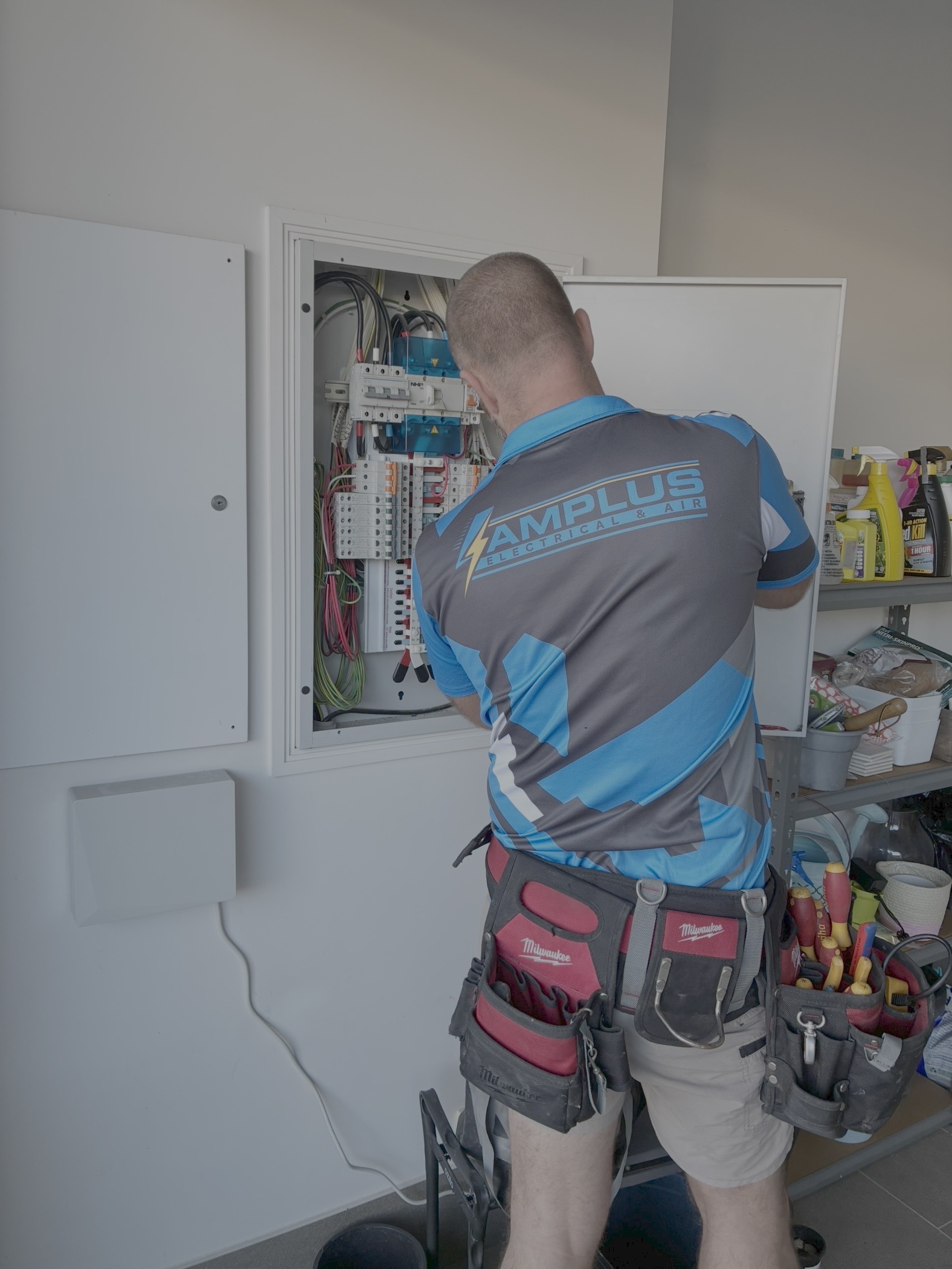
As a licensed electrician and air conditioning installer working across Capalaba, Cleveland, and the Redlands, I size systems for Brisbane homes every week. For Capalaba-specific pricing, see our Capalaba split system costs. The good news: it’s not complicated once you know the formula. Here’s exactly how to work out what size split system you need, plus the Brisbane-specific factors most guides miss.
Split System Sizing Chart: Room Size to kW (Brisbane Guide)
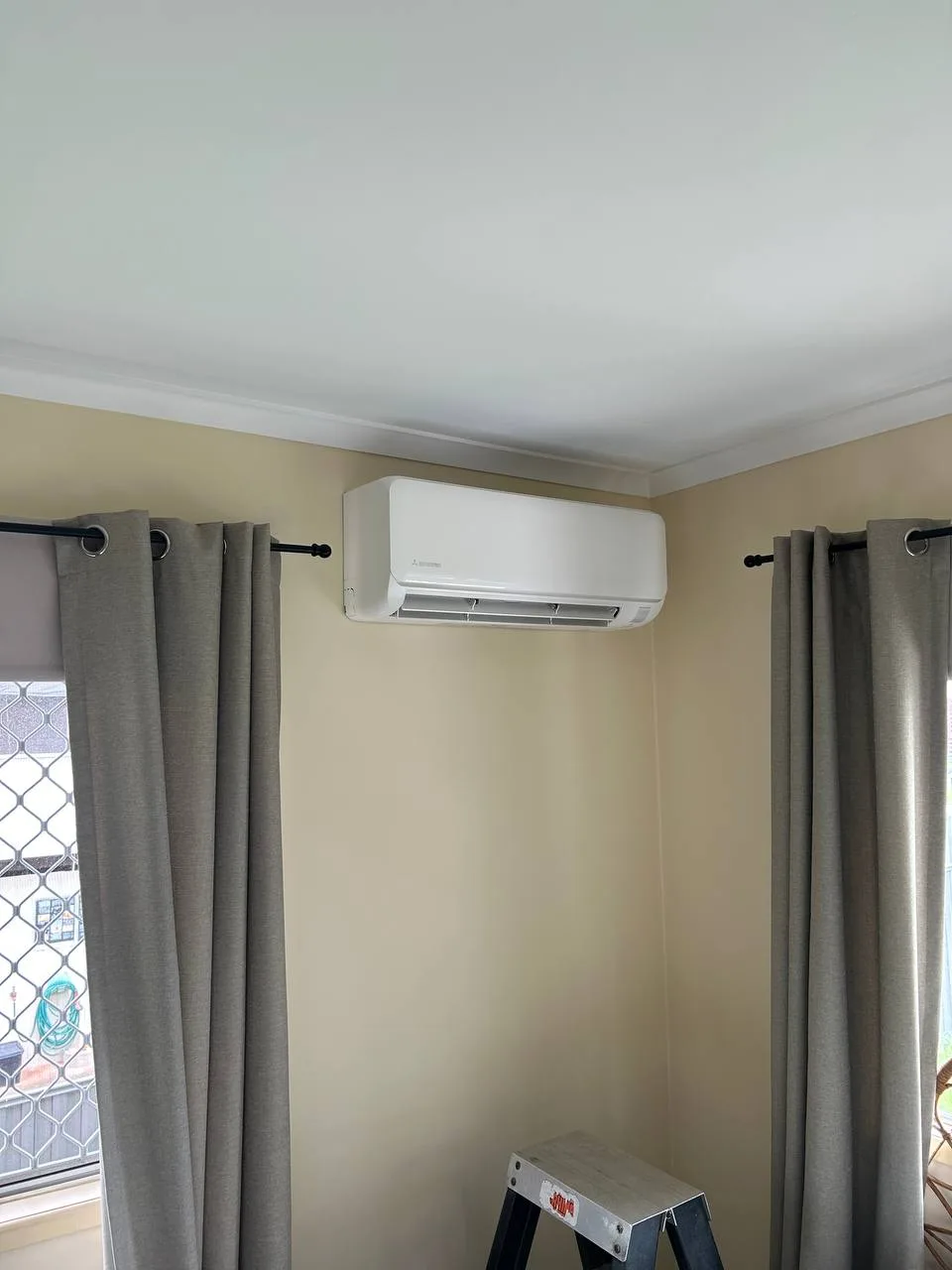
This is the starting point. Match your room’s floor area to the right kilowatt (kW) output: For suburb-by-suburb pricing, read our Redlands-specific installation guide.
| Room Size (m²) | Split System Size (kW) | Typical Room Type | Installation Cost (Brisbane 2026) |
|---|---|---|---|
| 10–15 m² | 2.0–2.5 kW | Small bedroom, home office | $1,300–$1,800 |
| 15–25 m² | 2.5–3.5 kW | Master bedroom, small living room | $1,400–$2,200 |
| 25–35 m² | 3.5–5.0 kW | Large bedroom, medium living room | $1,600–$2,800 |
| 35–50 m² | 5.0–6.0 kW | Open-plan living, large lounge | $1,800–$3,200 |
| 50–70 m² | 6.0–8.0 kW | Large open-plan, combined living/dining | $2,200–$3,500 |
| 70+ m² | 8.0–9.0+ kW | Very large spaces, multi-head system | $2,800–$4,500+ |
How to measure your room: Multiply length × width in metres. A 4m × 3.5m bedroom = 14 m², so you need a 2.5 kW system. A 6m × 5m open-plan living area = 30 m², so you need a 5.0 kW system.
For a detailed breakdown of what these systems cost fully installed, see our split system installation cost guide.
The Brisbane Factor: Why Local Conditions Matter
Generic sizing charts assume standard conditions. Brisbane isn’t standard. Here’s what makes our climate different:
Humidity (The Big One)
According to the Australian Refrigeration Council (ARCtick), proper system sizing is critical in humid climates like Brisbane to ensure efficient dehumidification.
Brisbane’s summer humidity regularly hits 70-80%. Your split system doesn’t just cool — it dehumidifies. High humidity means your system works harder to remove moisture from the air. In coastal Redlands suburbs like Wellington Point, Birkdale, and Thornlands, that salt-laden humid air is even more demanding.
What this means for sizing: If your room gets direct afternoon sun or has poor ventilation, add 0.5 kW to your calculated size. The extra capacity handles humidity spikes without the unit running flat out.
Ceiling Height
Most Brisbane homes built from the 1970s to 2000s have 2.4m ceilings. Modern builds often go 2.55m or even 2.7m. Queenslander homes can have 3m+ ceilings with the original highset design.
The rule: For every 0.3m above 2.4m, add 10% to your kW requirement. A 2.7m ceiling in a 20 m² room means you need 3.5 kW instead of 2.5 kW.
Insulation Quality
The YourHome.gov.au guide explains how insulation quality directly affects heating and cooling efficiency.
Older Redlands homes (1960s-1980s) often have minimal or no wall insulation. The ceiling insulation might be original and compressed. This means heat bleeds in faster, and your system works harder to maintain temperature.
What I see on the job: A 25 m² bedroom in a 1970s Capalaba home with no wall insulation needs a 3.5 kW system. The same room in a 2010s build with proper insulation gets away with 2.5 kW. That’s a $400-600 difference in installation cost, but the undersized unit would cost you $200+ per summer in extra electricity.
Window Size and Orientation
West-facing rooms with large windows get hammered by afternoon sun. North-facing rooms get all-day heat. South-facing rooms are easier to cool.
The adjustment: Large west or north-facing windows (more than 20% of wall area) = add 0.5-1.0 kW. Double glazing helps, but most Brisbane homes still have single-glazed aluminium windows.
Common Sizing Mistakes Brisbane Homeowners Make
Mistake #1: Using the “Rule of Thumb” Without Adjusting
You’ll see advice online saying “2 kW per 20 m²” or similar. That’s a starting point, not a rule. It ignores ceiling height, insulation, window orientation, and Brisbane’s humidity. A 20 m² west-facing bedroom with 2.7m ceilings needs 3.5 kW, not 2.0 kW.
Mistake #2: Buying the Cheapest Unit That “Fits”
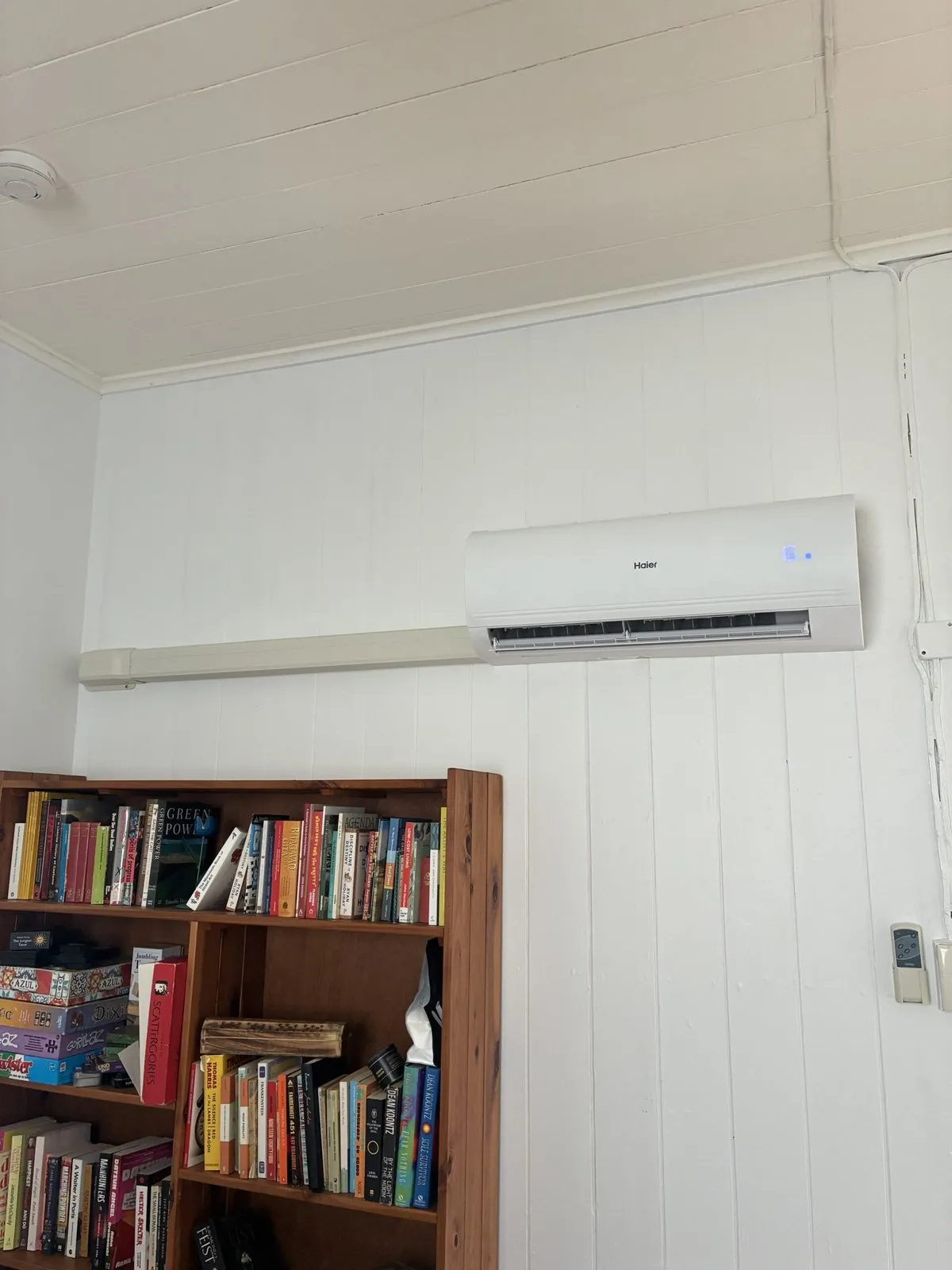
A 2.5 kW Haier from Bunnings might cost $800, while a 2.5 kW Daikin costs $1,400. The Haier has a lower energy rating (maybe 3 stars), while the Daikin is 5-6 stars. Over 10 years, the Haier costs $600+ more in electricity. The Daikin also lasts longer and runs quieter.
For a full brand comparison with real Brisbane pricing, check which split system brands are the most reliable and compare running costs over 10 years.
Mistake #3: Ignoring the Electrical Side
Split systems over 2.5 kW usually need a dedicated circuit from your switchboard. If your switchboard is old (fuse box, no safety switches), you’ll need an upgrade before installation. This can add $1,200-2,500 to the job.
Real example: I installed a 5.0 kW system in a 1980s Cleveland home last month. The switchboard was original with ceramic fuses. Had to upgrade to a modern circuit breaker board with a dedicated 20A circuit for the aircon. Total job: $3,800 (system + switchboard upgrade). If I’d quoted just the system at $1,800, the homeowner would’ve been blindsided.
For more on switchboard costs, see our switchboard upgrade cost guide.
Mistake #4: Sizing for the Whole House Instead of Room-by-Room
Some homeowners try to cool their entire house with one massive system in the hallway. This doesn’t work. Split systems are designed for single rooms or open-plan zones. If you want whole-home cooling, you need either multiple split systems or a ducted system.
The comparison: Three split systems (2.5 kW each for bedrooms, 5.0 kW for living) costs $5,000-7,000 installed. A ducted system for the same house costs $10,000-15,000+. Most Brisbane homes go with multiple splits — cheaper to install, cheaper to run (you only cool the rooms you’re using), and easier to maintain.
How to Calculate Your Exact Size (Step-by-Step)
Step 1: Measure Your Room
Length × width = floor area in m². For L-shaped rooms, break it into two rectangles and add them together.
Step 2: Start with the Base kW
Use the sizing chart above. For a 14 m² bedroom, start with 2.5 kW.
Step 3: Add for Ceiling Height
If your ceiling is 2.7m or higher, add 10% per 0.3m above 2.4m. A 2.7m ceiling = add 10% = 2.5 kW × 1.1 = 2.75 kW. Round up to 3.0 kW.
Step 4: Add for Poor Insulation or Large Windows
If your room has no wall insulation or large west/north-facing windows, add 0.5-1.0 kW. A 14 m² bedroom with 2.7m ceilings and a big west window = 3.0 kW + 0.5 kW = 3.5 kW.
Step 5: Check the Energy Rating
You can verify energy ratings on the official Energy Rating website, which provides detailed comparison tools for split system air conditioners.
Don’t just look at kW — look at the energy rating label. A 3.5 kW unit with a 6-star rating uses less electricity than a 3.5 kW unit with a 3-star rating. Over 10 years, that’s $800-1,200 in electricity savings.
For detailed running costs by size and brand, see our split system running costs guide.
Real Brisbane Examples: What I’ve Installed
Example #1: Capalaba Bedroom (1970s Home)
Room: 4m × 3.5m = 14 m²
Ceiling: 2.4m (standard)
Insulation: Minimal wall insulation, original ceiling insulation
Windows: One west-facing aluminium window (1.5m × 1.2m)
Calculation: 2.5 kW base + 0.5 kW for west window = 3.0 kW
Installed: Mitsubishi Electric 2.5 kW (actually 2.5 was enough because the window has an awning that blocks afternoon sun)
Cost: $1,650 fully installed with dedicated circuit
Example #2: Wellington Point Living Room (2000s Home)
Room: 6m × 5m = 30 m² open-plan
Ceiling: 2.55m (slightly higher)
Insulation: Good wall and ceiling insulation
Windows: Large north-facing sliding doors (3m × 2.1m)
Calculation: 5.0 kW base + 0.5 kW for high ceiling + 0.5 kW for large north windows = 6.0 kW
Installed: Daikin 6.0 kW
Cost: $2,400 fully installed (existing switchboard had capacity for dedicated circuit)
Example #3: Birkdale Master Bedroom (1980s Queenslander)
Room: 5m × 4.5m = 22.5 m²
Ceiling: 2.7m (highset Queenslander)
Insulation: No wall insulation, compressed ceiling batts
Windows: Two west-facing windows (total 3m × 1.2m)
Calculation: 3.5 kW base + 1.0 kW for high ceiling + 0.5 kW for west windows = 5.0 kW
Installed: Mitsubishi Heavy Industries 5.0 kW
Cost: $2,100 fully installed
What Happens If You Get the Size Wrong?
Too Small: The Slow Burn
- Runs constantly: The unit never reaches temperature, so the compressor runs 24/7. Your electricity bill doubles or triples.
- Never gets comfortable: On 35°C days, the room stays at 26-27°C no matter what you set the thermostat to.
- Kills the compressor: Continuous running wears out the compressor in 3-5 years instead of 10-15 years.
- High humidity: The unit can’t dehumidify fast enough, so the room feels clammy even when it’s “cool.”
Too Big: The Short-Cycle Problem
- Short-cycling: The unit cools the room in 5-10 minutes, turns off, then turns on again 10 minutes later. This on-off-on-off pattern wastes energy and stresses the compressor.
- Humidity problems: The unit cools fast but doesn’t run long enough to dehumidify properly. The room feels cold but clammy — like a poorly air-conditioned shop.
- Temperature swings: One minute it’s 22°C, ten minutes later it’s 25°C. Constant cycling creates uncomfortable temperature variations.
- Higher upfront cost: Bigger units cost more to buy and install. You’re paying for capacity you don’t need.
Split System vs Multi-Head vs Ducted: Which Is Right for Your Home?
Single Split System (One Room)
Best for: Cooling one bedroom, living room, or home office.
Cost: $1,300-3,500 installed.
Pros: Cheapest option, easy to install, energy-efficient (only cool what you use).
Cons: Only cools one room.
Multi-Head System (2-5 Rooms)
Best for: Multiple bedrooms or living zones.
Cost: $4,000-8,000 installed (one outdoor unit, 2-5 indoor units).
Pros: One outdoor unit (less visual impact), can cool multiple rooms, each room has independent temperature control.
Cons: More expensive than multiple single splits, if the outdoor unit fails, all indoor units stop working.
Ducted System (Whole Home)
Best for: Large homes, whole-home cooling, new builds.
Cost: $8,000-22,000 installed.
Pros: Cools entire home, hidden indoors (only vents visible), single thermostat control.
Cons: Expensive, requires roof space for ducts, harder to retrofit in existing homes, higher running costs if cooling unused rooms.
For a detailed comparison, see our split system vs ducted guide.
What Size Split System Do Most Brisbane Homes Need?
Based on 15+ years of installing air conditioners across the Redlands, here’s what I see most often:
- Bedrooms (12-18 m²): 2.5 kW is the sweet spot. Handles Brisbane humidity, cools quickly, runs quietly.
- Master bedrooms (18-25 m²): 3.5 kW. Larger rooms need the extra capacity, especially with ensuites or walk-in robes.
- Living rooms (25-40 m²): 5.0-6.0 kW. Open-plan living areas need bigger units, especially with high ceilings or large windows.
- Home offices (10-15 m²): 2.0-2.5 kW. Smaller rooms, but you want quiet operation and precise temperature control.
How Much Does It Cost to Run the Right Size?
A correctly sized split system in Brisbane costs roughly:
- 2.5 kW (bedroom): $0.20-0.30 per hour to run = $30-50 per month in summer
- 3.5 kW (master bedroom): $0.30-0.50 per hour = $50-80 per month
- 5.0-6.0 kW (living room): $0.50-0.75 per hour = $80-120 per month
These are real-world costs for Brisbane homes with proper insulation and modern inverter units. Older units or poorly insulated homes cost 30-50% more.
For a detailed breakdown by brand and size, see our split system running costs guide.
Common Mistakes When Choosing Split System Size
After installing hundreds of split systems across Brisbane, we see the same sizing mistakes over and over. Here’s what to avoid:
Buying Based on Price, Not Size
A 2.5kW system might be $500 cheaper than a 3.5kW, but if your room actually needs 3.5kW, you’ll pay for it in electricity bills and discomfort for years. The upfront saving is never worth it.
Ignoring Ceiling Height
Standard calculations assume 2.4m ceilings. If you have higher ceilings (common in older Queenslander homes), you need more capacity. A room with 3m ceilings has 25% more air volume to cool than one with 2.4m ceilings.
Forgetting About Heat Sources
Kitchens, home offices with multiple computers, or rooms with large windows facing west all generate extra heat. These rooms need additional capacity beyond the basic room size calculation.
Frequently Asked Questions
Can I install a split system myself?
No. In Queensland, split system installation must be done by a licensed electrician with an ARCtick refrigerant handling licence. DIY installation voids the warranty, can void your home insurance, and is illegal. The electrical connection requires a dedicated circuit and compliance certificate. Always hire a licensed professional.
How long does installation take?
A standard single split system takes 2-4 hours to install. This includes mounting the indoor unit, running refrigerant pipes through the wall, installing the outdoor unit, connecting the dedicated circuit, and testing. If you need a switchboard upgrade, add 2-3 hours.
Do I need a dedicated circuit for my split system?
Yes, for systems over 2.5 kW. The Queensland Building and Construction Commission requires all electrical work to be performed by licensed contractors. Split systems draw a lot of current when the compressor starts (up to 15 amps for a 5.0 kW unit). A dedicated circuit prevents overloading and tripping your breakers. If your switchboard is old, you may need an upgrade first — this costs $1,200-2,500.
What’s the best brand for Brisbane?
Daikin, Mitsubishi Electric, and Mitsubishi Heavy Industries are the top three for Brisbane homes. They handle humidity well, have high energy ratings (5-6 stars), and last 10-15 years with proper maintenance. Haier and TCL are budget options — cheaper upfront but lower energy ratings mean higher running costs.
How often should I service my split system?
Once a year, ideally in spring before summer. A service includes cleaning the filters, checking refrigerant levels, cleaning the coils, and inspecting the electrical connections. Cost: $150-250. Regular servicing keeps your system running efficiently and extends its life by 3-5 years.
Is it cheaper to leave the aircon on all day or turn it off?
In Brisbane summer, it’s cheaper to leave it on at a moderate temperature (24-26°C) than to turn it off and let the room heat up, then cool it down again. Modern inverter units use very little power to maintain temperature. Turning it off means the unit works flat out to cool the room when you turn it back on, which uses more energy.
Need a Licensed Split System Installer in Brisbane?
If you’re not sure what size split system you need, or you want a quote for installation, call Amplus Electrical & Air. I’m a licensed electrician and ARCtick-certified refrigerant handler based in Capalaba, working across the Redlands and Brisbane. I’ll assess your room, recommend the right size, and give you an upfront fixed quote.
Phone: 0419 014 146
Online booking: Book a free quote
Licence: Electrical Contractor Licence #1500996 | ARCtick Licence #L183747
We service Capalaba, Cleveland, Wellington Point, Ormiston, Birkdale, Thornlands, Victoria Point, Redland Bay, Sheldon, and all Brisbane suburbs.
Need a Licensed Electrician in Brisbane Bayside?
Aaron is a licensed electrician (Lic. 1500996) and ARC-certified A/C technician serving Capalaba, Cleveland, Wynnum, Manly, Birkdale, Thornlands, Victoria Point and surrounding suburbs. Honest advice, upfront pricing, and quality work guaranteed.