EV Charger Installers Near Me in Brisbane — Your Complete 2026 Guide
Looking for a licensed EV charger installer in Brisbane? Costs, charger brands like Zappi and Hypervolt, QLD regulations, and what to expect from your installer.
If you’re looking for a licensed EV charger installer in Brisbane, the short answer is this: choose a local electrician who can assess your switchboard, install a compliant dedicated circuit, confirm any current network or connection requirements where relevant, and give you a certificate of testing and safety. For most Brisbane homes, a compliant EV charger installation lands somewhere between $1,300 and $3,000 installed, depending on the charger, cable run, and whether your switchboard needs upgrading.
This guide covers what installation actually involves, what affects the price, which charger brands are worth considering, and how to choose a Brisbane EV charger installer who won’t cut corners. If you’re comparing bigger home-upgrade costs at the same time — like whether to install split system or ducted air conditioning — our air conditioning installation cost guide is a useful companion read.
How Do You Choose the Right EV Charger Installer in Brisbane?
Not all electricians have hands-on experience with EV charging systems. Here’s what separates a quality EV charger installer from a general sparky doing their first one.
What to Look for in an EV Charger Installer
- Queensland electrical contractor licence (non-negotiable — it’s illegal without one)
- Experience with switchboard assessments for EV load
- Knowledge of current Queensland EV-charging requirements, maximum demand and network considerations
- Familiarity with popular charger brands (Zappi, Hypervolt, Ocular, Wallbox, Tesla Wall Connector)
- Willingness to do a proper site assessment before quoting — not just a price over the phone
Red Flags When Choosing an Installer
- No compliance certificate provided after install
- Quoting without asking about your switchboard age or phase type
- Recommending a charger without checking your solar setup (if you have one)
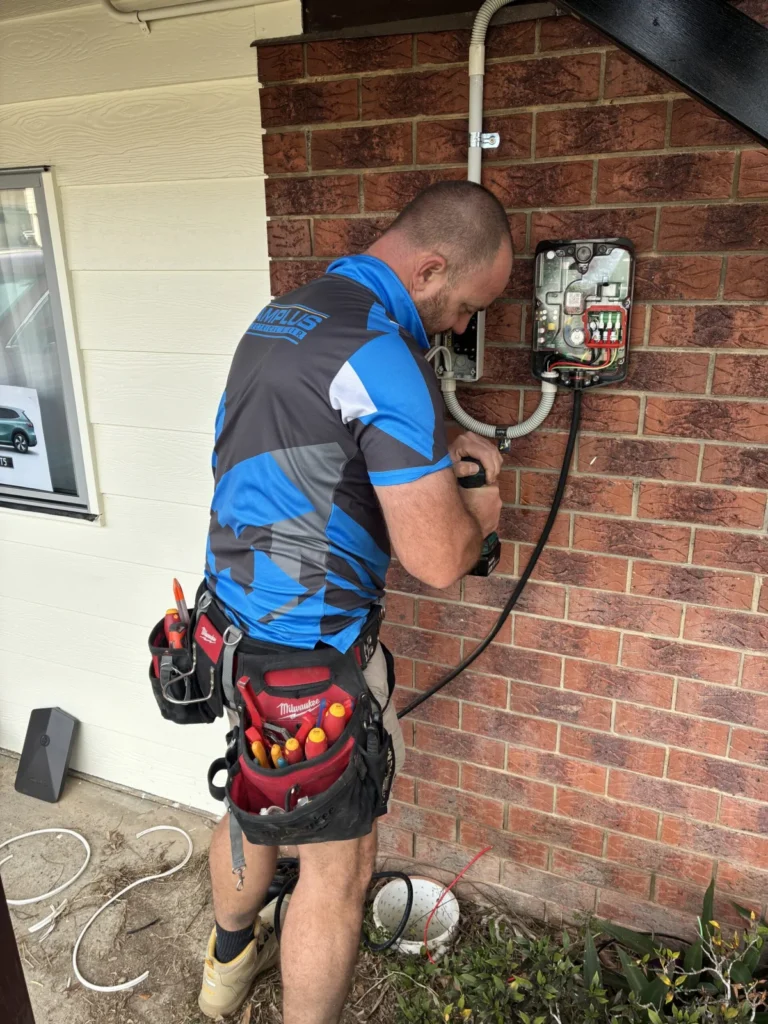
At Amplus Electrical, we assess your switchboard, phase supply, cable run distance, and existing solar before recommending a charger or quoting a price. Every install comes with a full compliance certificate.
How Much Does EV Charger Installation Cost in Brisbane?
For pricing, basic/simple installations start from $990. Most standard 7kW single-phase installations sit around $1,400–$2,200, while complex work — including some 22kW three-phase installations — can reach $2,400–$3,500. The final quote depends on the charger, cable route, switchboard, protection and property supply.
For a deeper breakdown of EV charger installation pricing in Brisbane, including 7kW vs 11kW vs 22kW comparisons, solar-aware chargers, and how each cost factor affects your final quote, see the 2026 cost guide.
For the complete walkthrough — from choosing the right charger to understanding installation day — read our comprehensive EV charger installation in Brisbane guide.
What Drives the Price Up or Down?
- Cable run length — Short runs under 10 metres keep costs low. Longer runs (20m+) or routing through brick walls add labour and materials.
- Switchboard condition — Modern boards with spare slots are straightforward. Older boards with ceramic fuses need a switchboard upgrade first (add $900–$2,000).
- Phase type — Single-phase (most homes) is standard. Three-phase gives faster charging options but costs more to wire.
- Charger brand — Budget units start around $600. Premium smart chargers with solar integration run $1,500+.
- Mounting location — Simple garage wall mount vs outdoor pedestal or complex cable routing.
The hidden cost nobody mentions: a quote can look cheap because it excludes switchboard work, protection, longer cable routes, trenching, testing or other site-specific requirements. Ask for a written breakdown of the charger, circuit and protection, cable route, labour, testing, certification and any network or connection steps that apply to your property.
Are There “Approved” EV Charger Installers in Brisbane?
In Australia, there’s no special “EV charger accreditation” like there is for solar (CEC). Any licensed electrical contractor can legally install an EV charger. However, “approved” matters in two ways:
- Manufacturer-approved: Some brands (like Tesla) have preferred installer networks. This can matter for warranty claims.
- Network-aware: Your installer should explain any current Energex or other network requirements that apply to the installation, rather than making a blanket promise about notification.
What Makes an Installer Genuinely Qualified?
- Understands AS/NZS 3000 (Wiring Rules) and AS/NZS 61851 (EV charging systems)
- Understands when smart charging, load management or other network-aware features may be useful, without treating them as automatically required for every home
- Provides the relevant testing records, certificate and installation documentation
- Has done enough installs to spot switchboard issues before they become problems
Amplus Electrical is a licensed Queensland electrical contractor. We assess the property, install compliant equipment, explain any applicable network or connection requirements, and provide full documentation. Learn more about our EV charger installation service.
Is Zappi a Good Choice for Brisbane EV Owners?
The Zappi by Myenergi is one of the most popular chargers in Australia for homeowners with solar panels. Here’s why:
Why People Love the Zappi
- Solar diversion mode — charges your car using excess solar power instead of exporting back to the grid. You’re essentially charging for free during the day.
- Three charging modes: Fast (full grid power), Eco (mix of solar + grid), and Eco+ (solar only)
- No internet required — works via CT clamp on your meter, not cloud-dependent
- 7kW or 22kW options (single-phase or three-phase)
Zappi Installation Considerations
- Requires a CT clamp on your main supply cable (adds ~15 min to install)
- Best positioned where the cable run from your meter board is short
- If you have solar, your installer needs to understand how the CT clamp reads generation vs consumption
Is it worth the premium? If you have solar: absolutely. The payback from charging on free solar vs. grid power is significant. If you don’t have solar, a standard smart charger will do the same job for less. Our free solar EV charging Brisbane guide shows you exactly how much you can save per year depending on your driving habits.
Is Hypervolt a Good EV Charger Option?
Hypervolt is a newer brand gaining traction in Australia. It’s a sleek, compact unit with solid smart features.
Hypervolt Highlights
- Built-in energy monitoring (no separate CT clamp needed on some models)
- App-controlled scheduling — set it to charge during off-peak tariffs (Energex Tariff 12A: 10pm–7am)
- Solar compatible with firmware updates
- Compact, modern design (smaller footprint than Zappi)
- Smart charging features that can support scheduling, monitoring or load management where the property and charging setup call for them
Who it suits: Homeowners who want a clean-looking, app-controlled charger with smart scheduling but don’t necessarily need full solar diversion. It’s a strong mid-range option.
Can You Save Money on EV Charger Installation Without Cutting Corners?
Yes — but know where the savings come from and where they shouldn’t.
Where You Can Legitimately Save
- Choose a quality budget charger ($600–$800 range) if you don’t need solar diversion or app control
- Keep the cable run short — install the charger on the garage wall closest to your meter board
- If your switchboard is modern and has spare slots, you avoid the upgrade cost entirely
Where You Should NOT Cut Costs
- The installer’s licence and experience (unlicensed work can create serious safety, compliance and insurance problems)
- Proper testing, documentation and certification
- Any applicable network or connection requirement — ask what applies to your property
- RCD protection on the EV circuit (safety-critical)
Bottom line: A properly installed budget charger by a licensed electrician beats a premium charger installed by someone cutting corners. The install quality matters more than the charger brand.
What Does an EV Charger Installation Actually Involve?
Here’s what happens when you book an EV charger install with a qualified Brisbane electrician:
Step 1: Site Assessment
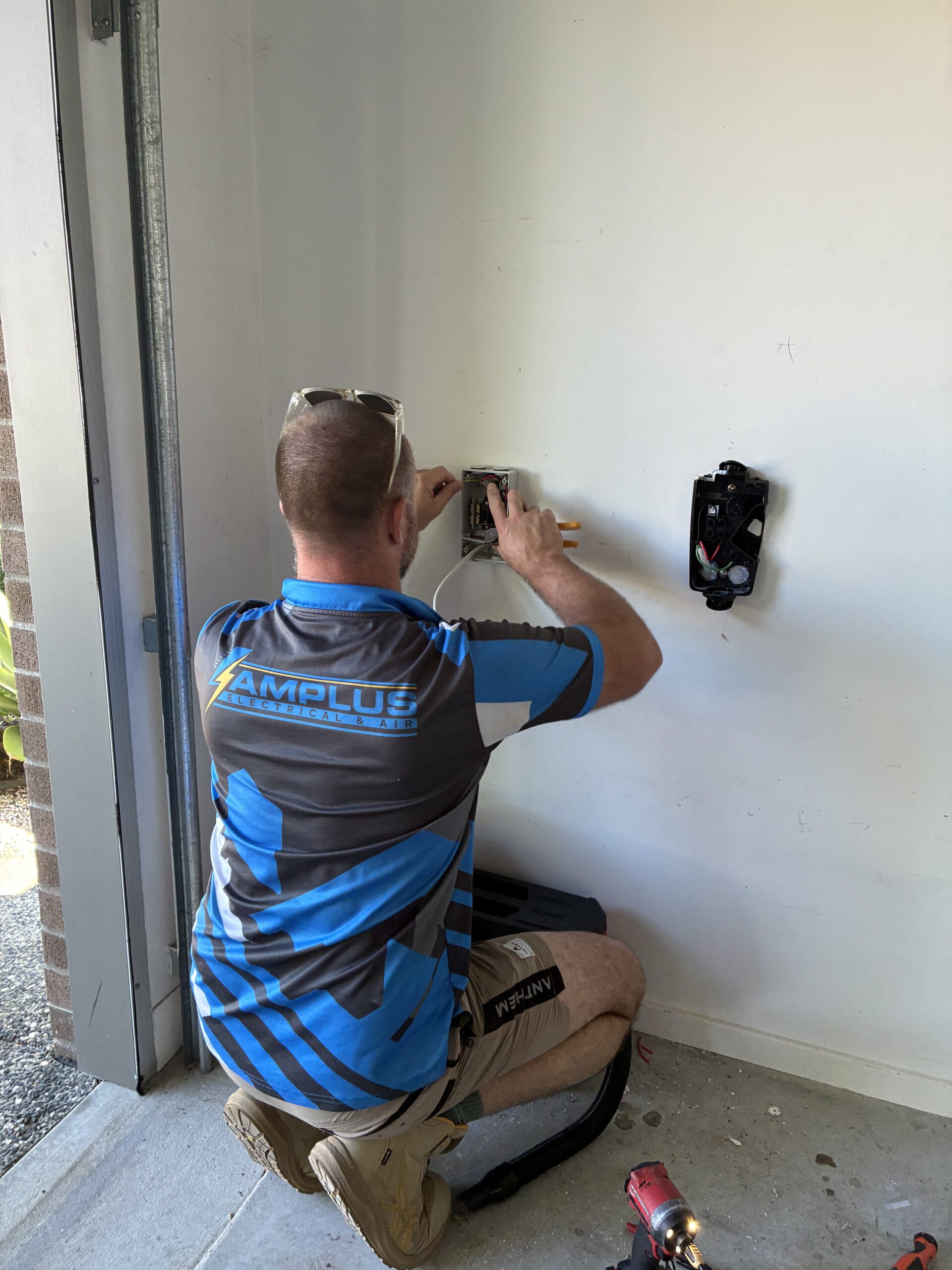
- Check your switchboard (age, spare capacity, RCD protection, phase type)
- Measure the cable run from meter board to your preferred charger location
- Check if your home has single-phase or three-phase supply
- Assess your solar system (if applicable) for integration options
Step 2: Quote & Charger Selection
- Recommend a charger based on your car, driving habits, solar setup, and budget
- Provide a fixed-price quote covering all materials and labour
- Explain any switchboard work needed
Step 3: Installation Day (Typically 2–4 Hours)

- Install dedicated circuit breaker and RCD in your switchboard
- Run cable from switchboard to charger location
- Mount and wire the charger unit
- Install CT clamp if required (Zappi or solar-diverting chargers)
- Test, commission, and pair with your phone app
- Complete compliance certificate
Step 4: Compliance, testing and any network requirements
- Complete the required electrical testing and commissioning
- Provide the relevant certificate and installation documentation
- Confirm any current DNSP, connection or notification requirement that applies to the property and charger
Why Choose a Brisbane-Based EV Charger Installer?
Going local matters more than you’d think:
- Site assessment in person — no guessing cable runs or switchboard condition from photos
- Local follow-up support — if something needs adjusting post-install, you can deal with the same Brisbane-based team
- Brisbane-specific knowledge — we know which suburbs have older switchboards (Queenslanders in Paddington, New Farm, Ascot), which areas are single-phase vs three-phase, and current local network and connection requirements
- Warranty service — if your charger has an issue, a local installer can diagnose and swap it without waiting weeks
Amplus Electrical is based in Brisbane and services the greater Brisbane region including Capalaba, the Redlands, Cleveland, and surrounding suburbs. We’re not a call centre dispatching random contractors — we’re the electricians who show up and do the work.
For Bayside-specific detail on the homes and switchboards we work with, see the EV charger installation across the Redlands guide.
Queensland EV Charger Regulations You Need to Know (2026)
Queensland’s EV-charging requirements are changing, but the practical rule for choosing an installer remains simple: the charger must be suitable for the property, installed on a correctly designed circuit, tested and documented.
The 1 October 2026 change
The former blanket 20A/active-device-management framing for standard single-phase home EV charger installations changes from 1 October 2026. A 32A charger — approximately 7.4kW — may be suitable for some homes without that older network-management arrangement. That does not mean every property can automatically take 32A, or that every network, connection or notification requirement has disappeared.
What a good installer still checks
- Maximum demand alongside air conditioning, hot water, cooking, pool equipment, solar, batteries and other large loads
- Switchboard condition, main switch and service capacity, phase supply and available space
- Dedicated circuit, cable sizing, voltage drop, isolation, earthing and appropriate RCD/RCBO protection
- The vehicle’s onboard AC charging limit — a 32A wall charger does not make every vehicle charge at 7.4kW
- Any current Energex/DNSP connection, metering or notification requirement that applies to the installation
When smart charging or load management may still help
Load management can still be useful where the property has limited supply capacity, several large simultaneous loads, two EVs, solar and battery coordination, or where it avoids a more expensive supply upgrade. It is a design option, not a blanket substitute for assessment.
Electrical compliance
- Dedicated circuit with correctly selected protection
- RCD/RCBO protection appropriate to the charger and installation
- Correct cable sizing for the run length, installation method and load
- Proper earthing, testing, commissioning and certification
All of this is standard practice for any competent electrician — but worth knowing so you can ask the right questions. For more on safety switches, see our guide on how often to test safety switches in Queensland.
Ready to Install an EV Charger at Home?
Getting a home EV charger installed in Brisbane doesn’t need to be complicated. The right installer will assess the property, recommend a charger that suits your vehicle and electrical setup, complete the installation and testing, and explain the documentation and any network steps that apply.
Amplus Electrical & Air is a licensed Queensland electrical contractor specialising in EV charger installations across Brisbane. We install all major brands including Zappi, Hypervolt, Wallbox, Ocular, and Tesla Wall Connectors.
What You Get with Amplus
- Free site assessment and fixed-price quote
- Licensed, insured installation with full compliance certificate
- Applicable network or connection requirements explained and handled where required
- Switchboard upgrades if needed (no subcontracting — we do it all)
- Ongoing support from a local Brisbane team
Book your free EV charger assessment today →
Related reading: If you want a deeper technical breakdown of amps, AC vs DC charging, ATO tax treatment, and smart home integration, read our EV Home Charging Australia guide.
Common Mistakes Homeowners Make When Choosing an EV Charger Installer
After completing EV charger installations across Brisbane, we’ve seen homeowners make the same avoidable mistakes. Here’s what to watch out for:
Mistake #1: Choosing the Cheapest Quote Without Asking What’s Included
A $1,200 quote might look attractive until you realise it doesn’t include testing, certification, network or connection steps where applicable, or RCD protection. Always ask for a detailed breakdown of what’s included before booking.
Mistake #2: Not Checking if the Installer Has Actually Done EV Charger Work Before
Any licensed electrician can legally install an EV charger, but that doesn’t mean they’ve done it before. Ask how many EV chargers they’ve installed in the last 12 months. If the answer is “a few” or “not many yet,” you’re essentially their guinea pig. You want someone who’s done this enough times that the process is second nature.
Mistake #3: Forgetting to Ask About Post-Installation Support
What happens if your charger stops working three months later? Is the installer still around to help, or did they quote so low they’ll be out of business by then? A reputable Brisbane installer will be around for warranty work, troubleshooting, and any adjustments you need as your EV habits evolve.
Mistake #4: Buying the Charger Yourself to “Save Money”
This seems logical until you realise the installer won’t warranty work done on equipment they didn’t supply. If the charger has a fault, the manufacturer will deal with you directly, and your installer will charge you hourly to diagnose whether it’s the charger or the installation. It’s cleaner to let your installer supply and warrant the whole package.
Mistake #5: Ignoring the Switchboard Assessment
If an installer quotes you a price without asking to see your switchboard, they’re guessing. They might turn up on installation day and tell you it’ll cost an extra $1,500 for a switchboard upgrade you didn’t budget for. A proper site assessment upfront prevents these surprises.
What to Expect During Your EV Charger Site Assessment
A thorough site assessment should take 20-30 minutes and cover these key areas:
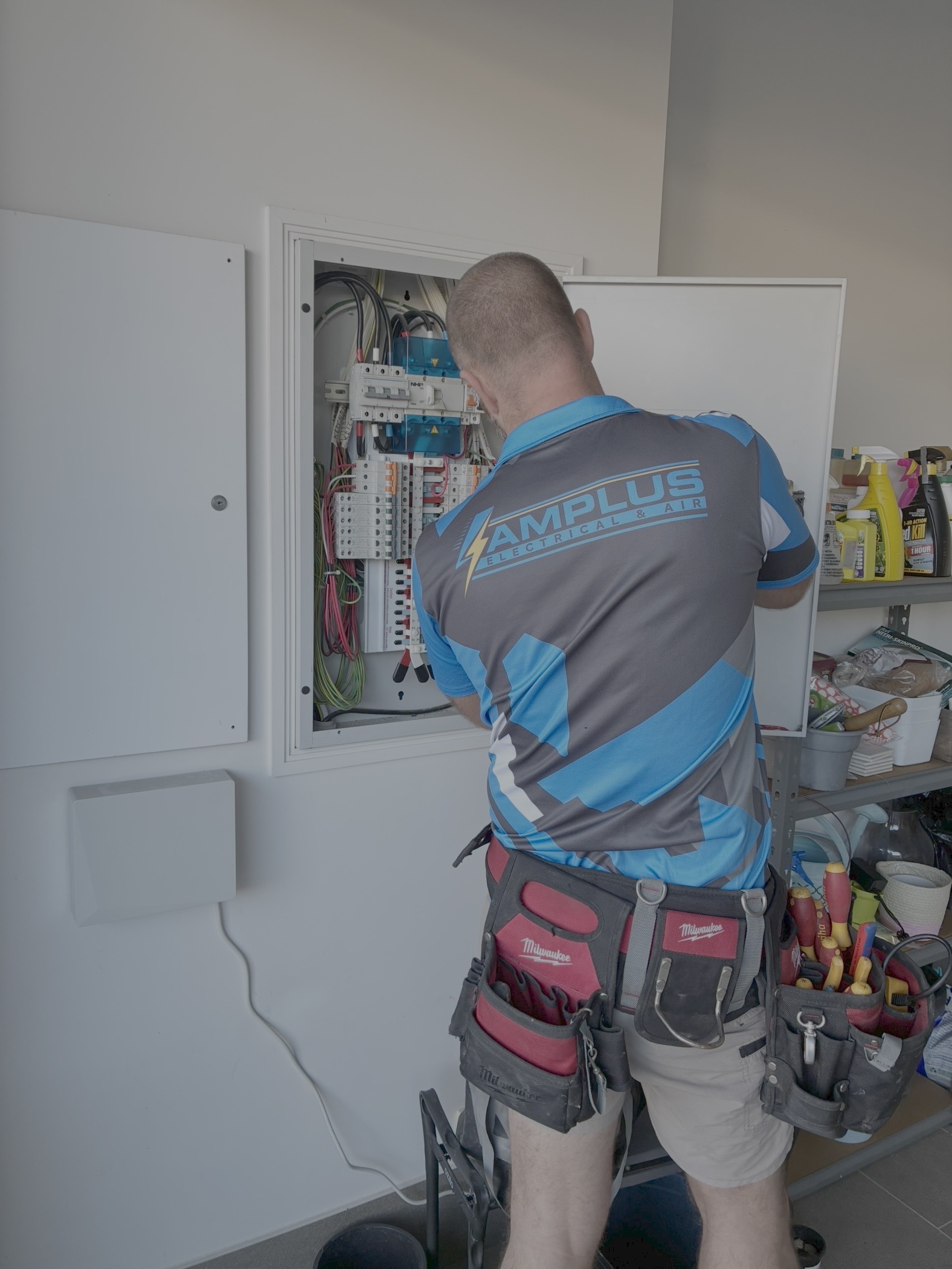
Switchboard Inspection
Your installer will check the age of your switchboard, whether it has spare capacity for a dedicated EV circuit, if it has RCD protection, and whether it’s single-phase or three-phase. If your switchboard is over 20 years old or has ceramic fuses, it will likely need upgrading before an EV charger can be safely installed.
Cable Run Measurement
The distance from your switchboard to your preferred charger location affects the cost. Short runs under 10 metres are straightforward. Longer runs (20+ metres) or runs that require drilling through brick walls or concrete slabs add labour and materials. Your installer will measure this and factor it into the quote.
Charger Location Discussion
Where do you park your EV? Is it in a garage, carport, or outdoor space? Your installer will discuss the best location for the charger based on cable length, weather protection, and convenience. They’ll also check if the wall structure can support the charger unit.
Solar System Assessment (If Applicable)
If you have solar panels, your installer will check your inverter type, system size, and whether a solar-diverting charger like the Zappi would be suitable. They’ll explain how the CT clamp works and where it needs to be installed to read your solar generation accurately.
Fixed-Price Quote
After the assessment, your installer should provide a fixed-price quote that includes the charger unit (if they’re supplying it), all materials, labour, testing, certification and any known network or connection steps. There should be no hidden extras unless something unexpected is discovered during installation (like hidden asbestos in the wall cavity, which is rare but possible in older Brisbane homes).
Frequently Asked Questions About EV Charger Installation
How long does EV charger installation take?
Most standard installations take 2–4 hours. If a switchboard upgrade is needed, allow a full day.
Can I install an EV charger myself?
No. Fixed-wiring EV charger work must be carried out by a licensed electrician in Queensland. DIY work can create electrical-safety, compliance, warranty and insurance problems.
Do I need to upgrade my switchboard for an EV charger?
Not always. If your switchboard is modern with spare capacity and RCD protection, you’re likely fine. Older boards with ceramic fuses will need upgrading — which is a safety improvement for your whole house. Read more about signs your switchboard needs replacing.
What’s the best EV charger for solar owners?
The Zappi by Myenergi is the standout for solar diversion. It can use surplus solar generation for charging when the home and vehicle setup allow it, reducing grid energy use.
Is a 7kW charger fast enough?
For most people, yes. A 7kW charger adds roughly 40–50km of range per hour. Plug in when you get home, wake up to a full battery. Unless you’re driving 200+ km daily, 7kW overnight is more than enough.
Do I need three-phase power for an EV charger?
No. Most Brisbane homes are single-phase and a 7kW single-phase charger is perfectly adequate for daily driving. Three-phase (22kW) is only worth considering for commercial use or if you already have three-phase supply.
What’s the difference between Level 1 and Level 2 charging?
Level 1 is a standard 10A power point — painfully slow (8–12km range per hour). Level 2 is a dedicated wall charger on its own circuit — 5 to 7 times faster. Every EV owner who drives daily should have Level 2 at home.
Will an EV charger increase my electricity bill?
Yes, but far less than petrol costs. Charging a typical EV costs roughly $4–$6 per 100km on grid power. With solar and off-peak tariffs, it can drop below $2 per 100km. Compare that to $12–$18 per 100km for petrol.
Find Your Local EV Charger Installer
We install EV chargers across Brisbane Bayside, the Redlands, and the inner-east. Visit your suburb page for property-specific guidance and local service availability.
For a full guide to air conditioning installation professionals in Brisbane, see our complete Brisbane air conditioning installation guide.