EV Home Charging Australia — Amps, AC vs DC, ATO Benefits & Apps Explained (2026)
Everything Australian EV owners need to know about home charging — amps, AC vs DC, ATO benefits, smart apps, and how to set it up properly.
If you want the short version first: home EV charging in Australia is AC charging, most households are best served by a 7kW single-phase charger, and there are real ATO and salary-packaging tax advantages if the vehicle is used the right way. Check your home’s EV readiness before you buy to avoid unexpected upgrade costs.
You’ve bought an EV — or you’re about to. Now you’re Googling things like “how many amps does a home charger need”, “is home charging AC or DC”, and “can I claim it on tax through the ATO”.
This is the most comprehensive guide to EV home charging in Australia. It answers the technical and financial questions that most articles skip. It’s not about choosing an installer or comparing brands — we’ve already written that guide. This is about understanding what’s actually happening when you plug in at home, what your house needs, and how to make it as cheap as possible.
Why This Guide Exists
How EV Home Charging Actually Works
Your EV has a built-in component called an onboard charger. It converts AC power from the grid into DC power for the battery. When you plug in at home, you’re feeding AC power to that onboard charger — the charger on the wall is really just a smart power delivery device (technically called EVSE — Electric Vehicle Supply Equipment).
This is an important distinction: the “charger” on your wall doesn’t charge your car directly. It delivers power safely to your car’s internal charger, which does the actual work. The Australian Government’s energy.gov.au has a good primer on charging equipment types if you want the official overview.
AC vs DC Charging — What You’re Actually Getting at Home
This is one of the most searched questions about EV charging, and the answer is straightforward:
Home charging is always AC.
- AC (Alternating Current) is what comes out of every power point and switchboard in Australia. Your home charger delivers AC power to your car’s onboard charger, which converts it to DC to store in the battery.
- DC (Direct Current) fast charging bypasses the car’s onboard charger entirely and feeds power straight into the battery at 50kW–350kW. These are the large commercial units at highway stops and shopping centres. They cost $50,000+ and require commercial-grade three-phase power — they’re not a residential option.
Why does this matter? Because the speed of your home charging is limited by your car’s onboard charger capacity, not just the wall unit. Most EVs have a 7kW or 11kW onboard charger. Even if you install a 22kW wall unit, a car with a 7kW onboard charger will only draw 7kW. Check your vehicle’s specs before deciding what charger to buy.
Amps Explained — What Your Home Actually Needs
Amps determine how much power your charger can deliver. Here’s what the numbers mean in real terms for Australian homes:
Single Phase Charging (230V — Most Australian Homes)
| Amps | Power (kW) | Range Added Per Hour | What It Is |
|---|---|---|---|
| 10A | 2.3kW | ~10km | Standard power point — painfully slow |
| 15A | 3.5kW | ~15km | Dedicated 15A outlet — slightly less slow |
| 32A | 7.4kW | ~35km | Dedicated Level 2 wall charger — the sweet spot |
Three Phase Charging (400V)
| Amps Per Phase | Power (kW) | Range Added Per Hour |
|---|---|---|
| 16A | 11kW | ~55km |
| 32A | 22kW | ~110km |
Continuous Load: The 80% Rule
Here’s something most guides don’t mention: EV charging is classified as a continuous load under Australian wiring rules (AS/NZS 3000:2018). A continuous load is anything that runs for more than 4 hours.
This means the circuit must be rated at 125% of the charger’s draw — the same electrical capacity planning applies whether you’re installing an EV charger or an air conditioning system. See our split system vs ducted air conditioning guide for help planning your home’s cooling needs. 125% of the charger’s draw. A 32A charger needs a 40A circuit breaker. This isn’t optional — it’s a safety requirement that your electrician should handle automatically, but it’s worth understanding why your quote might mention a “40A breaker” for a “32A charger”.
The same capacity planning applies to other major electrical upgrades. If you’re considering switching from halogen to LED downlights, our halogen vs LED downlights technical guide explains the power requirements and circuit considerations for lighting upgrades.
What Does Your Switchboard Need?
- Modern homes (post-2000): Typically 80A–100A main switches. A 32A EV circuit fits with room to spare alongside your other circuits.
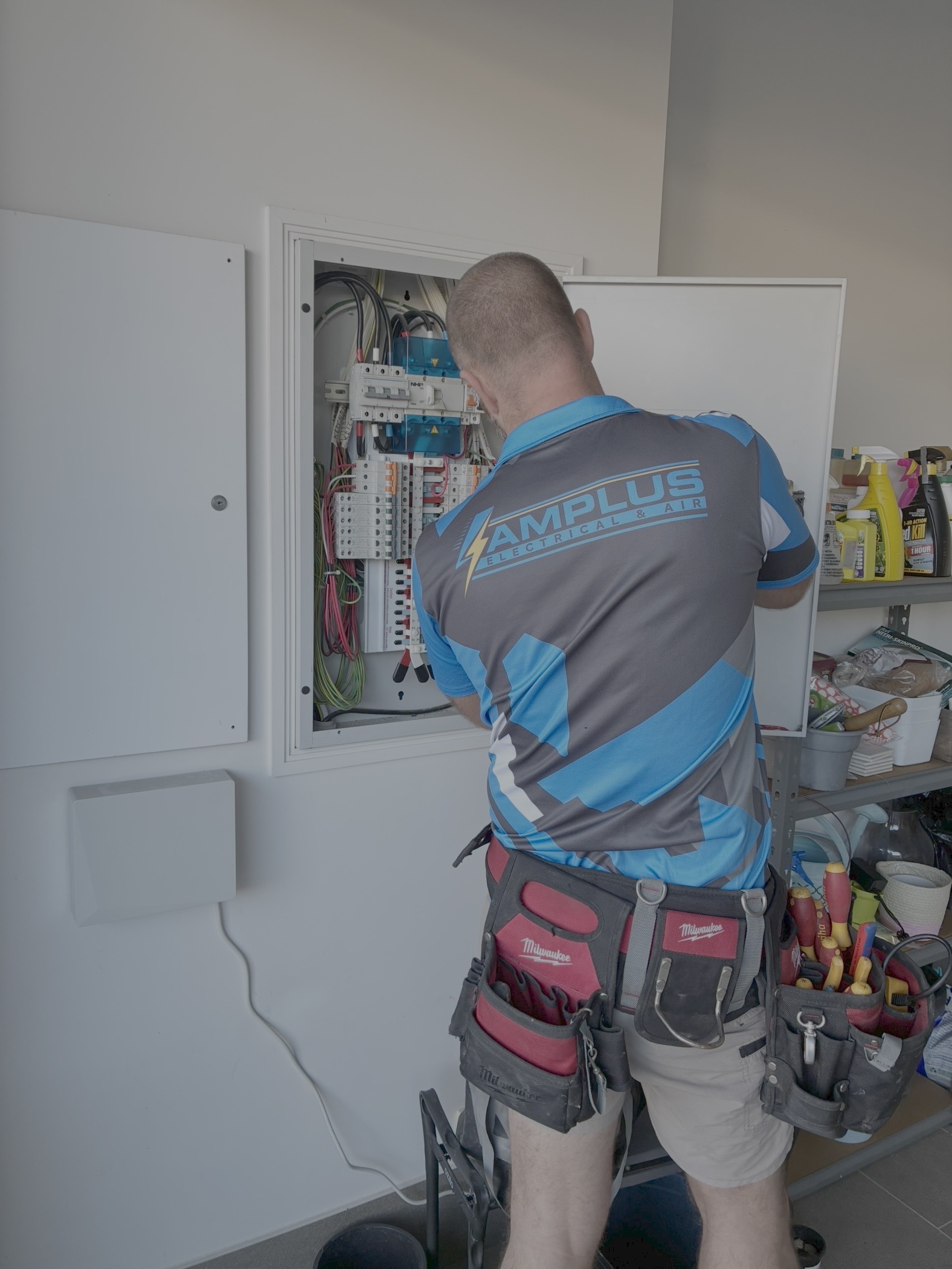
- Older homes (1970s–90s): Often 60A main switches or ceramic fuse boards. A switchboard upgrade is usually needed before adding an EV charger. Not sure if yours needs replacing? Check our guide on signs your switchboard needs replacing.
- Three phase homes: Already have significantly higher capacity. A 22kW charger uses 32A per phase — well within the typical 63A-per-phase supply.
Critical point: Never assume your switchboard can handle it. Adding a 32A circuit to a maxed-out board is a fire hazard. A licensed electrician must assess available capacity before any EV charger work begins.
ATO Tax Benefits for EV Home Charging
This is where real money comes back to you. The ATO has established clear guidelines for EV charging — and most Australians don’t know about them yet.
The FBT Exemption — The Big One
Under the Electric Car Discount (effective 1 July 2022), eligible EVs provided through salary sacrifice or as company cars are completely exempt from Fringe Benefits Tax. Depending on the vehicle, this saves employees $5,000–$15,000 per year — effectively making an EV cheaper than the equivalent petrol car when salary packaged.
Eligibility requirements:
- Zero or low-emission vehicle (BEV or PHEV)
- First held and used on or after 1 July 2022
- Below the luxury car tax threshold for fuel-efficient vehicles ($91,387 for 2025–26)
Full details on the ATO’s electric cars exemption page.
Home Charging Electricity — The 4.20c/km Rate
Under ATO Practical Compliance Guideline PCG 2024/2, there’s now a simple shortcut method for calculating home charging costs:
- Rate: 4.20 cents per kilometre travelled
- For FBT: Employers can reimburse employees for home EV charging using this rate as an exempt car-expense payment benefit
- For income tax: If you use your EV for work travel and charge at home, you can claim at this rate as a deduction
- Evidence: You need odometer records. The ATO extended transitional rules for keeping records, but a logbook is the safest approach
To put this in perspective: 20,000km of work travel = $840 in deductible charging costs using the shortcut method.
The Home Charger Itself — How It’s Classified
The ATO has specifically clarified that a home charging station is NOT a car expense. It’s classified as either:
- A property fringe benefit (if employer provides the charger), or
- An expense payment fringe benefit (if employer reimburses the cost)
This is a separate category from the EV’s FBT exemption. Whether it’s also FBT-exempt depends on how the purchase is structured — your accountant can advise on the optimal approach for your situation.
Instant Asset Write-Off for Business
If you’re a sole trader or small business purchasing an EV charger for your business premises, you may be able to claim it under the instant asset write-off — currently for assets under $20,000 for businesses with turnover under $10M. See the ATO’s instant asset write-off page for current thresholds.
Bottom line: Between the FBT exemption on the car, the 4.20c/km home charging rate, and potential write-offs on the charger itself, running an EV through your business or salary package is significantly tax-advantaged. Talk to your accountant — this is one of the few areas where the tax system actually works in your favour.
EV Charging Apps — What Actually Matters
Every smart charger comes with a manufacturer app. Some are excellent. Some are barely functional. Here’s what’s available and what features are actually worth caring about.
Manufacturer Apps for Home Chargers
| App | Works With | Standout Feature |
|---|---|---|
| Tesla | Tesla Wall Connector | Seamless integration if you own a Tesla — scheduling, solar tracking, charge history all in one place |
| myWallbox | Wallbox Pulsar Plus/Max | Power Sharing — automatically balances load across multiple chargers (great for two-EV households) |
| Fronius Solar.web | Wattpilot | Best-in-class solar surplus charging — genuinely intelligent solar-to-EV management |
| myenergi | Zappi | Three charging modes (Fast/Eco/Eco+) — Eco+ charges purely from solar with no grid draw |
| Evnex | Evnex E2 | Dynamic load management built in — prevents overloading your switchboard automatically |
| Hypervolt | Hypervolt Home | Built-in energy monitoring without needing a separate CT clamp |
The Features That Actually Save You Money
- Scheduled charging — This alone can save you 30–50% on charging costs. Set your charger to run during off-peak tariff hours (Energex Tariff 12A: 10pm–7am) when electricity drops from ~35c/kWh to ~18c/kWh. Most EVs also have built-in scheduling, so you’ve got a backup if the app is clunky.
- Solar surplus charging — If you have solar panels, this feature only charges when your panels are producing more than your house is using. In Brisbane, a 6.6kW system typically exports 15–25kWh on a good day — enough to add 75–125km of range from surplus solar.
- Energy monitoring — Track exactly how much electricity your EV uses and what it costs. Essential for claiming the ATO’s 4.20c/km rate with confidence.
What About OCPP?
OCPP (Open Charge Point Protocol) is an open communication standard for EV chargers. The Open Charge Alliance maintains the standard (currently OCPP 2.1). Why should you care?
- A charger with OCPP isn’t locked to the manufacturer’s app or cloud platform
- If the company goes bust or discontinues the app, your charger still works with alternative platforms
- It’s required for compliance with Queensland’s 2025 demand-response regulations
- It enables integration with third-party energy management systems (including Home Assistant)
Our recommendation: Always choose an OCPP-capable charger. It’s future insurance that costs nothing extra.
Public Charging Apps (For Away from Home)
When you’re not charging at home, these are the apps Brisbane EV owners use most:
- PlugShare — The biggest charger database. Community-updated with real-time availability.
- Chargefox — Australia’s largest fast-charging network. Essential for road trips.
- Ampol AmpCharge — Growing network at Ampol service stations across QLD.
- Zuup Roam — Aggregates multiple smaller networks into one app (launched Dec 2025).
Smart Home Integration — EV Charging with Home Assistant
If you run Home Assistant (the open-source smart home platform), you can build genuinely intelligent charging automation that goes well beyond what any manufacturer app offers.
What Home Assistant Adds Over Manufacturer Apps
- Real-time solar surplus charging — Adjust charging amps every few seconds based on actual PV production and household consumption, not the charger’s built-in estimate
- Home battery coordination — Prioritise filling your home battery during peak tariff hours, then shift EV charging to overnight or next-day solar
- Dynamic load management — Monitor your entire switchboard draw in real time and throttle the EV charger when other high-draw appliances kick in (air con, oven, pool pump). Prevents main breaker trips without needing an expensive hardware DLM device.
- Cost optimisation — Pull real-time pricing from Amber Electric or time-of-use tariff schedules and only charge when power is cheapest
- Cross-device automation — “If it’s sunny tomorrow (BOM forecast), delay overnight charging and wait for solar” — no manufacturer app can do this
Best Chargers for Home Assistant Integration
- Wallbox Pulsar Plus/Max — Native Home Assistant integration via cloud API
- Fronius Wattpilot — Local Modbus/API, no cloud dependency, excellent for solar
- OpenEVSE — Fully open-source hardware and software, deepest HA integration available
- go-e Charger — Local HTTP API, very popular in the HA community
- Any OCPP charger — Via the OCPP Home Assistant integration
The HACS Integration: EV Smart Charger
A purpose-built Home Assistant integration (available via HACS) specifically for solar-aware EV charging:
- Solar surplus detection with automatic charging rate adjustment
- Home battery SOC coordination — doesn’t steal from your Powerwall
- Overnight catch-up charging based on tomorrow’s weather forecast
- All processing runs locally — no cloud, no latency, no privacy concerns
Reality check: Home Assistant integration is for people who already run HA and want to squeeze every dollar of value from their solar. If you just want to plug in and charge overnight on a schedule, the manufacturer’s app does the job perfectly well.
Charging Costs Compared: Grid vs Solar vs Off-Peak
Here’s what it actually costs to charge an EV at home in Queensland, based on a typical 60kWh battery and common Energex tariffs:
| Charging Method | Rate (per kWh) | Cost for Full Charge | Cost per 100km |
|---|---|---|---|
| Peak grid (Tariff 11, daytime) | ~35c | $21.00 | ~$5.25 |
| Off-peak (Tariff 12A, 10pm–7am) | ~18c | $10.80 | ~$2.70 |
| Excess solar (self-consumed) | ~0c* | $0 | ~$0 |
| Feed-in tariff offset** | ~7c | $4.20 | ~$1.05 |
*You still pay the daily supply charge; the marginal energy cost is near zero when charging from surplus solar.
**Opportunity cost: you’re using solar that would otherwise earn ~7c/kWh feed-in.
Compare to petrol: A typical petrol car costs $12–$18 per 100km at current Brisbane fuel prices. Even charging from the peak grid is less than half the cost. On solar, you’re driving for essentially nothing.
This is the fundamental economic argument for EV home charging in Australia — and why fuel prices being through the roof are pushing so many Australians to make the switch.
If you’re weighing the move, the cost of installing an EV charger in Brisbane is the other half of the equation — what you pay once upfront versus what you save every week on fuel.
Beyond EV charging, other electrical upgrades like LED lighting can also significantly reduce your energy costs. Our technical comparison of halogen vs LED downlights shows how switching to LED can cut lighting energy use by up to 80%.
Electrical Safety & Compliance for EV Charging
EV charger installation is regulated electrical work in Australia. Here’s what the rules require — and why cutting corners is genuinely dangerous.
Australian Standards That Apply
- AS/NZS 3000:2018 (Wiring Rules) — The foundation of all electrical installation work. Governs circuit protection, cable sizing, earthing, and the continuous load requirements discussed above.
- AS/NZS 3008 — Cable selection and current-carrying capacity. Determines what gauge cable your electrician runs based on distance and load.
- AS 61851 — Specific to EV charging equipment. Covers communication between the charger and vehicle, safety interlocks, and fault protection.
What Must Be in Place
- Dedicated circuit — Your EV charger must be on its own circuit, not shared with other outlets or appliances
- RCD protection — A dedicated safety switch (RCD) is required on the EV circuit. Read our guide on how often to test safety switches in Queensland.
- RCM mark — The charger itself must carry the Regulatory Compliance Mark, confirming it meets Australian electrical safety standards
- DNSP notification — In South East Queensland, Energex must be notified before installing chargers above 20A single-phase. Your electrician should handle this as part of the install.
- Compliance certificate — You must receive a Certificate of Compliance for Electrical Work (CCEW) on completion. Keep this — you’ll need it for insurance and if you sell the house.
Self-installation is illegal in Australia. All fixed electrical work must be completed by a licensed electrical contractor — in Queensland, licensing is administered by the Electrical Safety Office under the Electrical Safety Act 2002. There are no exceptions for EV chargers.
If you’re in the Bayside, the Redlands suburb-by-suburb EV charger guide covers what an install actually involves on different home types around Capalaba, Cleveland, Wellington Point, Redland Bay and the rest of the Redlands.
Common Mistakes to Avoid
- Buying a charger before checking your switchboard — If your board needs a switchboard upgrade, that changes the budget and timeline. Assessment first, purchase second.
- Choosing a non-OCPP charger — Queensland’s demand-response rules require smart capability. A “dumb” charger off Amazon might be cheap now but will cause compliance headaches later.
- Ignoring your car’s onboard charger limit — A 22kW wall charger is wasted money if your car only accepts 7kW. Check your vehicle specs.
- Skipping off-peak tariffs — Charging on peak rates costs almost double. Even without solar, scheduling charges for 10pm–7am can save hundreds per year.
- Not claiming ATO benefits — If you salary sacrifice your EV or use it for work, you’re leaving thousands of dollars on the table if you don’t claim.
- Long extension leads instead of a proper install — Running an extension cord to a 10A socket is a fire risk. EV charging draws continuous high current — it needs a dedicated circuit with RCD protection.
Frequently Asked Questions
Is EV home charging AC or DC?
AC. All home EV chargers deliver AC power. Your car’s onboard charger converts it to DC for the battery. DC fast charging is only available at commercial public stations — it requires 50kW+ of power and costs $50,000+ to install.
How many amps does a home EV charger use?
A standard Level 2 home charger draws 32 amps on a dedicated single-phase circuit, delivering 7.4kW. Due to the continuous load 80% rule, this requires a 40A circuit breaker. Three-phase chargers draw 16A or 32A per phase for 11kW or 22kW.
Can I claim EV charging on my tax return?
Yes, if you use your EV for work-related travel. Under ATO PCG 2024/2, you can claim home charging electricity at 4.20 cents per kilometre. You’ll need odometer records as evidence. The FBT exemption on salary-sacrificed EVs is a separate (and even larger) benefit — talk to your accountant.
What’s the best app for EV home charging in Australia?
It depends on your charger brand — each has its own app. For solar owners, the Fronius Solar.web (with Wattpilot) and myenergi (with Zappi) apps offer the best solar surplus charging. For general smart features, myWallbox and Evnex are strong. If you run Home Assistant, any OCPP-compatible charger gives you the most flexibility.
Does Home Assistant work with EV chargers?
Yes — chargers with OCPP support, local APIs, or native integrations work with Home Assistant. Popular options include Wallbox, Fronius Wattpilot, OpenEVSE, and go-e Charger. HA enables advanced automation like real-time solar surplus charging, dynamic load management, and cost optimisation that manufacturer apps can’t match.
Can I charge my EV from solar panels?
Absolutely — and it’s the cheapest way to run an EV. A smart charger with solar surplus mode automatically charges only when your panels are producing excess power. In Brisbane, a 6.6kW solar system typically exports 15–25kWh on a good day — enough to add 75–125km of range at zero energy cost.
How much does it cost to charge an EV at home?
On Queensland peak rates (~35c/kWh): about $5.25 per 100km. On off-peak tariffs (~18c/kWh): about $2.70 per 100km. On surplus solar: close to zero marginal cost, though exported solar has a feed-in opportunity cost. Compare to petrol at $12–$18 per 100km — home EV charging is usually far cheaper.
What does the ATO say about home EV charger installation?
The ATO classifies a home charging station as a property fringe benefit or expense payment fringe benefit — not a car expense. It’s separate from the EV’s FBT exemption. Employer-funded installations may still be FBT-exempt depending on structure. Business owners may claim under the instant asset write-off for assets under $20,000. See the ATO’s official guidance.
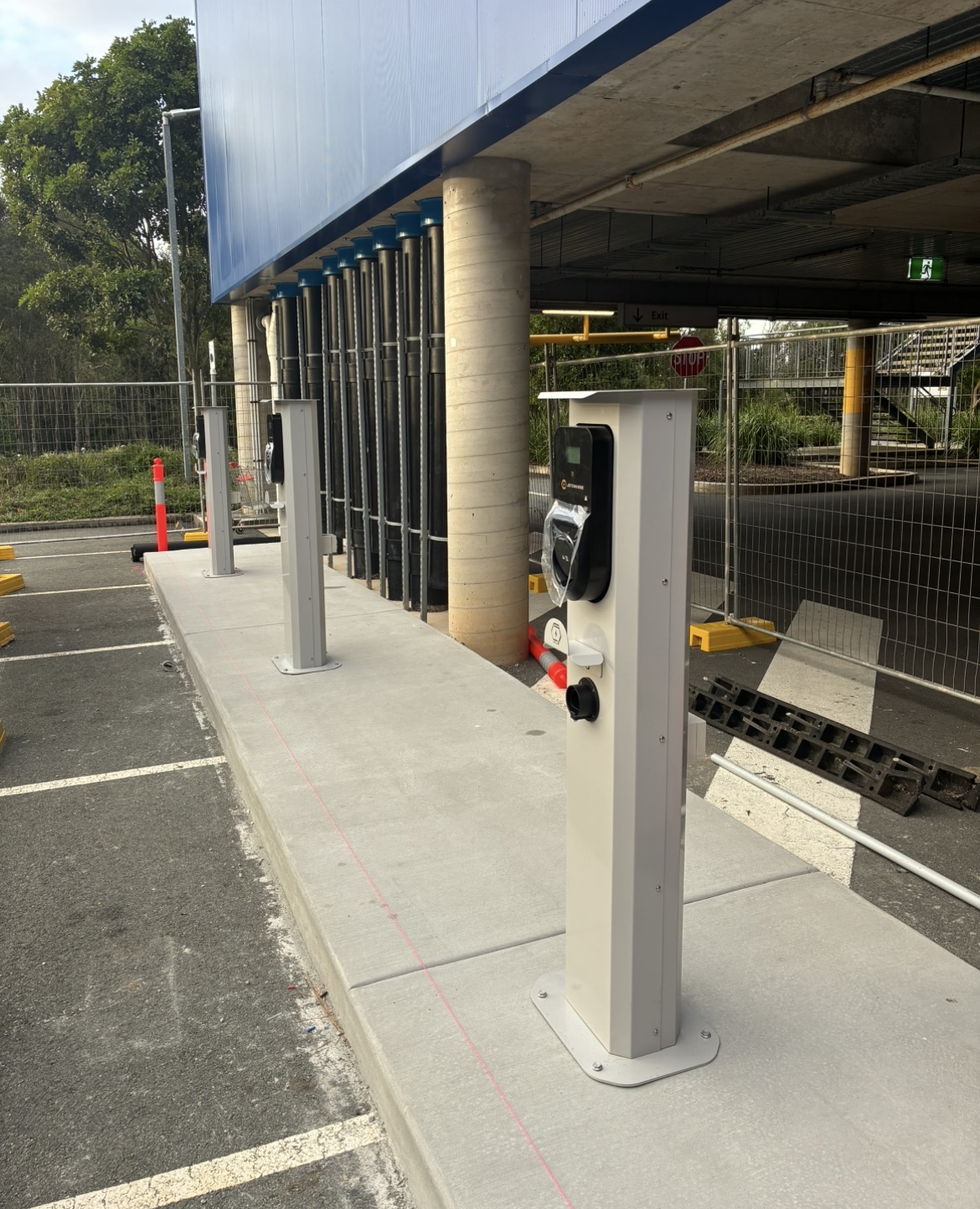
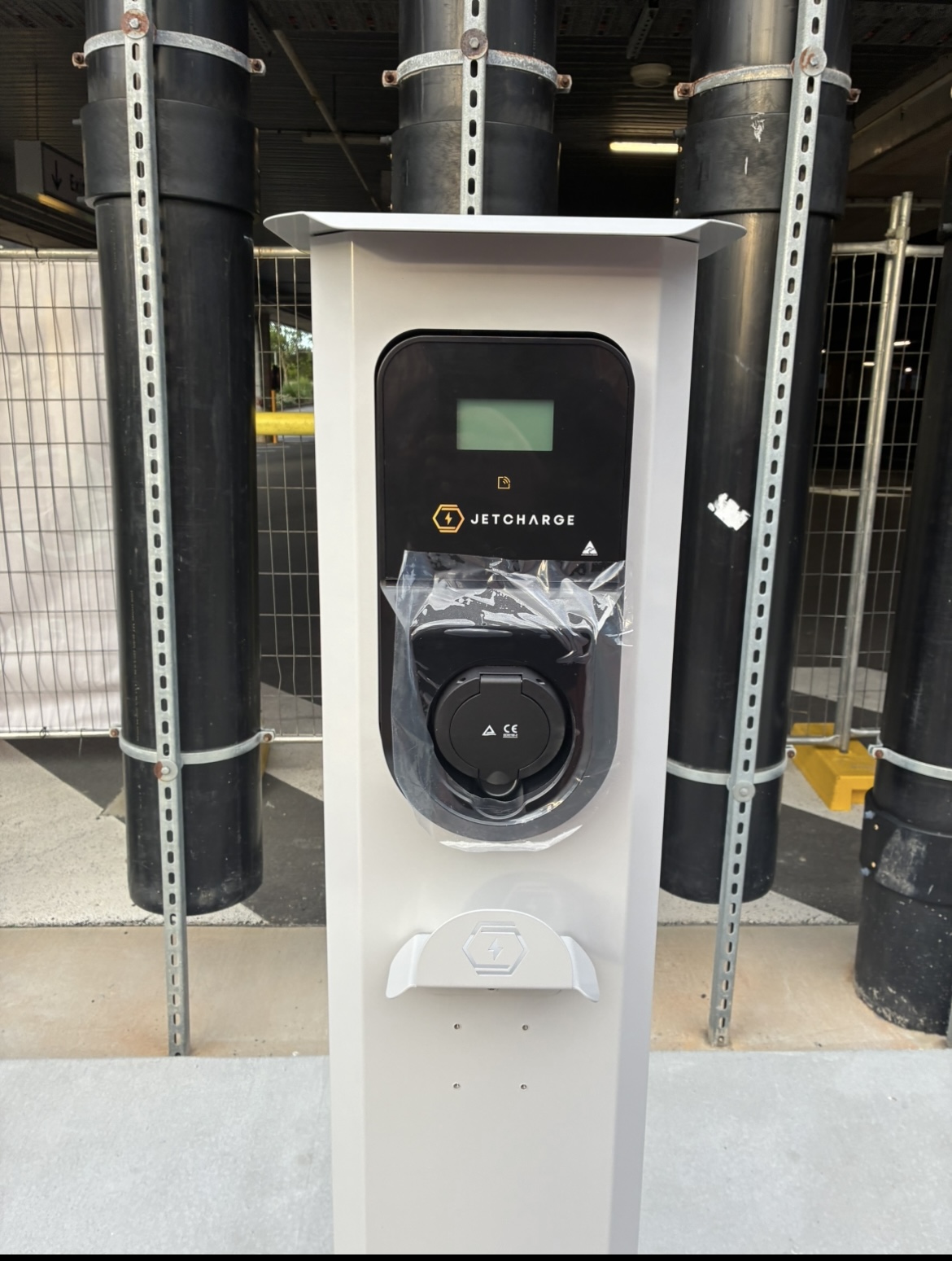
Already know what you need? Read our complete guide to finding EV charger installers in Brisbane, or check out our EV charger installation service for Capalaba and Brisbane Bayside.
Need your switchboard assessed first? Learn about our switchboard upgrade service — often the first step before an EV charger can be safely installed in older Brisbane homes.
📞 Call Aaron: 0419 014 146 | Licensed Electrical Contractor, QLD Lic No. 1500996 | About Amplus Electrical & Air
📍 Find Your Local EV Charger Installer If you have solar panels and want to see exactly how much you can save with real numbers for light, average, and heavy driving, our surplus solar EV charging guide breaks down the annual savings using an EVnex charger.
We install EV chargers across Brisbane Bayside, the Redlands, and the inner-east. Visit your suburb page for property-specific guidance:
For the complete guide to EV charger installation in Brisbane — from choosing a charger through to installation day — check out our comprehensive EV charger installation guide.
For a full guide to air conditioning installer guide for Brisbane, see our complete Brisbane air conditioning installation guide.
Need a Licensed Electrician in Brisbane Bayside?
Aaron is a licensed electrician (Lic. 1500996) and ARC-certified A/C technician serving Capalaba, Cleveland, Wynnum, Manly, Birkdale, Thornlands, Victoria Point and surrounding suburbs. Honest advice, upfront pricing, and quality work guaranteed.