How Often Should Safety Switches Be Tested? A Queensland Homeowners Guide
How often should safety switches be tested in Queensland? Test frequency, how to do it properly, and why skipping it is a serious safety risk.
Safety switches in Queensland homes should be tested every 3 months using the built-in test button, and professionally checked every 1–2 years if you want confidence they’re tripping within spec. The push-button test takes about 30 seconds, costs nothing, and confirms your family is actually protected from electric shock. A safety switch that isn’t tested is a safety switch you can’t trust — and like any mechanical electrical device, they can fail silently over time.
That’s the part many Brisbane homeowners don’t realise. A safety switch can look perfectly normal — no warning lights, no error messages — until the day a fault occurs and it fails to trip. That’s why regular testing isn’t optional. It’s essential.
For guidance on electrical safety and emergency guide, see our comprehensive electrical emergency guide.
Here’s everything Queensland homeowners need to know about testing, maintaining, and upgrading safety switches — from how to find the right switch in your switchboard, to what to do when one fails, to when it’s time to call a licensed electrician.
What Is a Safety Switch — And Why Does It Matter?
A safety switch (also called a Residual Current Device or RCD) monitors the flow of electricity through a circuit. If it detects even a tiny amount of current leaking to earth — which happens when someone gets an electric shock, or when faulty wiring contacts metal or water — it cuts power in about 30 milliseconds.
To put that in perspective, a heartbeat takes about 800 milliseconds. A safety switch reacts 25 times faster than that. It’s the single most important device in your switchboard when it comes to protecting your family from electrocution.
Safety switches are not the same as circuit breakers. This is a common misconception that we hear almost every week. Circuit breakers protect against overloads and short circuits — they stop wiring from overheating and catching fire. Safety switches protect against electrocution — they stop you from being harmed. You need both. For a detailed explanation, see our safety switch and RCD installation guide.
How to Identify a Safety Switch in Your Switchboard
Before you can test your safety switch, you need to know which one it is. Most modern switchboards have a mix of circuit breakers and safety switches, and they can look similar at first glance.
Here’s how to tell them apart:
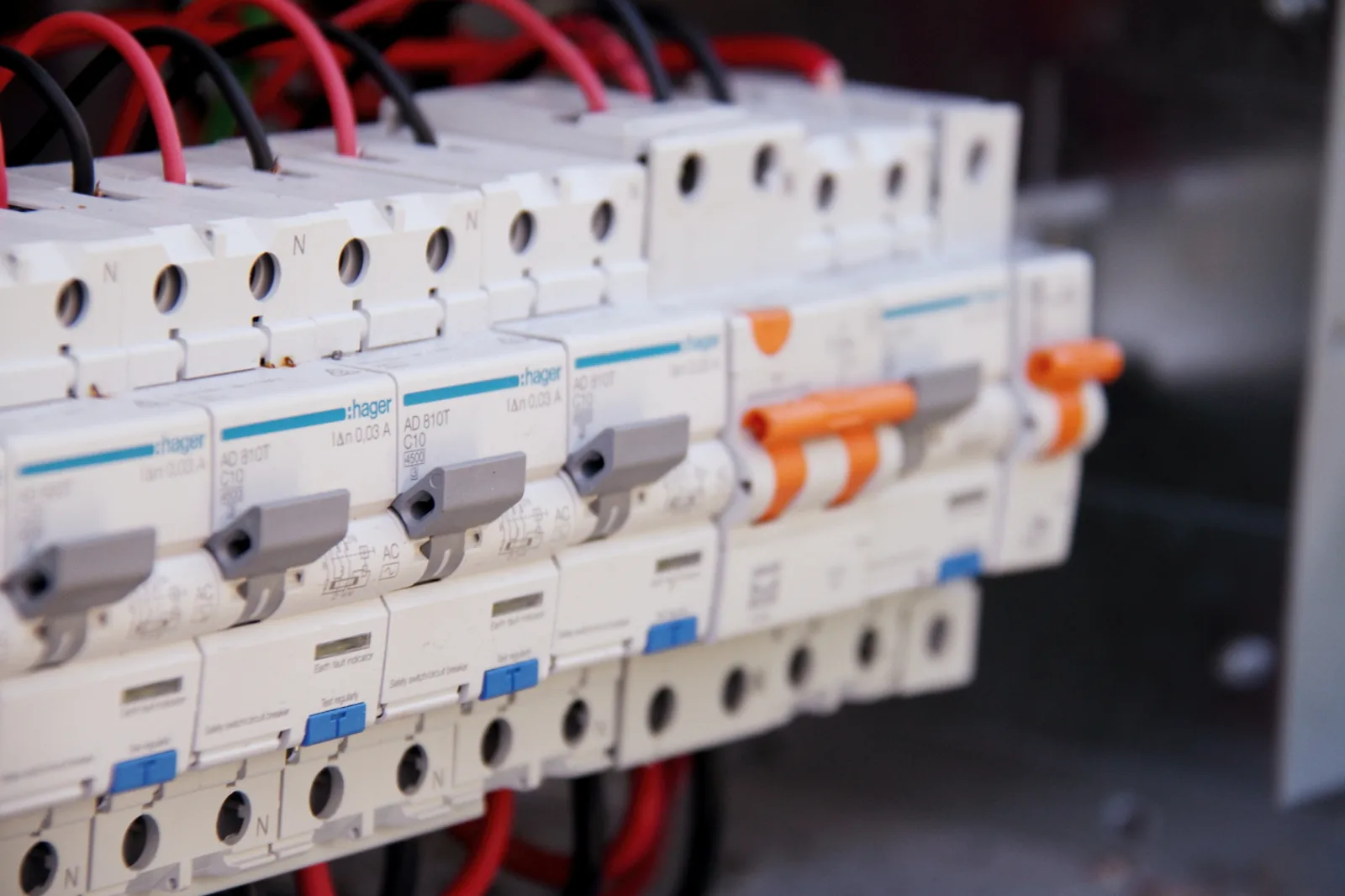
- Safety switch: Has a small “T” or “Test” button on the front. Usually wider than a standard circuit breaker (takes up about 2 module widths). May be labelled “RCD” or “Safety Switch”.
- Circuit breaker: No test button. Usually narrower (1 module width). Labelled with an amp rating like “16A” or “20A”. Protects wiring, not people.
- RCBO (combo unit): Has both a test button AND overload protection in one unit. These are the gold standard — they do both jobs. Common in newer switchboards and switchboard upgrades.
If you’re not sure which is which, don’t guess. Take a photo of your switchboard and send it to a licensed electrician. At Amplus Electrical & Air, we identify switchboard layouts for free as part of any free assessment.
How Often Should You Test Safety Switches?
The official recommendation from the Queensland Electrical Safety Office, Energex, and safety switch manufacturers is clear:
| When to Test | Why |
|---|---|
| Every 3 months | Standard maintenance — confirms the switch mechanism is operational and will trip under fault conditions |
| After installation | Verify everything works from day one — catches manufacturing defects or installation errors early |
| After any electrical work | Confirm the switch wasn’t affected by the work — especially if wiring was modified or circuits were added |
| After a power outage or storm | Surges can damage safety switch mechanisms without visible signs — Brisbane’s storm season makes this critical |
| After water exposure | Flooding or leaks near the switchboard can cause corrosion that affects trip sensitivity over time |
| Before selling your property | Queensland law requires working safety switches at point of sale — test and document before listing |
The quarterly test is the most important one. A good way to remember is to test on the first day of each season — or set a recurring reminder on your phone for January 1, April 1, July 1, and October 1.
Most people never test their safety switches. Research suggests fewer than 20% of Australian homeowners test quarterly as recommended. Don’t be in that 80%.
How to Test Your Safety Switch — Step-by-Step
Testing takes about 30 seconds. Here’s exactly what to do, with the details most guides skip:
Before You Start
- Save any computer work. Testing will cut power to the protected circuits for a few seconds. If you’re in the middle of something important, save it first.
- Unplug sensitive electronics. Computers, TVs, and other sensitive devices can occasionally be affected by the brief power interruption. Unplugging them is a precaution, not a requirement — but it’s good practice.
- Note which circuits are currently on. Before pressing the test button, take a quick mental note of which lights and appliances are running. This helps you confirm exactly which circuits the safety switch protects.
The Test
- Go to your switchboard. It’s usually in the garage, laundry, or on an external wall. In older Queensland homes, it might be mounted on an external brick wall near the meter box.
- Open the switchboard cover. You should see a row of switches. Look for the ones with a small “T” or “Test” button — those are your safety switches.
- Make sure the safety switch is in the ON position. If it’s already off, turn it on first. You can’t test a switch that’s already tripped.
- Press the test button firmly. Push and release — don’t hold it down. You should hear a distinct “click” sound.
- The switch should trip immediately — flipping to the OFF position. Power will go off to all the circuits it protects.
- Check inside your home. Walk through the house and check which lights, power points, and appliances have lost power. This tells you exactly which circuits are protected by that safety switch. If any circuits are still live, they’re not protected — and that’s a serious safety gap.
- Flip the switch back to ON. Power should restore immediately. If it won’t stay on, there may be a fault on one of the protected circuits. Don’t force it — see the troubleshooting section below.
- Repeat for each safety switch. Most modern homes have 2–4 safety switches. Test every single one.
What the Results Mean
| Result | What It Means | What to Do |
|---|---|---|
| Switch trips, power cuts, resets fine | ✅ Working correctly | Nothing — test again in 3 months |
| Switch does NOT trip when button pressed | ❌ FAILED — no shock protection | Call a licensed electrician immediately |
| Switch trips but won’t reset | ⚠️ Fault on protected circuit | Unplug all appliances, try again. If still won’t reset, call an electrician |
| Switch trips immediately after resetting | ⚠️ Active fault on circuit | Don’t keep resetting — call a fault finding electrician |
What If Your Safety Switch Doesn’t Trip?
If pressing the test button does nothing, your safety switch has failed. This means you currently have no shock protection on those circuits. It’s not an emergency in the “call 000” sense — but it is urgent.
Here’s what to do:
- Don’t panic — but don’t ignore it either
- Avoid using appliances on the affected circuits where possible. If the safety switch covers the power points in your kitchen, use the ones on a different circuit until it’s fixed.
- Call a licensed electrician to inspect and replace the switch as soon as possible. At Amplus Electrical & Air, we carry common safety switch sizes on our vans and can usually replace a failed unit the same day. Call 0419 014 146 or book online.
- Do not attempt to repair or replace a safety switch yourself — this is licensed electrical work under Queensland’s Electrical Safety Act 2002. Working inside a live switchboard is extremely dangerous without proper training.
A failed safety switch is not uncommon, especially in older units. The internal mechanism can degrade over time due to heat, humidity, and electrical surges. Brisbane’s subtropical climate — with its hot summers and high humidity — accelerates this process. Homes in Bayside suburbs like Cleveland, Victoria Point, and Redland Bay face additional corrosion risk from salt air.
Are Safety Switches Required by Law in Queensland?
📖 Source: WorkSafe Queensland — Safety switches
Yes. Queensland has some of the strongest safety switch laws in Australia. Here’s what’s required:
| Requirement | When It Applies |
|---|---|
| Safety switches on all power point circuits | Mandatory since 1992 for new homes |
| Safety switches on all lighting circuits | Required for homes built or rewired after 2003 |
| Safety switches on all circuits | Required for rental properties; recommended for all homes |
| Working safety switches at point of sale | Required when selling a Queensland property |
If your home was built before 1992 and hasn’t been updated, you may not have safety switches at all. That means your home has zero protection against electrocution on those circuits.
The upcoming 2027 electrical safety deadline is also prompting many homeowners to review their overall electrical compliance. Safety switches and switchboards are often the first things that need attention.
Signs Your Safety Switch Might Be Faulty
Between quarterly tests, watch for these warning signs:
- It doesn’t trip when you press the test button — the most obvious and most serious sign
- It trips randomly for no apparent reason — could indicate a wiring fault on the circuit, moisture ingress, or the switch itself deteriorating
- It trips every time you use a specific appliance — the appliance may be faulty, or the safety switch may be overly sensitive due to age
- It’s physically damaged — cracks, discolouration, or signs of overheating on the switch body
- It’s more than 15–20 years old — even if it passes the test button check, older switches can have slower trip times that may not meet current standards
- Your switchboard has no test buttons at all — you may not have safety switches, just circuit breakers. These look similar but serve different purposes.
If any of these apply, book an inspection. A fault finding specialist can diagnose the issue and recommend the right fix.
Push-Button Test vs Professional RCD Test
There are two levels of safety switch testing, and both serve a purpose:
Push-Button Test (DIY — Every 3 Months)
This is the test described above. It confirms the switch’s basic trip mechanism is working. Every homeowner should do this quarterly. It’s free, takes 30 seconds, and requires no tools.
What the push-button test does NOT check:
- Whether the switch trips at the correct current threshold (30mA for standard residential RCDs)
- Whether the trip time meets Australian Standards (under 300ms at rated current)
- Whether the switch has degraded beyond safe operating parameters
Professional RCD Test (Electrician — Every 1–2 Years)
A licensed electrician uses a calibrated RCD testing device that measures the exact trip time and current sensitivity of your safety switch. This is far more accurate than the push-button test and is the only way to confirm your switch meets Australian Standards.
A professional test confirms:
- The switch trips at the correct current threshold (30mA for standard residential RCDs)
- The trip time meets Australian Standards (under 300ms at rated current, under 40ms at 5× rated current)
- The switch hasn’t degraded beyond safe operating parameters
- The earth continuity of the circuit is intact
Professional testing is recommended every 1–2 years for homeowners. For rental properties, landlords must ensure safety switches are tested at regular intervals as part of their compliance obligations under the Residential Tenancies and Rooming Accommodation Act 2008.
Safety Switches and Rental Properties
📖 Reference: WorkSafe Queensland — Electrical safety
If you’re a Queensland landlord, your obligations are specific:
- All circuits must have safety switches — not just power circuits, but lighting and all other circuits too
- Switches must be tested and maintained — as part of your duty of care to tenants
- Documentation is required — keep records of when switches were installed, tested, and replaced
- Personal liability applies — if a tenant is injured and your safety switches were non-compliant or faulty, you carry personal liability
For a comprehensive overview of landlord electrical obligations in Queensland, see our guide to the landlord electrical compliance checklist for QLD rental properties.
How Much Does Safety Switch Installation or Replacement Cost?
If your home needs new safety switches or replacements, here’s what to expect in Brisbane and the Redlands in 2026:
| Service | Typical Cost |
|---|---|
| Single safety switch replacement | $150 – $250 |
| Safety switch installation (per circuit) | $180 – $300 |
| Full safety switch upgrade (all circuits, 3-bed home) | $400 – $800 |
| Professional RCD testing (per switch) | $50 – $80 |
| Switchboard upgrade (if board can’t accommodate modern RCDs) | $1,200 – $2,500 |
These costs are a guide for Brisbane, Capalaba, Cleveland, and surrounding Redlands suburbs. The actual price depends on your switchboard’s condition, the number of circuits, and whether any additional work is needed. A switchboard upgrade may be recommended if the board is too old to accommodate modern safety switches — common in pre-1992 homes across Alexandra Hills, Thornlands, and Victoria Point.
Brisbane-Specific Considerations
- Humidity and corrosion. Brisbane’s subtropical climate accelerates wear on safety switch internals. Salt air in Bayside suburbs like Wynnum, Manly, Cleveland, Victoria Point, and Redland Bay can cause corrosion that affects trip sensitivity. This makes regular testing even more important in these areas.
- Storm season surges. Lightning strikes and power surges during Brisbane’s November–March storm season can damage safety switches without any visible signs. Testing after major storms is strongly recommended — especially in suburbs prone to thunderstorms like Capalaba, Alexandra Hills, and Sheldon.
- Older housing stock. Many homes in Capalaba, Alexandra Hills, Thornlands, Wellington Point, and Ormiston were built before safety switch requirements existed. These homes often have no RCDs at all, or only on some circuits. If your home was built before 1992, we strongly recommend a full switchboard inspection.
- Pool and outdoor circuits. If you have a pool, spa, or extensive outdoor lighting, these circuits require safety switches with enhanced specifications (30mA trip threshold, sometimes 10mA for pool circuits). Brisbane’s outdoor lifestyle means many homes in suburbs like Birkdale, Sheldon, and Burbank have more wet-area circuits than average.
- Acreage properties. Homes on larger blocks in Sheldon, Burbank, and Mount Cotton often have submains and multiple switchboards. Each switchboard needs its own safety switch testing — don’t forget the shed or workshop board.
Common Myths About Safety Switch Testing
“My circuit breaker is the same as a safety switch”
No. Circuit breakers protect wiring from overloads and short circuits. Safety switches protect people from electric shock. They look similar but do completely different jobs. If your switchboard only has circuit breakers and no safety switches, your family has no shock protection. See our detailed breakdown of safety switch vs circuit breaker for the full explanation.
“I tested it once, it’s fine forever”
Safety switches are mechanical devices. The internal mechanism can stick, corrode, or wear out over time. A switch that worked perfectly last year can fail this year. That’s why the 3-month testing cycle exists — it’s the only way to catch a failure before it matters.
“If the lights still work, the safety switch is fine”
The lights working tells you the circuit is live. It tells you nothing about whether the safety switch will trip during a fault. The push-button test is the only way to confirm the safety mechanism is functional.
“I don’t need a professional test if I test it myself”
The push-button test confirms the mechanism moves. A professional test confirms it moves at the right speed and the right current threshold. Both are important. Think of it like a car — you can check the brakes work by pressing the pedal, but only a mechanic can tell you if they’ll stop you in the distance you need.
“Safety switches last forever”
Most manufacturers recommend replacing safety switches after 15–20 years, even if they still pass the push-button test. Internal components degrade over time, and older switches may not meet current trip-time standards. If your switchboard is original to a pre-1992 home, the safety switches (if they exist at all) are well past their service life.
For more details, see our guide on safety switch testing for landlords.
For more details, see our guide on safety switch compliance.
Frequently Asked Questions
What happens if I never test my safety switch?
Nothing — until something goes wrong. The danger is that a failed safety switch gives no warning. You won’t know it’s faulty until someone gets a shock or a fault occurs, and by then the switch can’t protect you. Regular testing is the only way to catch a failure before it matters.
Can a safety switch go bad without me knowing?
Yes. Safety switches can fail internally without any external sign. The mechanism can stick, corrode, or degrade due to heat and humidity. This is why the push-button test exists — it’s the only way to confirm the switch will actually trip when needed.
How many safety switches does my home need?
At minimum, one for each circuit group. A typical 3-bedroom Brisbane home has 2–4 safety switches covering power, lighting, and dedicated circuits (common for air conditioners — see our Brisbane air conditioning installers guide for how dedicated circuits factor into a split or ducted install) and EV chargers). Best practice is one safety switch per circuit for maximum protection.
Can I replace a safety switch myself?
No. All work inside a switchboard must be performed by a licensed electrician in Queensland. This includes safety switch replacement. The Electrical Safety Act 2002 is clear on this — and for good reason. Working inside a live switchboard is extremely dangerous without proper training.
What’s the difference between a safety switch and a circuit breaker?
A circuit breaker protects your wiring from overheating due to overloads or short circuits. A safety switch (RCD) protects people from electric shock by detecting current leaks. They look similar on a switchboard, but they do very different jobs. Your home needs both.
Do safety switches protect against all electrical accidents?
No. Safety switches protect against earth faults — where current leaks to ground through a person or faulty equipment. They don’t protect against contact between active and neutral conductors (line-to-line shock). However, earth faults account for the vast majority of domestic electrical accidents, so safety switches address the biggest risk.
My safety switch keeps tripping. What should I do?
First, unplug all appliances on the affected circuit and reset the switch. Plug them back in one at a time to identify the faulty appliance. If the switch trips with nothing plugged in, the issue is in the wiring itself. Call a fault finding electrician to diagnose the problem.
Are safety switches required when selling a home in Queensland?
Yes. Queensland law requires that a property being sold must have safety switches installed on all power point circuits (and all circuits for properties built or rewired after 2003). If you’re selling, get your safety switches tested and documented before listing. For a full pre-sale electrical checklist, see our house buying electrical inspection guide.
How much does it cost to test safety switches professionally?
Professional RCD testing typically costs $50–$80 per switch in Brisbane. Most electricians offer a discount when testing multiple switches at once. If you’re having a switchboard upgrade done, testing is often included.
Safety Switch Maintenance Tips
Beyond regular testing, here are practical ways to keep your safety switches in good working order:
- Keep the switchboard clean and dry. Dust, cobwebs, and moisture can affect switchboard components. Wipe down the exterior of your switchboard every few months, and make sure the area around it stays dry. In Brisbane’s humid climate, consider using a dehumidifier in the room where your switchboard is located if it’s in an enclosed space like a garage or laundry.
- Check for signs of overheating. If you notice any discolouration, burning smell, or warmth around your switchboard, this could indicate loose connections or overloaded circuits. Call an electrician immediately — don’t try to investigate inside the switchboard yourself.
- Label your circuits clearly. Most switchboards have a circuit directory card inside the door. Make sure it’s accurate and up to date. This makes testing easier and helps you quickly identify which circuits are affected if a safety switch trips. If the labels are faded or missing, ask your electrician to update them during their next visit.
- Avoid overloading circuits. While safety switches don’t protect against overloads (that’s what circuit breakers do), overloaded circuits can cause heat buildup that affects nearby components, including safety switches. Spread high-draw appliances across different circuits where possible.
- Document your tests. Keep a simple log of when you tested each safety switch and the results. This is especially important for rental property owners who need to demonstrate compliance. A quick note in your phone or a spreadsheet is enough — just record the date, which switches you tested, and whether they passed.
- Schedule professional inspections. Even if your push-button tests are all passing, have a licensed electrician perform a professional RCD test every 1–2 years. They’ll use calibrated equipment to verify trip times and current sensitivity, catching issues the push-button test can’t detect.
For rental properties, landlords should also keep records of when safety switches were installed, replaced, or professionally tested. This documentation protects you in the event of a dispute and demonstrates your compliance with Queensland’s electrical safety obligations.
Make Sure Your Protection Actually Works
A safety switch is only as good as its last test. If you haven’t tested yours in the last 3 months, go do it now — it takes 30 seconds and could save a life.
If your safety switch fails the test, or if your home was built before 1992 and you’re not sure whether you have safety switches at all, call Amplus Electrical & Air on 0419 014 146. We’re a Capalaba-based licensed electrical contractor (Licence #1500996) servicing Brisbane, the Redlands, and Bayside suburbs. We can test, replace, and upgrade safety switches same-day in most cases.
Book a Safety Switch Test Online
Need a Licensed Electrician in Brisbane Bayside?
Aaron is a licensed electrician (Lic. 1500996) and ARC-certified A/C technician serving Capalaba, Cleveland, Wynnum, Manly, Birkdale, Thornlands, Victoria Point and surrounding suburbs. Honest advice, upfront pricing, and quality work guaranteed.