Halogen vs LED Downlights: Complete Technical Comparison for Brisbane Homes (2026)
Halogen vs LED downlights: complete technical comparison covering colour temperature (Kelvin), CRI ratings, beam angles, IP ratings, IC ratings, dimming compatibility, MR16 vs GU10, and transformer issues. Written by a licensed Brisbane electrician with real installation data.
If you’re wondering whether an LED upgrade is worth the investment, start with our complete guide to LED lighting upgrades in Brisbane. That guide covers costs, savings, and payback periods. This guide is the technical deep dive — the specifications, compatibility issues, and quality markers that separate a good LED installation from a bad one.
The Core Technical Differences: Halogen vs LED
Let’s start with the fundamental physics. Halogen and LED lighting work on completely different principles, which explains why their performance characteristics are so different.
How Halogen Downlights Work
Halogen bulbs use a tungsten filament enclosed in a quartz envelope filled with halogen gas (usually iodine or bromine). When electricity flows through the filament, it heats to around 2,700°C and produces light. The halogen gas helps redeposit evaporated tungsten back onto the filament, extending the bulb’s life slightly compared to traditional incandescent bulbs.
The problem? About 90% of the energy consumed becomes heat, not light. A 50W halogen downlight produces roughly 800 lumens of light output and radiates the rest as heat. That’s why halogen downlights are a fire risk in ceiling cavities — they’re essentially small heaters pointing at your insulation.
How LED Downlights Work
LEDs (Light Emitting Diodes) work on a completely different principle. When current flows through a semiconductor material, electrons recombine with electron holes, releasing energy in the form of photons (light). This process is called electroluminescence.
The key advantage: LEDs produce very little heat relative to their light output. An 8-10W LED downlight produces the same 800 lumens as a 50W halogen, but runs at around 40-60°C on the heat sink — not 300°C on the bulb surface. That’s a 6-7x reduction in operating temperature.
Colour Temperature: Understanding Kelvin Ratings
Colour temperature is measured in Kelvin (K) and describes whether light appears warm (yellow/orange) or cool (blue/white). This is where many homeowners make mistakes when upgrading from halogen to LED.
Halogen Colour Temperature
Halogen bulbs naturally produce a warm white light around 2700-3000K. This is why halogen lighting feels “cozy” — it’s similar to traditional incandescent lighting that we’ve used for decades. The colour rendering is excellent (CRI 95-100), meaning colours look natural and accurate under halogen light.
LED Colour Temperature Options
LEDs can be manufactured to produce any colour temperature, but the most common options for residential use are:
| Colour Temperature | Appearance | Best For | Avoid If |
|---|---|---|---|
| 2700K (Warm White) | Very warm, yellow/orange tone | Living rooms, bedrooms, creating cozy atmosphere | You want bright task lighting |
| 3000K (Warm White) | Warm but slightly whiter than 2700K | General residential use, closest match to halogen | You want a modern, crisp look |
| 4000K (Cool White) | Neutral white, no yellow or blue cast | Kitchens, bathrooms, workspaces | You want a warm, relaxed feel |
| 5000K+ (Daylight) | Cool, slightly blue tone | Garages, commercial spaces, detail work | It’s a living space (feels clinical) |
My recommendation for Brisbane homes: If you’re replacing halogen downlights and want to maintain the same warm feel, choose 3000K LEDs. This is the closest match to halogen’s natural colour temperature. Going to 4000K will make your home feel noticeably different — some people love it, others find it too clinical for living spaces.
For a detailed breakdown of what to expect during an LED upgrade, see our LED lighting upgrades guide.
Colour Rendering Index (CRI): Why It Matters
CRI measures how accurately a light source reveals the colours of objects compared to natural light. The scale runs from 0-100, with 100 being perfect colour accuracy (natural sunlight).
Halogen CRI: 95-100
Halogen bulbs have excellent colour rendering because they produce a continuous spectrum of light (like sunlight). This is why your skin looks natural under halogen lighting, and why retail stores used to prefer halogen for displaying products.
LED CRI: 80-95 (Quality Dependent)
LEDs produce light at specific wavelengths, so their colour rendering depends on the quality of the phosphor coating and the LED chip. Here’s what you’ll find in the market:
- CRI 80-85: Standard residential LEDs. Acceptable for most applications, but colours may look slightly less vibrant than under halogen.
- CRI 90-95: High-quality LEDs. Excellent colour rendering, very close to halogen. These cost 20-30% more but are worth it for living spaces.
- CRI 95+: Premium LEDs, often used in art galleries and photography studios. Overkill for most homes.
My recommendation: For Brisbane homes, aim for CRI 90+ in living rooms, kitchens, and bathrooms where colour accuracy matters. CRI 80+ is fine for hallways, garages, and utility spaces.
Beam Angles: Spotlight vs Flood
Beam angle determines how wide or narrow the light spreads. This is critical for creating the right atmosphere and ensuring even light distribution.
Halogen Beam Angles
Halogen downlights typically come in two beam angles:
- Narrow beam (24-30°): Creates a focused spotlight effect. Good for highlighting specific features or creating dramatic pools of light.
- Wide beam (60°): Creates a broader wash of light. Better for general illumination but can create harsh shadows if not spaced correctly.
LED Beam Angles
LEDs offer more flexibility because the lens design can be customized. Common options:
- 38-45° (Medium beam): Most versatile for residential use. Good balance of focused light and coverage. This is what I recommend for most Brisbane homes.
- 60°+ (Wide flood): Better for high ceilings or large rooms where you want even light distribution without dark spots.
- 15-24° (Narrow spot): For accent lighting, highlighting artwork, or creating dramatic effects.
Spacing rule of thumb: For 38-45° beam angles in a standard 2.4m ceiling, space downlights 1.2-1.5m apart. For 60° beams, you can space them 1.5-1.8m apart.
Dimming Compatibility: The Hidden Headache
This is where many DIY LED upgrades fail. Not all LEDs work with all dimmers, and mixing the wrong combination leads to flickering, buzzing, or lights that won’t dim at all.
Halogen Dimming
Halogen bulbs are resistive loads — they work with virtually any dimmer. Old-style leading-edge dimmers (the ones installed in most Brisbane homes from the 1990s-2010s) were designed for halogen and incandescent loads.
LED Dimming Challenges
LEDs are electronic loads with drivers that convert AC to DC. This creates compatibility issues:
- Leading-edge dimmers (old style): Often cause flickering or buzzing with LEDs because the dimmer expects a higher minimum load. A circuit with 10x 50W halogens (500W total) might only have 10x 8W LEDs (80W total) — below the dimmer’s minimum threshold.
- Trailing-edge dimmers (new style): Designed for electronic loads like LEDs. Much smoother dimming, no flickering. But you need to replace your existing dimmer switches.
- Smart dimmers: Some LED-specific dimmers offer app control and scene setting. More expensive but very convenient.
My recommendation: If you’re upgrading from halogen to LED and want dimming, budget for new trailing-edge dimmer switches. It’s an extra $150-250 per circuit, but it eliminates flickering and gives you smooth, quiet dimming. Alternatively, use non-dimmable LEDs on non-dimmer circuits and only install dimmable LEDs where you actually need dimming.
IP Ratings: Bathroom and Outdoor Requirements
IP (Ingress Protection) ratings tell you how well a light fixture is sealed against dust and water. This is critical for bathrooms, laundries, and outdoor areas in Brisbane’s humid climate.
Understanding IP Ratings
The format is IP followed by two digits:
- First digit (0-6): Protection against solid objects (dust). 6 = completely dust-tight.
- Second digit (0-9): Protection against liquids. 4 = protected from splashing water. 65 = protected from low-pressure water jets.
Where You Need What
| Location | Minimum IP Rating | Why |
|---|---|---|
| Living rooms, bedrooms, hallways (dry areas) | IP20 | Basic protection against fingers and small objects. No water exposure. |
| Bathrooms (Zone 2: 60cm outside bath/shower) | IP44 | Protected from water splashes. Required by Australian Standards. |
| Bathrooms (Zone 1: directly above bath/shower) | IP65 | Protected from water jets. Required if light is within 60cm of shower head. |
| Outdoor covered areas (eaves, patios) | IP44 | Protected from rain splashes. Covered areas don’t need IP65. |
| Outdoor exposed areas (no cover) | IP65 | Protected from direct rain. Required for exposed outdoor lighting. |
Common mistake: Using IP20 LEDs in bathrooms because they’re cheaper. This is a safety hazard and violates Australian wiring rules. Always check the IP rating before installing in wet areas.
IC Ratings: Ceiling Insulation Compatibility
IC (Insulation Coverage) ratings tell you whether an LED downlight can be covered by ceiling insulation. This is critical for Brisbane homes with ceiling insulation, which is required by the National Construction Code for all new builds since 2010.
IC Rating Options
- IC-4 (Can be covered): Safe to install with insulation directly touching or covering the light. These have built-in heat sinks that keep the fixture cool. This is what you want for insulated ceilings.
- Non-IC rated: Must have clearance from insulation (usually 100-200mm). If covered, the fixture overheats and fails prematurely. Some councils require non-IC lights to have a physical barrier to prevent insulation contact.
My recommendation: Always use IC-4 rated LEDs in Brisbane homes. They’re safer, more efficient (no heat loss through insulation gaps), and eliminate the risk of insulation being pushed aside during installation.
For more on fire safety and LED upgrades, see our LED lighting upgrades guide.
Lumens vs Watts: Understanding Brightness
Watts measure energy consumption. Lumens measure light output. When comparing halogen to LED, you need to understand the lumen equivalence.
Halogen to LED Lumen Equivalence
| Halogen Wattage | Halogen Lumens | Equivalent LED Wattage | LED Lumens |
|---|---|---|---|
| 20W | 200-250 lm | 3-4W | 200-250 lm |
| 35W | 350-400 lm | 5-6W | 350-400 lm |
| 50W | 500-600 lm | 7-9W | 500-600 lm |
| 75W | 800-900 lm | 10-12W | 800-900 lm |
| 100W | 1200-1400 lm | 15-18W | 1200-1400 lm |
Key takeaway: For most Brisbane homes replacing 50W halogen downlights, you want 7-9W LED downlights producing 500-600 lumens. Going higher (12W+) will be too bright for standard rooms unless you have very high ceilings.
Transformer Compatibility: MR16 vs GU10
This is the most confusing part of LED upgrades. Halogen downlights use transformers to step down voltage from 240V to 12V. The type of transformer determines your LED options.
MR16 Halogen (12V, requires transformer)
MR16 bulbs have two pins spaced 5.3mm apart and run on 12V AC. They require a transformer (either electronic or magnetic) to convert 240V mains to 12V.
The problem: Many older magnetic transformers have a minimum load of 20-50W. If you replace 10x 50W halogens (500W total) with 10x 8W LEDs (80W total), you’re below the transformer’s minimum load. This causes flickering, buzzing, or lights that won’t turn on at all.
Solutions:
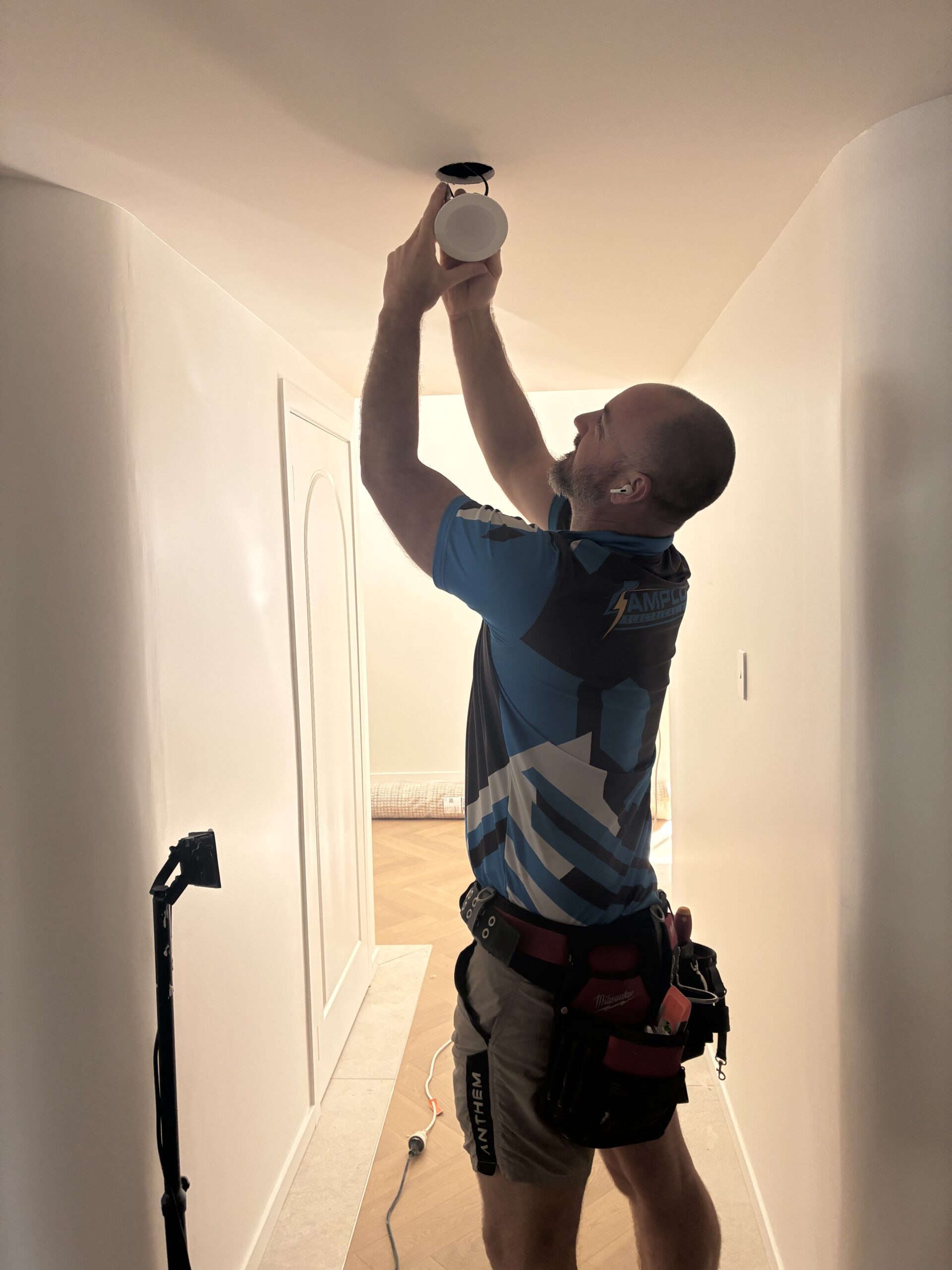
- Option 1: Replace the transformer. Remove the old transformer and wire the LEDs directly to 240V. This requires an electrician but eliminates transformer compatibility issues. Most Brisbane homes I upgrade go this route.
- Option 2: Use LED-compatible transformers. Some modern electronic transformers work with low LED loads. But you need to check compatibility with your specific LED model.
- Option 3: Use GU10 LEDs. GU10 bulbs run directly on 240V (no transformer needed). But you need GU10 sockets, which means replacing the existing MR16 fittings.
GU10 Halogen (240V, no transformer)
GU10 bulbs have two pins spaced 10mm apart with a twist-lock base. They run directly on 240V mains, so no transformer is needed. Upgrading GU10 halogens to GU10 LEDs is straightforward — just swap the bulbs (assuming the existing dimmer is LED-compatible, or you install a new dimmer).
My recommendation: For MR16 halogen systems, replace the transformer and wire LEDs directly to 240V. It’s cleaner, more reliable, and eliminates future transformer failures. For GU10 systems, just swap the bulbs.
Quality Markers: How to Spot a Good LED Downlight
Not all LEDs are created equal. Here’s what separates a quality LED from a cheap one that will fail in 2 years:
1. Brand Reputation
Stick to established brands with a presence in the Australian market:
- Top tier: Philips, Osram, Crompton, HPM, Clipsal. These have rigorous quality control and honour warranties.
- Mid tier: Mercator, Arlec, Brilliant. Acceptable for most residential use, but check reviews.
- Avoid: Unbranded LEDs from eBay, Kmart, or random Amazon sellers. These often have poor colour rendering, short lifespans, and no warranty support.
2. Warranty Length
Quality LEDs come with 3-5 year warranties. If an LED only has a 1-2 year warranty, that’s a red flag — the manufacturer expects it to fail.
3. Lumen Maintenance (L70/B50)
This tells you how long the LED will maintain 70% of its original brightness. Quality LEDs are rated for L70 25,000-50,000 hours. Cheap LEDs might only be rated for L70 15,000 hours.
4. Heat Sink Design
LEDs produce heat at the semiconductor junction. A good heat sink (usually aluminium) dissipates this heat and extends the LED’s life. Cheap LEDs have minimal heat sinks, which is why they fail prematurely.
5. Driver Quality
The driver converts AC to DC and regulates current. Quality drivers (from brands like Tridonic, Philips Xitanium, or Inventronics) are more efficient and reliable than cheap generic drivers.
Real-World Comparison: Halogen vs LED in a Brisbane Home
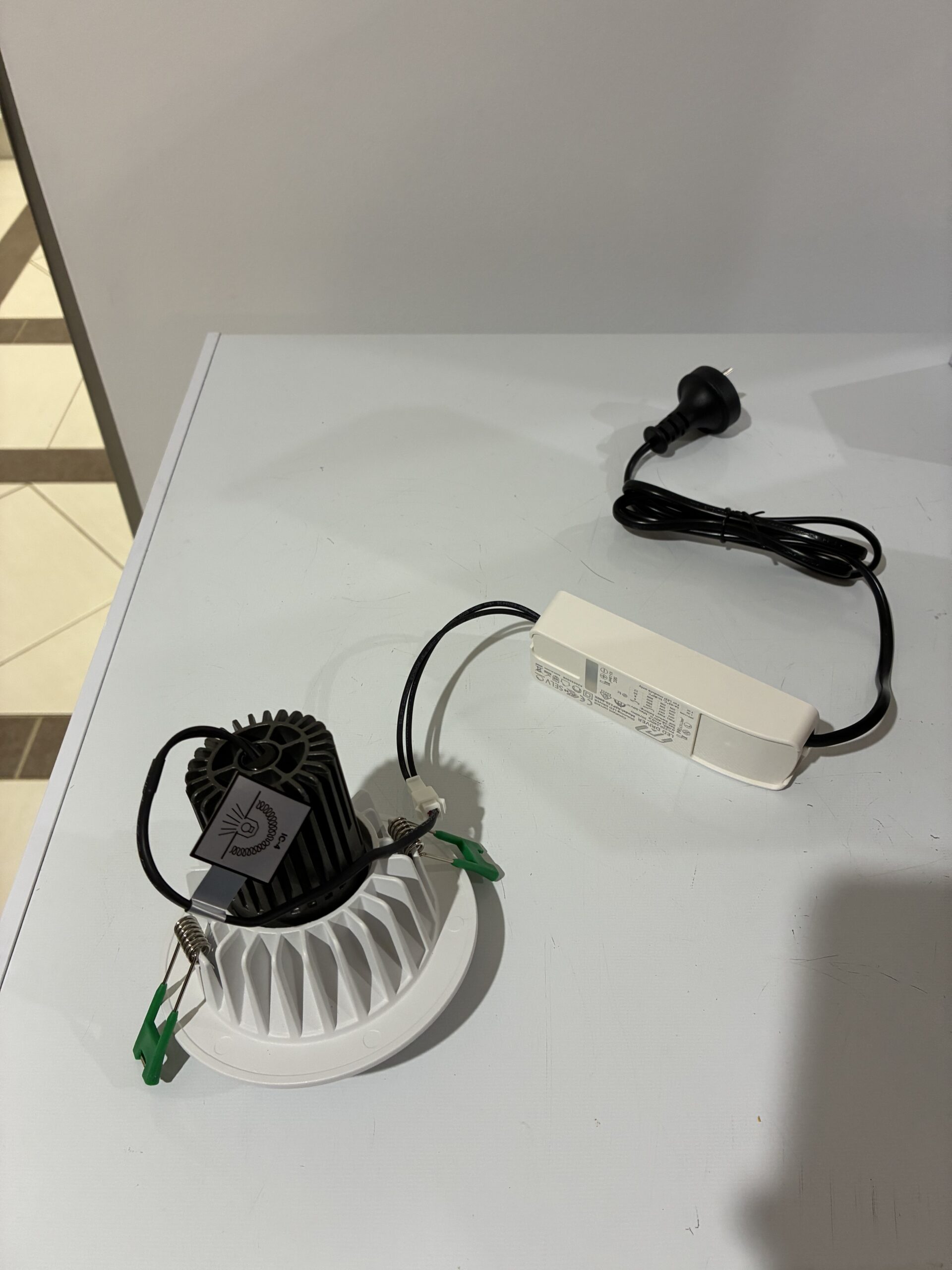
Let’s look at a real example from a Capalaba home I upgraded in 2026:
| Specification | Halogen (Before) | LED (After) |
|---|---|---|
| Number of downlights | 18 | 18 |
| Wattage per light | 50W | 9W |
| Total wattage | 900W | 162W |
| Colour temperature | 2800K (warm white) | 3000K (warm white) |
| CRI | 98 | 92 |
| Beam angle | 60° | 45° |
| IP rating | IP20 | IP44 (bathrooms), IP20 (other rooms) |
| IC rating | Non-IC (insulation clearance required) | IC-4 (can be covered with insulation) |
| Dimming | Yes (leading-edge dimmer) | Yes (new trailing-edge dimmer installed) |
| Annual energy cost (4hrs/day) | $373 | $67 |
| Annual savings | $306 per year | |
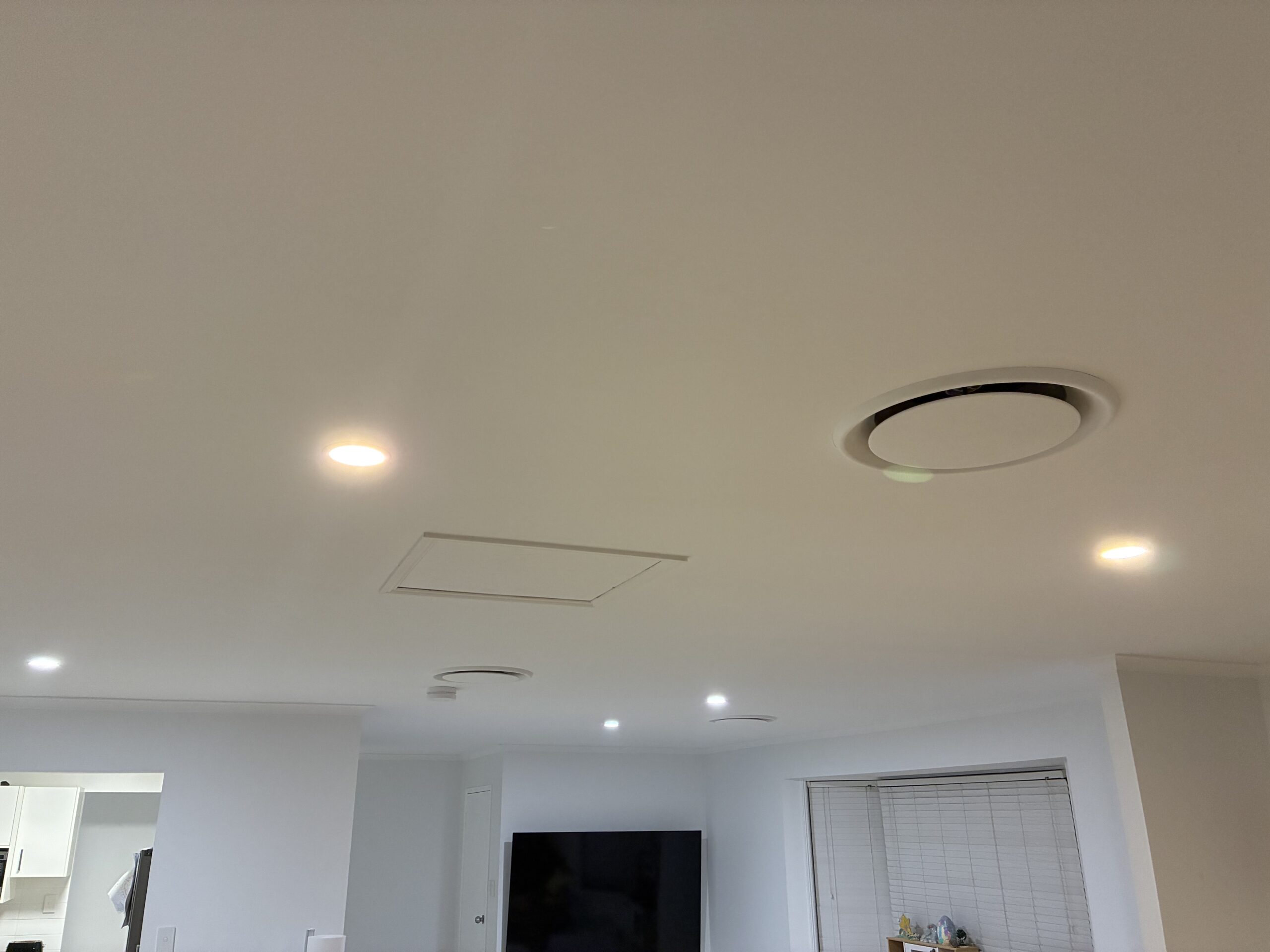
The customer was concerned about the colour difference, but 3000K LEDs with CRI 92 look almost identical to the 2800K halogens. The main difference they noticed was the lack of heat — the room felt cooler because the ceiling wasn’t radiating 900W of heat anymore.
Common Technical Mistakes to Avoid
Here are the mistakes I see most often when Brisbane homeowners try to upgrade to LED:
1. Ignoring Transformer Minimum Load
As discussed above, replacing halogens with LEDs on the same transformer often causes flickering. Always check the transformer’s minimum load rating, or replace the transformer entirely.
2. Using Non-IC-Rated LEDs with Insulation
If your ceiling has insulation, you must use IC-4 rated LEDs. Non-IC LEDs need clearance, which means cutting holes in your insulation — reducing its effectiveness and creating fire risk.
3. Choosing the Wrong Colour Temperature
Going from 2800K halogen to 4000K LED will make your home feel like a hospital. If you want to maintain the warm feel, stick to 2700K or 3000K.
4. Skimping on CRI
CRI 80 LEDs will make colours look dull compared to halogen (CRI 98). For living spaces, invest in CRI 90+ LEDs. The 20-30% price premium is worth it.
5. Not Checking IP Ratings for Wet Areas
Using IP20 LEDs in bathrooms is a safety hazard and violates Australian wiring rules. Always use IP44+ in bathrooms and IP65+ for exposed outdoor areas.
6. Mixing Dimmable and Non-Dimmable LEDs
If you have a dimmer circuit, all LEDs on that circuit must be dimmable. Mixing dimmable and non-dimmable LEDs causes flickering and can damage the dimmer.
Frequently Asked Questions
Can I replace halogen bulbs with LEDs myself?
If you have GU10 halogens (240V, twist-lock base), you can swap the bulbs yourself — just make sure the new LEDs are dimmable if you’re using a dimmer. For MR16 halogens (12V, two-pin base), you’ll likely need an electrician to replace the transformer or rewire to 240V. This is not a DIY job because it involves working with 240V wiring.
Will LEDs work with my existing dimmer switches?
Probably not perfectly. Old leading-edge dimmers designed for halogen often cause flickering with LEDs. The best solution is to install new trailing-edge LED-compatible dimmers. This costs $150-250 per circuit but gives you smooth, flicker-free dimming.
What’s the best colour temperature for Brisbane homes?
If you’re replacing halogen and want to maintain the same warm feel, choose 3000K. If you want a more modern, crisp look, 4000K works well in kitchens and bathrooms. Avoid 5000K+ in living spaces — it feels too clinical and blue.
Do I need IC-4 rated LEDs?
If your ceiling has insulation (required for all Brisbane homes built after 2010), yes. IC-4 rated LEDs can be safely covered with insulation. Non-IC LEDs need clearance, which reduces your insulation’s effectiveness and creates a fire hazard.
How do I know if an LED is good quality?
Look for: established brand (Philips, Osram, Crompton, HPM), 3-5 year warranty, CRI 90+, L70 rating of 25,000+ hours, and a substantial aluminium heat sink. Avoid unbranded LEDs from discount stores — they’re false economy.
What’s the difference between MR16 and GU10?
MR16 bulbs have two pins spaced 5.3mm apart and run on 12V (requires a transformer). GU10 bulbs have two pins spaced 10mm apart with a twist-lock base and run on 240V (no transformer needed). MR16 is more common in older Brisbane homes, GU10 in newer installations.
Can I use LED downlights in my bathroom?
Yes, but you must use IP44-rated LEDs in Zone 2 (60cm outside the bath/shower) and IP65-rated LEDs in Zone 1 (directly above the bath/shower). Using IP20 LEDs in bathrooms is a safety hazard and violates Australian wiring rules.
How much does it cost to upgrade from halogen to LED?
For a typical Brisbane home with 15-20 downlights, expect to pay $900-$1,500 for supply and installation, including transformer replacement and new dimmers if needed. The upgrade pays for itself in 2-3 years through energy savings. For a detailed cost breakdown, see our LED lighting upgrades guide.
Ready to Upgrade Your Brisbane Home’s Lighting?
Upgrading from halogen to LED is one of the best investments you can make in your home. You’ll save $300-500 per year on electricity, eliminate fire risk, and get better quality light. But the technical details matter — colour temperature, CRI, beam angles, dimming compatibility, and IP ratings all affect the final result.
If you’re in Brisbane or the Redlands and want a professional LED upgrade done right, I can help. I’m Aaron, a licensed Queensland electrician (Licence #1500996) based in Capalaba. I’ve upgraded hundreds of homes across Brisbane, from 1970s Queenslanders to modern builds.
What you get:
- Free on-site assessment and upfront quote
- High-quality IC-4 rated LEDs with 3-5 year warranty
- Transformer replacement and rewiring to 240V (no more transformer failures)
- New LED-compatible dimmer switches if needed
- IP44+ LEDs in bathrooms, IP20 in dry areas
- Full compliance certificate and electrical safety certificate
Call me on 0419 014 146 or book a free assessment online.
I service all of Brisbane and the Redlands: Capalaba, Cleveland, Wellington Point, Ormiston, Birkdale, Thornlands, Victoria Point, Redland Bay, Sheldon, Wynnum, Manly, Carindale, and surrounding areas.
Need a Licensed Electrician in Brisbane Bayside?
Aaron is a licensed electrician (Lic. 1500996) and ARC-certified A/C technician serving Capalaba, Cleveland, Wynnum, Manly, Birkdale, Thornlands, Victoria Point and surrounding suburbs. Honest advice, upfront pricing, and quality work guaranteed.