Are LED Lighting Upgrades Worth It for Your Home in Brisbane?
Thinking about upgrading to LED lighting? Most Brisbane homes cut lighting power use by 80-90% and save $400-$500 per year on electricity. Full guide to costs ($900-$1,500 for a typical home), savings, payback periods, and what to watch out for. Licensed electrician advice from Amplus Electrical & Air.
If you still have halogen downlights or old fluorescent tubes, upgrading to LED is almost always worth it. Most Brisbane households cut lighting power use by 80-90%, reduce ceiling heat, and avoid constant bulb replacements — with payback often landing inside 12 to 18 months. At Amplus Electrical & Air, a full home LED upgrade (15-20 lights) costs $900–$1,500 installed, and saves $400-$500 per year on electricity. For a detailed breakdown of downlight-only pricing, see our downlight installation cost guide.
I’ve installed LED lighting in hundreds of Brisbane homes — from 1970s brick veneer in Capalaba to modern builds in Victoria Point. The number one question I get is “will it really save me that much?” The answer is yes, and it’s not even close. Halogen downlights are energy dinosaurs. They waste 90% of their power as heat, burn out every 1-2 years, and pump heat into your ceiling that makes your air conditioner work harder. LEDs solve all of that.
This guide walks you through the real costs, real savings, and what to watch out for — from a licensed Capalaba electrician who does this every week. If your existing lighting circuits are older or you’re also renovating, it can make sense to review your renovation electrical plan or check whether the switchboard itself is overdue for an upgrade.
LED vs Halogen — The Numbers Don’t Lie
The biggest reason to switch to LED is energy savings. Here’s how the numbers stack up for a typical Brisbane home:
| Factor | Halogen Downlight | LED Downlight |
|---|---|---|
| Wattage per light | 50W | 8-10W |
| Lifespan | 2,000 hours | 25,000-50,000 hours |
| Annual cost per light (4hrs/day) | ~$27 | ~$4.50 |
| Heat output | Very high (fire risk in ceiling) | Minimal |
| Replacement frequency | Every 1-2 years | Every 10-15 years |
| Colour rendering index (CRI) | 95-100 | 80-95 (quality LEDs) |
A home with 20 halogen downlights uses roughly $540 per year just on those lights. Switch to LED and that drops to about $90. That’s a saving of $450 per year — and the LEDs last 10-25 times longer.
For most Brisbane homes, an LED upgrade pays for itself within 12-18 months through electricity savings alone. For a detailed breakdown of AC costs, see our split system running costs guide.

LED Lighting Energy Savings Calculator: Brisbane
Here’s a real-world example from a Capalaba home I upgraded in March 2026:
| Item | Before (Halogen) | After (LED) |
|---|---|---|
| Number of lights | 18 downlights | 18 LED downlights |
| Total wattage | 900W | 162W |
| Daily use (4 hours) | 3.6 kWh | 0.65 kWh |
| Annual cost (Energex Tariff 11: 28.5c/kWh) | $373 | $67 |
| Annual savings | $306 per year | |
| Upgrade cost | $1,260 (18 lights @ $70 each) | |
| Payback period | 4.1 years | |
That’s a conservative example. If you use your lights more than 4 hours per day (most families do), the payback drops to 2-3 years. And after that, it’s pure savings for the next decade.
Hidden savings most people miss: Halogen downlights pump heat into your ceiling, which makes your air conditioner work harder in summer. Switching to LED reduces ceiling heat load, which can cut your AC running costs by 5-10%. For a detailed breakdown of AC costs, see our [split system running costs guide](/air-conditioning/split-system-running-costs-brisbane/). For a detailed breakdown of AC costs, see our split system running costs guide.
It’s Not Just About Electricity Bills
Energy savings get the headlines, but there are several other benefits that make LED upgrades worthwhile:
1. Reduced Fire Risk
Halogen downlights run extremely hot — up to 300°C on the surface. When installed in ceilings with insulation nearby, they’re a genuine fire risk. In fact, halogen downlights are one of the most common causes of house fires related to lighting. LEDs run cool by comparison, dramatically reducing this risk.
IC-4 rated LED downlights are approved for direct contact with ceiling insulation. This is a significant safety improvement over halogen fittings, which require clearance and heat shields.
2. Better Light Quality
Modern LEDs offer superior colour rendering and consistency compared to older lighting technologies. You can choose warm white (2700K) for living areas, cool white (4000K) for kitchens and bathrooms, or daylight (5000K+) for workspaces. Many LED downlights now offer colour-temperature switching — one fitting that adjusts to suit the room.
3. Dimmable Options
Most quality LED downlights are dimmable, giving you full control over ambiance. This is especially valuable in living rooms, bedrooms, and dining areas. Just make sure your dimmer switch is LED-compatible — old halogen dimmers can cause flickering with LEDs. If you need a new dimmer, see our light switch installation cost guide.
4. No More Constant Bulb Replacements
Halogen bulbs burn out frequently — every 1-2 years with regular use. LEDs last 25,000-50,000 hours. For a light used 4 hours per day, that’s over 17 years. You’ll essentially forget about replacing bulbs.
5. Improved Home Value
Buyers and building inspectors notice lighting quality. A home with modern LED lighting throughout looks better, feels more contemporary, and signals that the property has been well maintained. If you’re selling, this is one of the cheapest upgrades with the biggest visual impact.
What Does an LED Upgrade Cost?
The cost depends on how many lights you’re replacing and whether the existing wiring and transformers need updating.
| Service | Typical Cost |
|---|---|
| LED downlight supply and install (per light) | $50 – $90 |
| Halogen to LED conversion (per light, including transformer removal) | $70 – $120 |
| Full home LED upgrade (10-20 lights) | $600 – $1,800 |
| LED dimmer switch upgrade | $80 – $150 per switch |
| Under-cabinet LED strip lighting (kitchen) | $200 – $500 |
| Outdoor LED lighting | $150 – $400 per light |
For a typical 3-bedroom Brisbane home (whether you’re in Birkdale, Ormiston, Rochedale, or anywhere in the Redlands) with 15-20 halogen downlights, a full LED conversion costs $900–$1,500 installed. For more on specific lighting projects, see our downlight installation cost guide and light switch installation cost guide. With annual savings of $400-$500, the payback period is 2-3 years — and then it’s pure savings for the next decade.
Real Examples: LED Upgrades We’ve Done in Brisbane
Here are three real jobs we’ve completed across the Redlands, from Carindale to Camp Hill to Coorparoo:
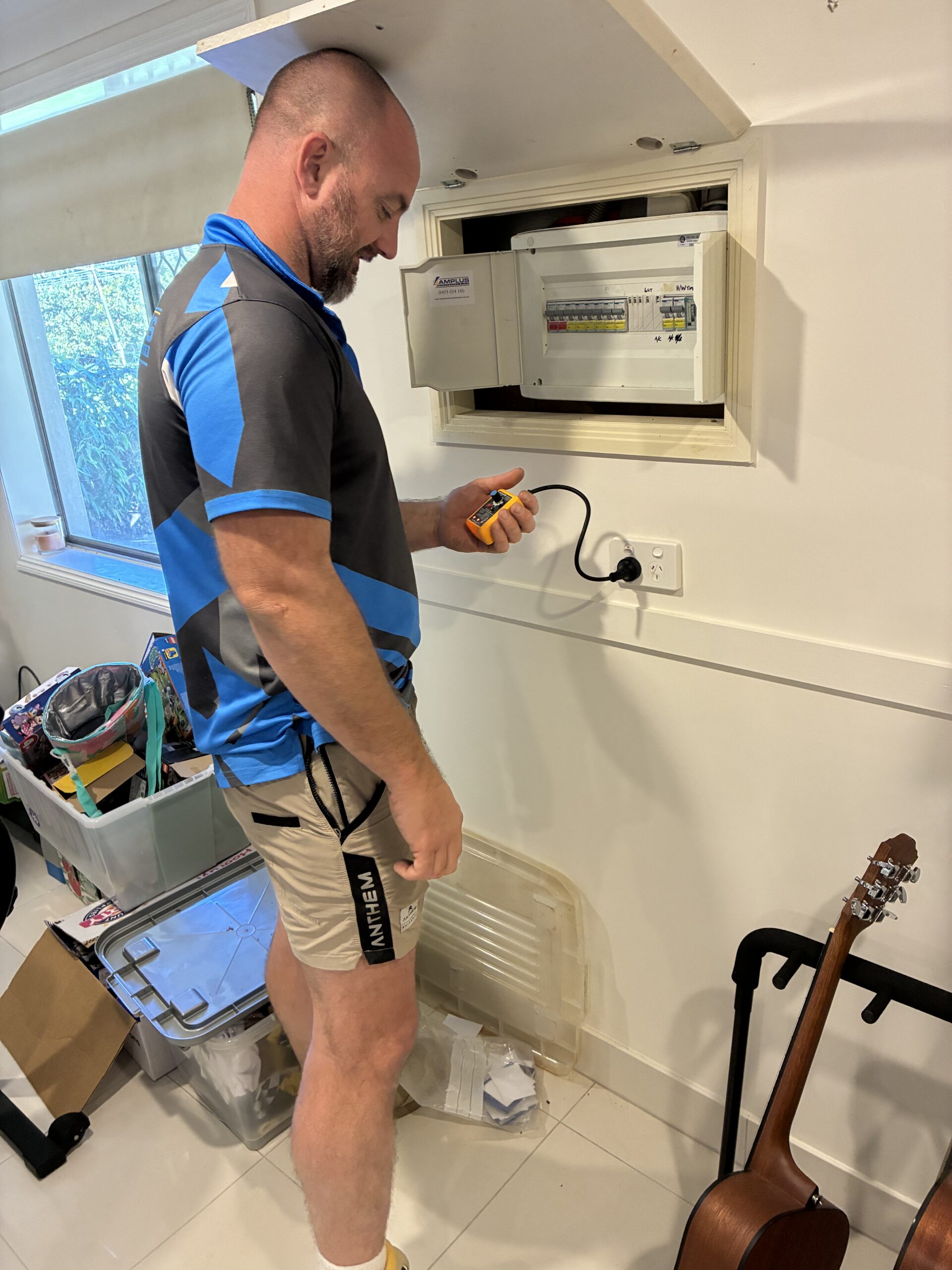
Example 1: Full Home Upgrade in Capalaba
The job: 1990s home with 20 halogen downlights throughout. Customer complained about high electricity bills and constant bulb replacements. We replaced all 20 with integrated LED downlights (10W, 4000K cool white for kitchen/living, 3000K warm white for bedrooms).
The cost: $1,400 (20 lights @ $70 each)
The savings: $450 per year on electricity. Payback in 3.1 years.
Example 2: Kitchen + Living Room in Cleveland
The job: Customer wanted better light quality in the main living areas. Replaced 12 halogen downlights with tri-colour LED downlights (switchable between 3000K/4000K/5000K). Installed two new LED-compatible dimmer switches.
The cost: $960 (12 lights @ $70) + $240 (2 dimmers @ $120) = $1,200
The savings: $270 per year. Payback in 4.4 years. Customer said the light quality transformation was “night and day.”
Example 3: Outdoor Security Lighting in Victoria Point
The job: Replaced 6 old halogen floodlights with LED security lights (30W each, motion sensor). Customer wanted better security and lower power bills.
The cost: $900 (6 lights @ $150 each)
The savings: $180 per year. Payback in 5 years. But the real win was the improved security — the LED lights are brighter, more reliable, and the motion sensors are more responsive.
DIY vs Professional Installation
This is a common question. Can you change halogen bulbs to LED yourself?
Simple bulb swap (same fitting): If your halogen fitting accepts a standard GU10 or MR16 LED bulb, you can swap the bulb yourself. However, you may still need an electrician to remove the old halogen transformer, as running LEDs through halogen transformers can cause flickering and premature failure.
Full downlight replacement: Replacing the entire fitting (the most common and best approach) is electrical work. In Queensland, this must be done by a licensed electrician. The old fitting, transformer, and wiring are removed and replaced with an integrated LED unit.
Our recommendation: A full downlight replacement is almost always better than a bulb-only swap. Integrated LED downlights are more reliable, better sealed against ceiling insulation, and come with proper IC-4 fire ratings. The cost difference per light is minimal when done professionally.
What About Fluorescent Tubes?
If your home, garage, or workshop still has fluorescent tube fittings, upgrading to LED tubes or LED panel lights is equally worthwhile:
- Energy savings: LED tubes use 40-60% less power than fluorescent tubes
- No flickering: Fluorescent tubes often develop an annoying flicker as they age. LEDs don’t.
- No ballast issues: Fluorescent fittings have ballasts that fail over time and waste energy. LED tubes can bypass the ballast entirely.
- Instant on: LEDs reach full brightness immediately. Fluorescent tubes take time to warm up, especially on cold mornings.
Replacing fluorescent fittings is licensed electrical work. A qualified electrician can advise on whether to retrofit LED tubes into existing fittings or replace the entire fitting with a modern LED panel.
Brisbane-Specific Considerations
- Ceiling insulation and fire ratings. Queensland homes often have ceiling insulation that sits directly against downlight fittings. Halogen lights need insulation clearance (fire risk). IC-4 rated LED downlights can be directly covered with insulation — safer and better for your home’s thermal performance.
- Outdoor lighting in Brisbane’s climate. Brisbane’s humidity, UV exposure, and storm season are tough on outdoor fittings. Choose IP65 or higher rated LED fittings for outdoor areas. Quality fittings with UV-stable housings last significantly longer in our conditions.
- Air conditioning interaction. Halogen lights pump heat into your rooms, making your air conditioning work harder. Switching to LED reduces heat load, which can noticeably reduce AC running costs — especially in summer.
- Solar synergy. If you have solar panels, LED lighting means you use less grid power during the evening. Combined with a battery system, LEDs help maximise your solar investment.
Choosing the Right LED Downlight for Brisbane Homes
Not all LEDs are created equal. Here’s what to look for:
For a deep technical comparison of halogen vs LED specifications — colour temperature, CRI, beam angles, IP ratings, and dimming compatibility — see our complete halogen vs LED downlights technical guide.
Wattage and Brightness
For most rooms, 8-10W LED downlights (equivalent to 50-65W halogen) provide plenty of light. For larger rooms or higher ceilings, you might want 12-15W. Avoid cheap 5W LEDs — they’re often underpowered and don’t last as long.
Colour Temperature
- 2700-3000K (warm white): Best for living rooms, bedrooms, dining areas. Creates a cozy, relaxed atmosphere.
- 4000K (cool white): Best for kitchens, bathrooms, home offices. Brighter, more alert feeling.
- 5000-6500K (daylight): Best for garages, workshops, task lighting. Very bright, almost blue-white.
Tri-colour LEDs let you switch between these options, which is handy if you’re not sure what you want.
Beam Angle
Standard beam angle is 60-90 degrees, which works for most rooms. For wider coverage (larger rooms), look for 100-120 degree beams. For focused task lighting (kitchen benches, desks), 40-60 degrees is better.
Brand Quality
We use Australian-compliant LED downlights from reputable brands like Clipsal, HPX, and Mercator. Cheap imports from eBay or Bunnings might save $10-20 per light, but they often have poor colour rendering, shorter lifespans, and no warranty. For a detailed comparison of downlight brands and costs, see our downlight installation cost guide.
Common LED Upgrade Mistakes to Avoid
1. Using Non-IC-Rated LEDs with Ceiling Insulation
IC-4 rated LEDs are approved for direct contact with insulation. Non-IC-rated LEDs need clearance, which compromises your ceiling’s thermal performance. Always confirm the IC rating before installation.
2. Not Upgrading the Dimmer Switch
Old halogen dimmers often cause flickering or buzzing with LEDs. A simple dimmer upgrade to an LED-compatible model fixes this. It’s a quick job that can be done during the LED installation.
3. Choosing the Wrong Colour Temperature
5000K daylight LEDs in a living room feel like a hospital. 2700K warm white in a kitchen can feel too yellow. Match the colour temperature to the room’s purpose.
4. Buying Cheap LEDs
Cheap LEDs often have poor colour rendering (CRI <80), which makes colours look washed out. They also have shorter lifespans and no warranty. Spend an extra $10-20 per light for quality LEDs from reputable brands.
5. Not Considering the Whole Home
Replacing just a few lights creates inconsistency. Doing the whole home at once is more cost-effective (the call-out fee is the same whether you replace 5 lights or 20) and gives you consistent light quality throughout.
LED Lighting Maintenance Tips for Brisbane Homes
One of the biggest advantages of LED lighting is minimal maintenance, but a few simple practices keep your system performing at its best:
Keep Fixtures Clean
Dust and debris accumulate on LED fixtures over time, reducing light output by up to 20%. In Brisbane’s humid climate, dust sticks more readily. Wipe down fixtures every 3-6 months with a soft, dry cloth. For outdoor fixtures, rinse with a garden hose (no pressure washer) to remove pollen and salt buildup.
Check for Flickering
If an LED starts flickering, it’s usually one of three issues: incompatible dimmer switch, loose connection, or failing driver. Flickering isn’t just annoying — it can cause headaches and eye strain. A licensed electrician can diagnose and fix the issue quickly.
Monitor Energy Bills
After your LED upgrade, track your electricity bills for the first 3-6 months. You should see a noticeable drop in lighting costs. If savings aren’t as expected, it could indicate an issue with the installation or that you’re using lights more than calculated.
Test Motion Sensors Annually
For outdoor LED security lights with motion sensors, test the sensor range and sensitivity once a year. Brisbane’s heat and humidity can affect sensor calibration over time. Most sensors have adjustment screws for range and duration — consult the manufacturer’s guide or call an electrician.
LED Lighting vs Other Energy-Saving Upgrades
How does LED lighting stack up against other common energy-saving improvements for Brisbane homes?
| Upgrade | Typical Cost | Annual Savings | Payback Period |
|---|---|---|---|
| LED lighting (full home) | $900-$1,500 | $400-$500 | 2-3 years |
| Ceiling insulation upgrade | $1,500-$3,000 | $300-$600 | 3-6 years |
| Split system air conditioner (energy-efficient) | $2,500-$4,500 | $500-$800 | 4-7 years |
| Solar panel system (5kW) | $5,000-$8,000 | $1,200-$1,800 | 4-6 years |
| Hot water heat pump | $3,000-$5,000 | $600-$900 | 4-6 years |
LED lighting offers the fastest payback period of almost any energy upgrade. It’s also the least disruptive — most homes can be fully upgraded in a single day with no mess, no structural changes, and immediate results.
For maximum impact, combine LED lighting with other upgrades. LED lighting reduces your overall electricity consumption, which means a smaller solar panel system can meet your needs. Similarly, reduced heat from LEDs means your air conditioner doesn’t work as hard, extending its lifespan and reducing maintenance costs.
Common Questions About LED Lighting in Older Brisbane Homes
Can LED lights be installed in 1970s-1980s homes?
Absolutely. Most Brisbane homes from the 70s and 80s have halogen downlights that are perfect candidates for LED upgrades. The existing wiring is usually in good condition, and the conversion is straightforward. We’ve upgraded hundreds of older homes across the Redlands — from Capalaba to Cleveland to Victoria Point.
What if my home has old wiring?
If your home still has the original wiring from the 60s or 70s, it’s worth having an electrician check the condition before installing LEDs. Old wiring isn’t necessarily a problem for LEDs (they draw less power than halogens), but it might indicate that your switchboard needs upgrading. For more on this, see our switchboard upgrade cost guide.
Will LEDs work with my existing light fittings?
In most cases, yes. LED downlights are designed to fit standard ceiling cutouts (typically 70-90mm diameter). If your existing halogen downlights have standard cutouts, the LED replacement will fit without modifying the ceiling. For non-standard sizes, an electrician can advise on the best solution.
Do I need to upgrade my switchboard for LED lighting?
Almost never. LED lights draw so little power that they actually reduce the load on your switchboard. A typical home with 20 LED downlights uses less than 200W total — compared to 1000W for halogens. If your switchboard needs upgrading for other reasons (old fuses, insufficient circuits, safety switches), it makes sense to do it at the same time, but LEDs themselves won’t trigger the need for an upgrade.
Frequently Asked Questions
How much can I save by switching to LED?
A typical Brisbane home with 15-20 halogen downlights saves $400-$500 per year on electricity by switching to LED. The exact saving depends on the number of lights, hours of use, and your electricity rate.
Do LED lights really last 25,000 hours?
Quality LED lights do, yes. Cheap imports may not. We use Australian-compliant LED downlights from reputable brands. At 4 hours of daily use, a 25,000-hour LED lasts over 17 years.
Will LED lights work with my existing dimmer?
Possibly not. Older dimmer switches designed for halogen bulbs often cause flickering or buzzing with LEDs. A simple dimmer upgrade to an LED-compatible model fixes this. It’s a quick job that can be done during the LED installation.
Are LED downlights safe against ceiling insulation?
IC-4 rated LED downlights are approved for direct contact with ceiling insulation. This is a significant safety improvement over halogen fittings, which require clearance and heat shields. Always confirm the IC rating before installation.
Can I replace just some lights, or should I do the whole house?
You can replace lights in stages, but doing the whole house at once is more cost-effective. The call-out fee is the same whether you replace 5 lights or 20. Most homeowners find the per-light cost drops significantly when doing a full home upgrade.
Do LED lights affect my switchboard?
LEDs draw much less power than halogens, so they actually reduce the load on your switchboard and circuits. However, if your switchboard is old and needs upgrading for other reasons, it makes sense to do both at the same time. Not sure if your switchboard needs attention? Check our guide on signs your switchboard needs replacing. For more on switchboard upgrades, see our switchboard upgrade cost guide.
What colour temperature should I choose?
For most Brisbane homes: warm white (2700-3000K) for living areas and bedrooms, cool white (4000K) for kitchens and bathrooms, daylight (5000-6500K) for garages and workshops. Tri-colour (selectable) LEDs give you flexibility to adjust.
Is it worth upgrading if I’m planning to sell?
Yes. Modern LED lighting is one of the most cost-effective upgrades for improving a home’s presentation. It makes rooms look brighter and more contemporary. Buyers notice — and it’s a fraction of the cost of a kitchen or bathroom renovation.
How long does an LED upgrade take?
For a typical 3-bedroom home with 15-20 lights, the upgrade takes 4-6 hours. We can usually complete it in a single visit. Your power will be off for about 30 minutes while we isolate the lighting circuit.
Do I need to remove the old halogen transformer?
Yes. Running LEDs through old halogen transformers can cause flickering and premature failure. We remove the transformer and wire the LED directly to mains power. This is part of the standard installation.
Ready to Upgrade Your Lighting?
An LED upgrade is one of the best value improvements you can make to a Brisbane home. Lower power bills, better light quality, reduced fire risk, and no more constant bulb replacements.
Get a Free LED Lighting Assessment
Book a licensed electrician to assess your lighting and provide an upfront quote. Same-day service across Brisbane and the Redlands.
📋 Book Online 📞 Call 0419 014 146Aaron Ross is a Master Electricians member, licensed electrician and owner of Amplus Electrical & Air in Capalaba, Brisbane. He holds Queensland Electrical Contractor Licence #1500996 and ARCtick Licence L183747 for refrigerant handling. Amplus serves Brisbane, the Redlands, and Bayside suburbs with same-day LED lighting upgrades.
Need a Licensed Electrician in Brisbane Bayside?
Aaron is a licensed electrician (Lic. 1500996) and ARC-certified A/C technician serving Capalaba, Cleveland, Wynnum, Manly, Birkdale, Thornlands, Victoria Point and surrounding suburbs. Honest advice, upfront pricing, and quality work guaranteed.