How Much Does It Cost to Run a Split System Air Conditioner in Brisbane? (2026 Guide)
In 2026, a typical inverter split system costs roughly $0.20–$0.75 an hour to run in Brisbane — about $0.23/hr for a small bedroom unit through to $0.73/hr for a large open-plan system running flat out. Because modern inverters ease off once the room hits temperature, your real-world cost is usually 40–60% lower than that. For most Redlands homes, expect around $30–$90 a month per system across summer.
If you’ve ever flicked on the air con during a Brisbane February and quietly winced thinking about the next power bill — you’re in good company. It’s one of the most common questions I get on the tools: “Aaron, what’s this thing actually costing me to run?”
The good news is that running costs are far more predictable than most people fear — once you understand how they’re worked out. The bad news is that plenty of online calculators get the maths flat wrong and scare people into sweating through summer for no reason. So let’s do it properly, with real South East Queensland electricity prices and the kind of numbers you’ll genuinely see on your bill. For Redlands-specific installation info, see our Redlands split system guide.
Curious about what happens during installation? See our complete installation day guide.
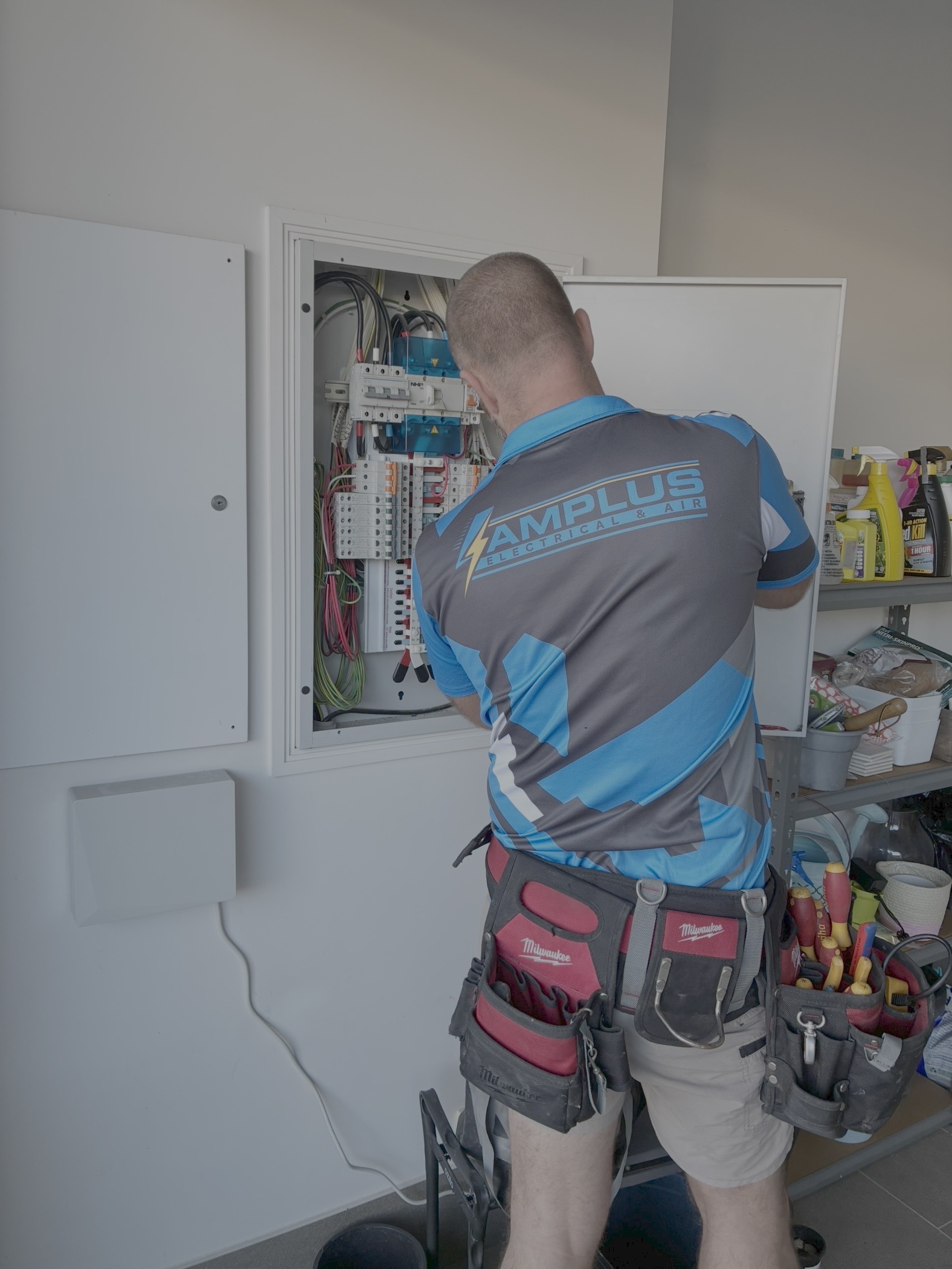
I’m Aaron, a licensed electrician and ARCtick-certified air conditioning technician at Amplus Electrical & Air in Capalaba. I install and service split systems right across the Redlands and Brisbane’s Bayside — Cleveland, Victoria Point, Wynnum, Alexandra Hills, all the way out to Redland Bay. After fitting hundreds of systems in Brisbane homes, I’ve seen exactly what drives running costs up (and what keeps them down). This guide is the honest version, based on real SEQ electricity rates and the kind of usage patterns I see in actual households, not marketing brochures.
Whether you’re trying to work out if that new split system will blow your power bill through the roof, or you’re comparing running costs between a split and a ducted setup, this is the plain-English breakdown. No jargon, no scare tactics — just the numbers you need to make a confident decision.
For the full installation pricing breakdown, head over to our Brisbane air conditioning installation cost guide. If you’re still deciding between split and ducted, the split vs ducted comparison covers the long-term cost differences in detail.
⚡ How Split System Running Costs Actually Work (the bit most guides get wrong)
Here’s the mistake nearly everyone makes: they see a “5kW split system” and assume it chews through 5 kilowatts of electricity. It doesn’t — not even close.
That kW rating is the cooling (or heating) capacity — how much heat the unit can shift — not how much power it pulls from the wall. Air conditioners move heat rather than create it, which makes them remarkably efficient — which is why a properly installed split system is one of the most cost-effective ways to cool or heat a room. A good inverter split produces roughly 3 to 4 units of cooling for every 1 unit of electricity it uses (that’s its energy-efficiency ratio).
So a 5kW-capacity unit might only draw about 1.5kW of actual power when it’s working hard — and significantly less once the room is comfortable.
The formula itself is dead simple:
Power drawn (kW) × hours run × your electricity rate ($/kWh) = cost
In South East Queensland in 2026, residential power on the Energex network runs roughly 30–35 cents per kWh, depending on your retailer and plan. I’ve used $0.33/kWh for every example below — check your latest bill for your exact rate.
Worked example: a 5kW unit drawing 1.5kW, run for 3 hours on a hot evening:
1.5 kW × 3 hrs × $0.33 = about $1.49 — and that’s at full noise. Once the room settles, it’s less.
⚡ What It Costs to Run a Split System by Size (2026)
These figures are the unit running at full power — a hot day, pulling a warm room down to temperature. Once it gets there, the inverter throttles back and the cost drops.
For a detailed breakdown of split system running costs, see our guide on split system installation costs in Brisbane.
| System size (capacity) | Typical power draw (flat out) | Cost per hour @ $0.33/kWh | Best suited to |
|---|---|---|---|
| 2.5 kW | ~0.7 kW | ~$0.23/hr | Bedroom, study, nursery |
| 3.5 kW | ~1.0 kW | ~$0.33/hr | Large bedroom, small lounge |
| 5.0 kW | ~1.5 kW | ~$0.50/hr | Living area, open-plan kitchen |
| 7.0–8.0 kW | ~2.2 kW | ~$0.73/hr | Large open-plan living |
The bit to remember: those are maximum numbers. Thanks to inverter technology, the average draw once a room is settled is often 40–60% of the figure above — so a 5kW unit holding a comfortable lounge might really be costing you 25–35 cents an hour, not 50.
How Star Ratings Affect Your Running Costs (the real savings over 10 years)
Air conditioners in Australia carry a mandatory energy rating label showing two numbers: the capacity in kW and a star rating from 1 to 10. That star rating isn’t just marketing — it’s the single biggest predictor of what you’ll actually pay in electricity over the life of the unit.
Here’s what the difference looks like in real money, based on a 5kW reverse-cycle split system running 6 hours a day for 4 months of the year (typical Brisbane summer usage):
| Star rating | Annual running cost | 10-year running cost | Savings vs 5-star |
|---|---|---|---|
| 5.0 stars | $1,460 | $14,600 | — |
| 6.0 stars | $1,220 | $12,200 | $2,400 saved |
| 7.0 stars | $1,060 | $10,600 | $4,000 saved |
| 8.0 stars | $920 | $9,200 | $5,400 saved |
Those numbers are based on current Energex Tariff 11 rates and assume proper sizing and maintenance. The gap between a 5-star and 7-star unit is roughly $400 a year — and over a 10-year lifespan, that’s $4,000 in electricity savings. The 7-star unit might cost $500–$800 more upfront, but it pays for itself inside two years and keeps saving after that. Before summer hits, check our split system summer preparation guide.
When you’re comparing quotes, always ask for the energy rating label. If the installer can’t show you the star rating, walk away. You can also check any model on the Australian Government Energy Rating website — it’s a free database of every registered air conditioner sold in Australia.
Split System Running Costs vs Other Household Appliances
To put air conditioning costs in perspective, here’s how a split system stacks up against other energy-hungry appliances in a typical Brisbane home:
| Appliance | Typical power draw | Cost per hour | Monthly cost (heavy use) |
|---|---|---|---|
| Split system (5kW) | ~1.5 kW | $0.50/hr | $45/month (5 hrs/day) |
| Refrigerator (modern) | ~0.15 kW (avg) | $0.05/hr | $36/month (24/7) |
| Electric oven | ~2.0 kW | $0.66/hr | $20/month (1 hr/day) |
| Clothes dryer | ~2.5 kW | $0.83/hr | $25/month (1 hr/week) |
| Pool pump | ~0.75 kW | $0.25/hr | $54/month (8 hrs/day) |
| EV charger (home) | ~7.0 kW | $2.31/hr | $70/month (1 hr/day) |
The air con looks expensive until you realise the pool pump is costing you more every month because it runs longer. And a clothes dryer for an hour costs nearly twice what the air con costs for the same time. The difference is that people run the air con for 5–8 hours on a hot day, which is when the bill adds up.
For context, an EV home charger running for an hour costs about $2.30 — four and a half times what the split system costs. If you’re worried about electricity bills, the air con is rarely the biggest culprit. It’s the stuff that runs 24/7 or gets used for hours at a time that really adds up.
Cooling vs Heating — Which Costs More in Brisbane?
Good news for us locals: a reverse-cycle split is the cheapest way going to heat a room — far cheaper than any plug-in electric heater, thanks to that same heat-moving efficiency.
In Brisbane’s mild winters, heating usually costs about the same or a touch less than cooling, simply because the gap between inside and outside temperature is smaller than on a 35°C scorcher. The big bills always come from summer cooling on the hottest, stickiest days — exactly when the unit runs closest to full power. Warming your Bayside home overnight in July barely registers next to a February heatwave.
Seasonal Running Costs: What to Expect Through the Year
Brisbane’s climate means your air con usage swings hard between seasons. Here’s what a typical Redlands household sees across the year, based on actual customer bills I’ve reviewed:
| Season | Months | Typical usage | Monthly cost (5kW unit) |
|---|---|---|---|
| Summer | Dec–Feb | 5–8 hrs/day cooling | $75–$120 |
| Autumn | Mar–May | 2–4 hrs/day (shoulder season) | $30–$50 |
| Winter | Jun–Aug | 3–5 hrs/day heating (cool nights) | $40–$65 |
| Spring | Sep–Nov | 1–3 hrs/day (occasional use) | $15–$30 |
Annual total for a single 5kW split system: roughly $480–$720 per year, depending on how hard you run it and how well-insulated your home is. Most homes I visit in the Redlands have two or three split systems, so total annual air con costs typically land between $1,000–$2,000 for the whole house.
Compare that to a ducted system cooling the entire house at once — which can run $1,500–$2,500+ per year — and you can see why split systems are the default choice for Brisbane homes. You only cool the rooms you’re actually using, not the spare bedroom or the garage.
Real-World Monthly Running Cost Examples
Here’s what it looks like for a few typical Redlands households (at $0.33/kWh, using realistic averaged inverter draw):
- Bedroom (2.5kW), 8 hours overnight cooling, summer → about $1.20 a night → roughly $36 a month.
- Living area (5kW), 5 hours each evening → about $1.50 a day → roughly $45 a month.
- Open-plan (7kW), heavy all-day weekend use in peak summer → $4–$6 a day on the big days.
Your real numbers move with how hot it is, the temperature you set, how well your home holds it, and how efficient your unit is. But for most homes, a single well-sized split is a $30–$90/month proposition over summer — not the budget-wrecker people brace for.
Quick Room Sizing Guide — Match the Unit to the Space
Getting the size right is the single biggest factor in keeping running costs low. An undersized unit runs flat out and never catches up; an oversized one short-cycles and wastes energy. Here’s a rough guide for Brisbane homes with standard 2.7m ceilings:
| Room size | Recommended capacity | Typical power draw | Hourly cost |
|---|---|---|---|
| Up to 20m² (bedroom, study) | 2.5 kW | ~0.7 kW | $0.23/hr |
| 20–40m² (large bedroom, lounge) | 3.5 kW | ~1.0 kW | $0.33/hr |
| 40–60m² (open-plan living) | 5.0 kW | ~1.5 kW | $0.50/hr |
| 60–80m² (large open-plan) | 7.0–8.0 kW | ~2.2 kW | $0.73/hr |
| 80m²+ (whole-floor living) | Multi-head or ducted | Varies | $1.00–$2.50/hr |
These figures assume average insulation and north/east aspect. Rooms with full western sun, raked ceilings, or large glass areas need to go up one size — that’s where most installs get it wrong. I always measure the room, check the insulation, and factor in the aspect before quoting. If another installer just asks “what size is the room?” without checking those other factors, they’re guessing.
For a deeper dive into sizing and why it matters, the air conditioning installation cost guide breaks it down room by room.
What Makes Your Split System Cost More to Run
Five things move the needle most:
- The temperature you set. Every degree below about 24–25°C can add roughly 10% to your running cost. Cranking it to 18°C doesn’t cool the room any faster — it just makes the unit grind harder for longer.
- The unit’s energy rating. More stars = less power for the same cooling — check the Energy Rating label when comparing models. Over a 10-year life, a cheap low-star unit can quietly cost you hundreds more.
- Sizing. An undersized unit runs flat out and never catches up; an oversized one short-cycles and wastes energy. Getting this right is everything.
- Your home. Insulation, ceiling height, window orientation and how much western sun a room cops all change the load.
- Maintenance. A clogged filter or dirty coil forces the unit to work harder for the same result — easily a 5–15% running-cost penalty.
How to Cut Your Split System Running Costs
Practical, no-nonsense wins:
- Set it to 24–25°C in summer (and around 20°C for winter heating). Comfortable and efficient.
- Use the inverter’s “eco” or “economy” mode if it has one — the YourHome energy guide from the Australian Government has more on efficient cooling.
- Clean the filters every few weeks in heavy-use season — two minutes for real savings.
- Run ceiling fans alongside the air con. Moving air feels 2–3°C cooler, so you can set the unit higher for the same comfort.
- Close doors and curtains to the room you’re cooling — don’t pay to cool the whole street.
- Drop the western blinds before the afternoon sun lands.
- Service it regularly so it runs at peak efficiency.
- Size it right at install — the single biggest long-term saving there is.
Does Solar Power Change the Maths?
If you’ve got solar panels on your roof, the running cost calculation shifts significantly. A typical 6.6kW solar system in Brisbane generates enough power to cover most of your daytime air con usage — and if you’ve got a battery, you can store that power for evening use too.
Here’s how it works in practice:
- Daytime cooling (9am–4pm): If your solar system is generating, your air con is essentially running on free electricity. A 5kW split drawing 1.5kW during the day costs you nothing if you’re exporting the rest of your solar to the grid or using it elsewhere in the house.
- Evening cooling (5pm–10pm): Once the sun goes down, you’re drawing from the grid again — unless you’ve got a battery. With a battery, you can store your daytime solar and use it to run the air con in the evening at effectively zero cost.
- Annual savings: A household with a 6.6kW solar system and a 10kWh battery can cut their air con running costs by 60–80% compared to a grid-only home. That’s the difference between paying $600/year and $120/year for the same cooling.
Without a battery, you’re still saving during the day, but evening usage hits the grid at full price. The payback period for a battery depends on how much evening air con you run — if you’re cooling bedrooms overnight, a battery makes a lot of sense. If you’re only cooling during the day, the solar panels alone are enough.
For a full breakdown of solar panel installation costs and payback periods in Brisbane, check out our solar panel installation cost guide.
Does a Bigger (or Cheaper) Unit Cost More to Run?
Not necessarily — and this trips a lot of people up.
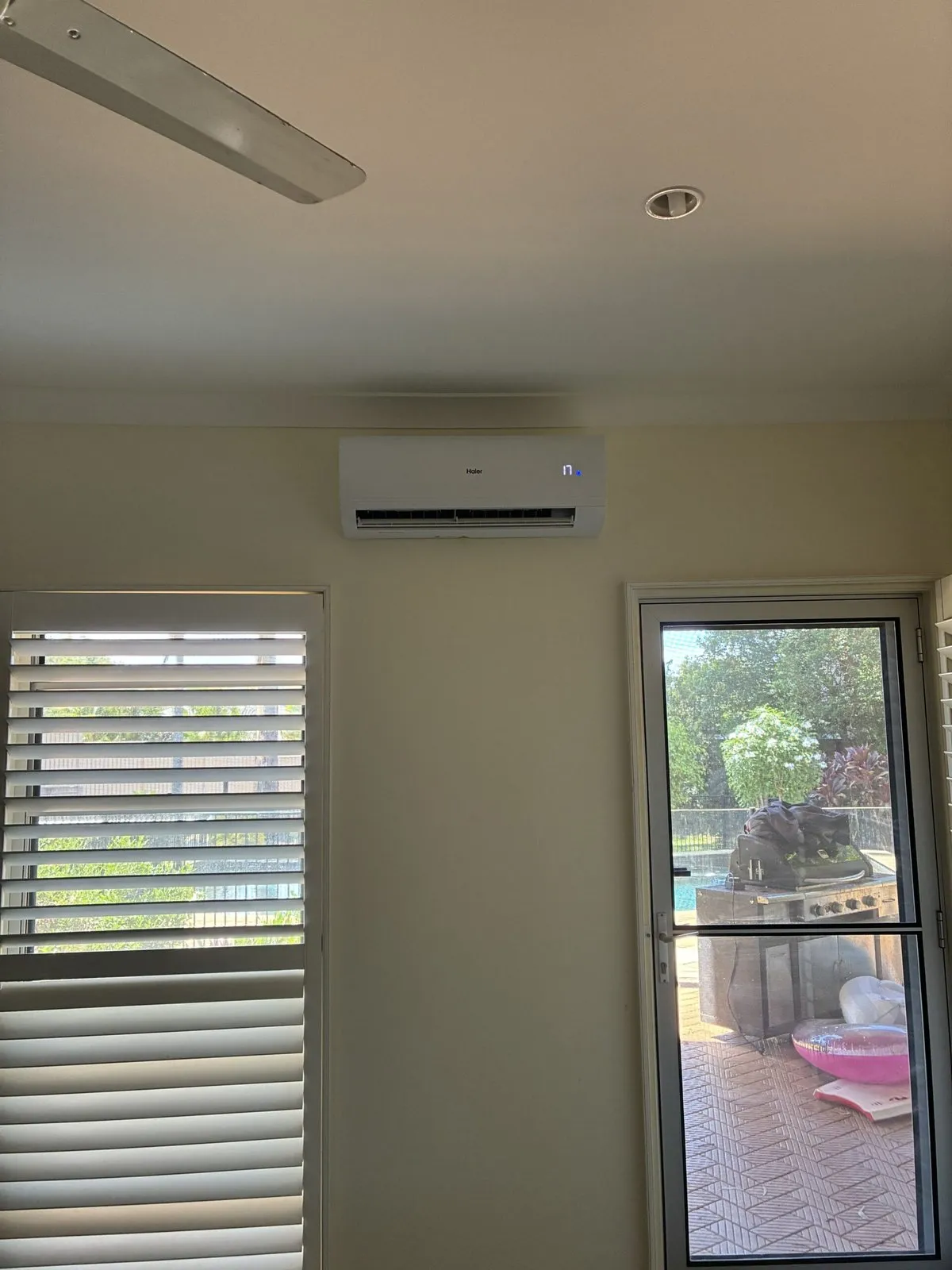
A bigger unit isn’t automatically dearer to run. A correctly sized larger unit cooling a big room can actually be cheaper than a too-small unit straining flat out in the same space, because it reaches temperature and backs off. The real problem is an oversized unit in a small room — it short-cycles on and off and wastes energy.
And a cheap unit is rarely cheap to own. A bargain low-star split might save you a few hundred up front, then quietly cost you more every summer for a decade. When you’re comparing quotes from air conditioning installers in Brisbane, look at the energy rating, not just the sticker — I dig into this in the air conditioning installation cost in Brisbane guide, and if you’re still weighing your options, the split system vs ducted air conditioning comparison will help you choose. For a detailed breakdown of the most energy-efficient split system brands and how they compare over 10 years of running costs, check out our comprehensive brand guide.
One Trade, One Quote, One Job Done Properly — the Electrical Side of Running Costs
This is where being a licensed electrician and an ARC-certified A/C tech actually matters — because most of the running-cost problems I’m called out to fix are electrical, not the unit itself.
- Undersized or poorly run cabling causes voltage drop, which makes the compressor work harder and hotter — bleeding efficiency.
- An old or overloaded switchboard can mean your air con isn’t on a proper dedicated circuit. Units over 3.5kW generally need their own circuit; sharing one is inefficient and a genuine safety risk. If your board is full of old fuses or trips when the air con kicks in, it’s worth reading the signs your switchboard needs replacing — or looking at a switchboard upgrade.
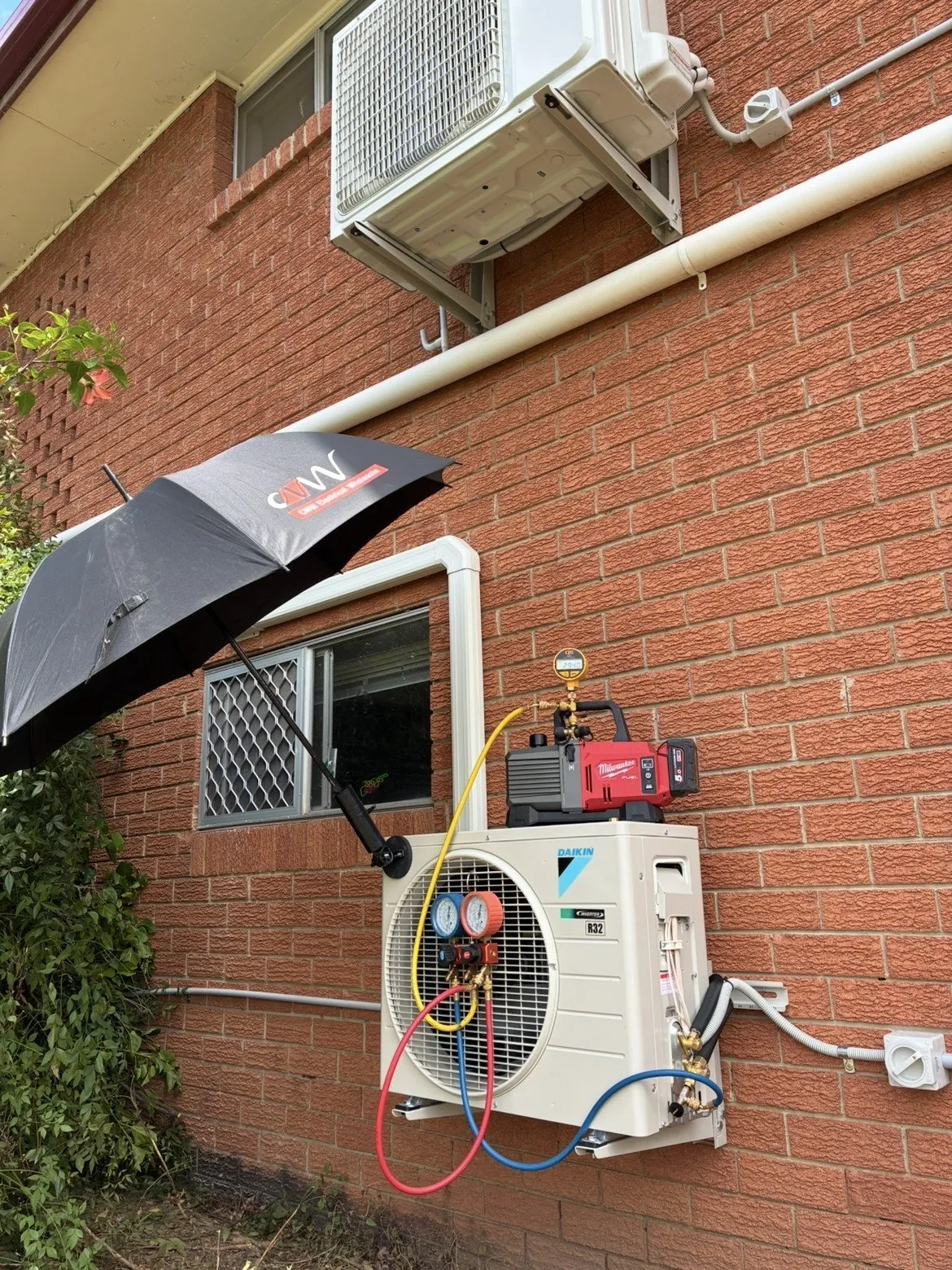
- A dodgy install — wrong refrigerant charge, poor pipe runs, bad placement — quietly drains efficiency for the entire life of the system. All refrigerant and electrical work must comply with Australian Standards (AS/NZS 3000 and AS/NZS 5149).
The advantage of using Amplus is simple: we do both sides in one visit. Aaron — a Master Electricians member and licensed electrician (Lic. 1500996) — handles the refrigeration and the electrical work together, so the system is sized, wired and charged to run as cheaply as it should — no finger-pointing between a sparky and an air con mob.
Want a system that’s cheap to run, not just cheap to buy? 📋 Request a Quote or 📞 Call Aaron 0419 014 146 for honest, upfront advice.
Split System Running Costs Across the Redlands
Kilowatt for kilowatt, running costs are the same wherever you are in the Bayside — what changes is the home. Older Cleveland and Wynnum homes often have less insulation and need a touch more grunt; newer builds around Victoria Point and Thornlands usually run leaner. I install and service split systems right across Capalaba — and if you’re after a full air conditioning installation in the Redlands, I handle ducted and split systems alike, Cleveland, Victoria Point, Wynnum, Alexandra Hills, Birkdale, Redland Bay and the surrounding suburbs — and I’ll always size to your home, not a marketing sticker.
Frequently Asked Questions
How much does it cost to run a split system per hour in Brisbane?
For a typical inverter unit in 2026, roughly $0.20–$0.75 an hour at full power — about $0.23/hr for a 2.5kW bedroom unit up to $0.73/hr for a 7kW open-plan system, based on a $0.33/kWh SEQ rate. Real-world averages are usually lower once the room reaches temperature.
Is it cheaper to leave the air con on all day or turn it on and off?
For short absences (an hour or two), leaving an inverter running at a steady, sensible temperature is often cheaper than letting the room heat up and forcing a hard restart. For longer absences, switch it off. The old “just leave it on all day” advice doesn’t apply to modern inverters the way people think.
What temperature should I set my air con to save money?
Around 24–25°C for cooling and about 20°C for heating. Every degree colder in summer adds roughly 10% to your running cost — and setting it lower doesn’t cool the room any faster.
Do split systems cost more to run for heating or cooling?
In Brisbane, heating is usually as cheap or cheaper than cooling, because our winters are mild and reverse-cycle heating is extremely efficient. Your biggest bills come from cooling on the hottest summer days.
Does a bigger air conditioner cost more to run?
Not if it’s sized correctly. A right-sized larger unit reaches temperature and throttles back. The costly mistakes are an undersized unit running flat out, or an oversized one short-cycling in a small room.
How much can a higher energy (star) rating save me?
A more efficient unit uses less power for the same cooling. Over a 10-year lifespan, a higher-rated model can save hundreds of dollars in running costs — often far more than the price difference at purchase. A 7-star unit can save $4,000+ over 10 years compared to a 5-star unit.
Why is my air conditioner suddenly costing more to run?
Common culprits: clogged filters or a dirty coil, low refrigerant from a leak, an ageing unit, or simply hotter weather making it work harder. A service usually sorts the first few.
Can a bad installation increase my running costs?
Yes — significantly. Incorrect refrigerant charge, poor pipe runs, an undersized circuit or voltage drop from bad cabling all make the system labour harder than it should. A proper licensed install pays for itself in lower bills.
Does solar power reduce air con running costs?
Absolutely. If you’ve got solar panels, daytime air con usage is essentially free. With a battery, you can store that power for evening use too. A 6.6kW solar system with a 10kWh battery can cut air con running costs by 60–80% compared to a grid-only home.
How much does air conditioning add to my electricity bill each year?
For a typical Brisbane home with one or two split systems, expect $480–$720 per year for cooling and heating. Homes with three or more systems or ducted air conditioning can see $1,000–$2,500+ annually, depending on usage and efficiency.
Get the Right System — and the Right Running Cost
The cheapest air conditioner to run is the one that’s sized, installed and wired correctly for your home from day one. If you want straight answers on what a system will cost you to run — before you buy — I’m happy to take a look.
📋 Request a Quote · 📞 Call Aaron 0419 014 146 · Book an air conditioning assessment online.
If your current split system is costing more to run than it should — especially if it’s over 10 years old or using R22 refrigerant — our split system replacement guide walks through the repair vs replace decision, including real running cost comparisons and pricing for Brisbane homes.
For more on split system running costs, see our a leaking aircon can increase running costs guide.
Aaron is a licensed electrician (Lic. 1500996) and ARC-certified air conditioning technician (ARC Lic. L183747) at Amplus Electrical & Air, serving Capalaba, Cleveland, Victoria Point, Wynnum, the Redlands and Brisbane’s Bayside. Upfront pricing, no call-out fees, one trade for both the electrical and the air con.
Need a Licensed Electrician in Brisbane Bayside?
Aaron is a licensed electrician (Lic. 1500996) and ARC-certified A/C technician serving Capalaba, Cleveland, Wynnum, Manly, Birkdale, Thornlands, Victoria Point and surrounding suburbs. Honest advice, upfront pricing, and quality work guaranteed.