Lic No. 1500996 | ARC Lic. L183747 | ARCtick Certified
Happy with our work? Leave us a Google review — it helps a local Burbank EV charger electrician keep showing up for families like yours.
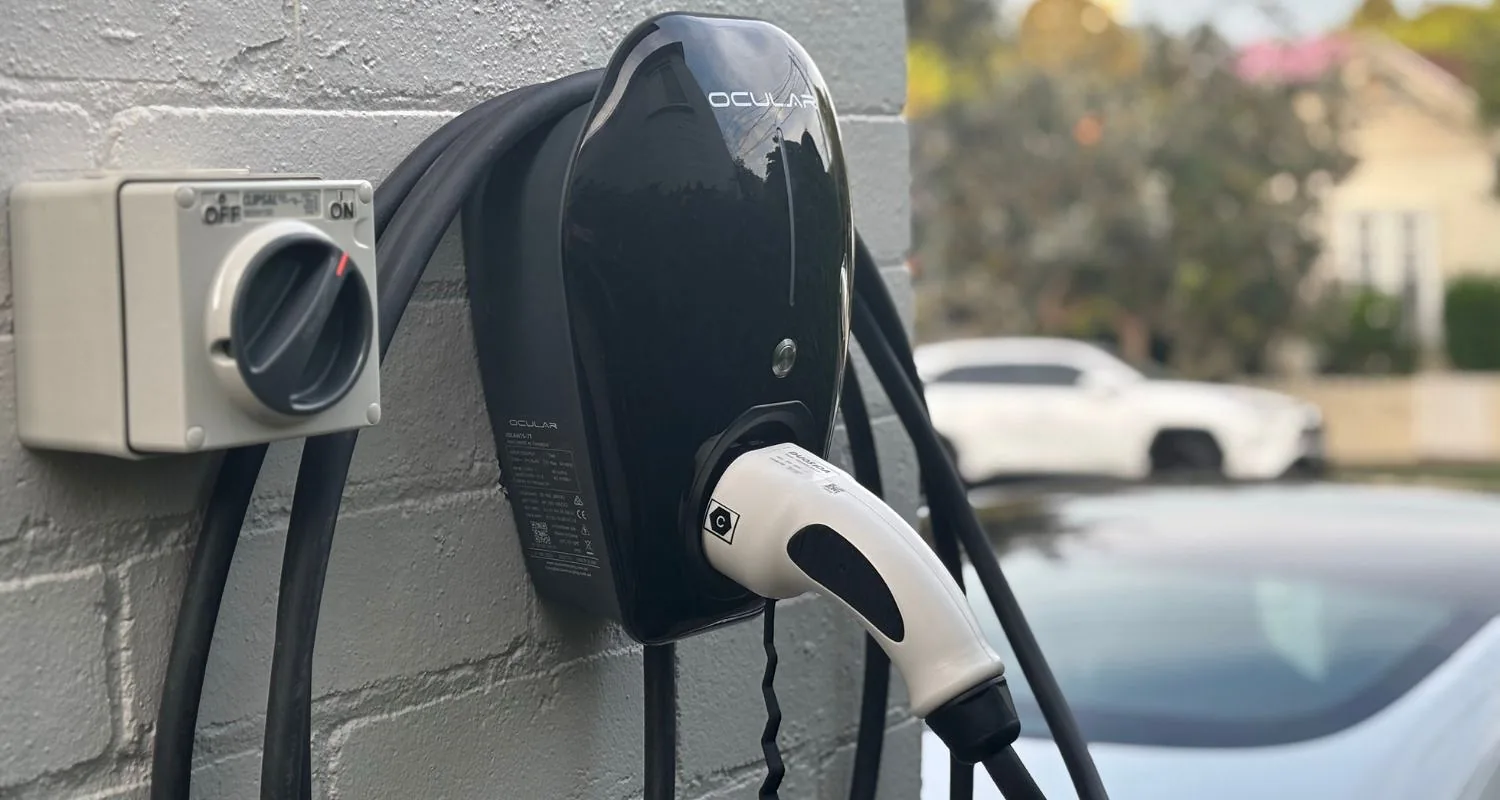
We install, configure and commission all leading EV charger brands available in Australia. Aaron will help you pick the right one for your vehicle, switchboard and solar setup.
The most popular home charger in Australia. Up to 11 kW on single phase, 22 kW on three phase. Wi-Fi connected, sleek, and compatible with all Tesla models. We install and configure it correctly — including Tesla app setup.
For BYD, Polestar, Hyundai, MG, Kia, BMW, Mercedes and any other Type 2 EV. Brands we regularly install include Fronius Wattpilot, ABB Terra, Wallbox Pulsar Plus, Ocular and EVSE. All AS/NZS certified.
Solar-aware chargers (Fronius Wattpilot, Wallbox Pulsar with sensors, Ocular IQ) let you charge from excess PV — useful for Burbank homes already running rooftop solar. We configure them to prioritise solar and stay inside Energex’s 20 A connection limit.
Not sure which charger suits your vehicle? Aaron can advise — 0419 014 146
Burbank homes built from 2005 onward almost universally have modern switchboards, adequate supply capacity, and straightforward garage layouts. The basic EV charger install is easy here. But Burbank also offers something many older suburbs cannot: a high proportion of three-phase supply, strong solar systems on large north-facing roofs, and households who are genuinely planning their home energy future. The opportunity is not just installing a charger — it is designing an integrated charging setup that works with solar, potentially supports two EVs, and fits into a broader electrification plan.
Newer estates, larger roofs, modern electrical infrastructure and forward-thinking households create ideal conditions.
Many Burbank estate homes were built with three-phase supply — originally for ducted air conditioning or pool equipment. This opens up 22kW charging for vehicles that support it, delivering significantly faster charging than single-phase.
Even if your vehicle only accepts 7kW or 11kW today, three-phase infrastructure means you are ready for faster-charging vehicles in future without rewiring.
Burbank’s estate layouts typically feature larger homes with significant north-facing roof area. Many already have 6.6-10kW solar systems generating substantial surplus. Pairing this with a solar-aware EV charger means driving on sunshine rather than grid power.
The economics are compelling: surplus solar exported at 5-8c/kWh is worth 30-35c/kWh when used to charge your EV instead.
From straightforward single-charger installs to three-phase setups and whole-home energy integration.
The reliable baseline for most households — a dedicated charger on the garage wall with proper circuit protection and clean installation.
For homes with three-phase supply and vehicles that support faster AC charging. Significantly reduces charge time for high-kilometre households.
Chargers configured to prioritise your solar surplus, with intelligent scheduling that switches to off-peak grid rates when solar is insufficient.
Circuit design that supports adding a second charger later without major rework — sized for two vehicles from day one.
Having three-phase supply does not automatically mean you need a 22kW charger. Here is when it genuinely adds value.
If your household drives 80km or more daily, a 22kW charger recovers that range in about 1 hour versus 4-5 hours on single-phase. For shift workers or households sharing one charger between two drivers, this speed matters.
Not all EVs can accept 22kW AC charging — many cap at 7kW or 11kW onboard regardless of wall charger output. We check your specific vehicle before recommending three-phase hardware.
If your next vehicle is likely to support faster AC charging (many newer models do), installing three-phase infrastructure now avoids retrofitting later. The cable and protection cost the same whether you use 7kW or 22kW today.
Burbank’s modern infrastructure keeps base costs low while three-phase and solar options add value for households that need them.
Modern boards, short cable runs and easy garage access mean the standard 7kW install is typically at the lower end of the price range. The infrastructure is already there — we just add the dedicated circuit.
A 22kW three-phase install costs more upfront but delivers 3x faster charging. For high-kilometre households or those sharing one charger between two drivers, the time savings are worth the investment.
Even on modern homes with three-phase supply, Energex notification and load management rules apply.
Burbank homes with three-phase supply have more headroom for EV charging, but Energex still requires notification for all EV charger installations and demand management for single-phase chargers above 20A. On three-phase installations, the load is distributed across phases which generally simplifies compliance. We handle all notification and documentation as standard.
No demand management required. Delivers solid overnight charging for typical daily driving. The simplest path on single-phase homes.
Load spread across three phases reduces per-phase impact. Generally straightforward compliance on Burbank homes with adequate three-phase supply.
The right answer depends on your supply type, vehicle capability and how you plan to use the home energy system long-term.
Burbank installs are among the most straightforward in our service area — modern infrastructure with genuine upgrade opportunities.
Burbank estate homes almost always have modern switchboards with spare circuit positions. Board upgrades are rarely needed — we just add the dedicated EV circuit.
A significant proportion of Burbank homes have three-phase supply (originally for ducted AC or pool). This creates an opportunity for faster charging that many owners do not realise they have.
Large north-facing roofs with 6.6-10kW systems are common. Many export significant surplus that could be charging an EV instead of earning minimal feed-in tariff.
Burbank families tend to think in terms of future needs — second EV, home battery, increased solar. We design the charger circuit as part of that bigger picture.
A practical process from first contact to charging confidently at home.
We discuss your EV, driving pattern, supply type (single or three-phase), solar system, and whether future expansion (second EV, battery) is planned.
We specify the charger that matches your vehicle, supply and goals — not over-specifying hardware the car cannot use, not under-specifying for future needs.
Dedicated circuit, protection, charger mounting, solar configuration, Energex notification — completed in one visit where possible.
Full testing, app setup, solar scheduling, and clear handover. We confirm the charger is working optimally with your energy system.
Burbank homeowners typically ask about three-phase options, solar integration and future-proofing for a growing EV household.
Not necessarily. The charger output needs to match what your vehicle can actually accept. Many EVs cap onboard AC charging at 7kW or 11kW regardless of wall charger capability. We check your specific vehicle first — there is no point paying for 22kW hardware the car cannot use. But if your vehicle supports it, three-phase charging is genuinely faster and worth considering.
If a second EV is likely within 3-5 years, absolutely. Running dual-ready cabling and protection during the first install adds $400-$800. Retrofitting a second circuit later — reopening walls, upgrading protection, potentially upgrading the board — costs significantly more. In Burbank where the infrastructure makes this easy, it is a smart investment.
On a typical Burbank home with a 6.6kW system, surplus solar can provide 50-90km of free EV range daily. At grid electricity rates of 30-35c/kWh, that is $5-$10 per day in avoided charging costs — roughly $1,500-$3,000 per year depending on driving pattern and solar production.
Yes. Smart chargers can integrate with home battery systems to coordinate energy flow — solar charges battery and car during the day, battery powers the house at night, grid is the last resort. We install chargers that support this integration even if you do not have a battery yet.
Because on modern estate homes, the value is in energy system design — not just bolting a charger to the wall.
We know when 22kW charging genuinely adds value and when it is over-specifying. Honest advice based on your actual vehicle and driving pattern.
We configure chargers to work with existing solar — maximising self-consumption rather than treating the EV as a separate dumb load.
We think about where your household is heading — second EV, battery storage, increased solar — and design the circuit infrastructure accordingly.
Burbank’s straightforward infrastructure means less labour and fewer surprises. We pass that efficiency on in our pricing.
The EV charger is part of your home energy system. We design it that way rather than treating it as an isolated circuit.
QLD Electrical Licence 1500996. Based locally, servicing Burbank regularly. One electrician who understands your setup.
Answers to the questions Burbank homeowners ask most.
A standard 7kW install in Burbank typically costs $1,100 to $2,200. Solar-integrated smart chargers run $1,600 to $3,000. Three-phase 22kW installations start from $2,500. Burbank’s modern infrastructure keeps costs toward the lower end.
Only if your vehicle supports three-phase AC charging. Many EVs cap at 7kW or 11kW onboard. We check your vehicle first and only recommend three-phase hardware when the car can actually use it.
Yes. A typical 6.6kW system on a Burbank home can provide 50-90km of free EV range daily from surplus solar. A solar-aware charger captures this automatically instead of exporting it at low feed-in rates.
If a second EV is likely within 3-5 years, yes. Adding dual-ready infrastructure during the first install costs $400-$800 extra. Retrofitting later costs significantly more.
Yes. All EV charger installations require Energex notification. We handle this as standard and document the load arrangement correctly for both single and three-phase installations.
Most Burbank installs are completed in 2 to 4 hours. Three-phase installations or dual-EV infrastructure may take a full half-day.
Yes. We install smart chargers that support integration with home battery systems. Even if you do not have a battery yet, the charger will be ready to coordinate with one when it is added.
Yes. Burbank estate homes typically have modern boards with spare capacity, short cable runs to the garage, and adequate supply. The install is usually one of the simplest in our service area.
Aaron is a fully licensed electrician working under Queensland and national regulators. The references below explain the standards and authorities we work to for EV charger installation in Burbank.
South-east Queensland’s electricity distributor. Energex sets the local connection, metering and EV load-management rules we work under in Burbank.
Queensland’s electrical safety regulator and licensing authority. Verify our electrical licence before any electrician works on your home.
All EV charger circuits we install in Burbank are wired to AS/NZS 3000 (Wiring Rules) — the same standard your insurer expects on a compliance certificate.
Verified Google reviews from homeowners and businesses across Brisbane Bayside & the Redlands.
Talk directly to Aaron for a proper quote, three-phase assessment and solar integration advice. No generic sales pitch — just practical guidance from a licensed electrician who designs EV charging as part of your home energy future.
Other services in Burbank
❄️ Split System Installation Burbank · 🔥 Smoke Alarm Installation Burbank · ⚡ Electrician Burbank
🔌 EV Charger Installation — Nearby Suburbs